


Recombinant Inositol-1,4,5-Trisphosphate Receptor Type 1 (ITPR1)(N-6His)
Alternative NamesIP3R; IP3R1; Insp3r1; SCA15; SCA16; Spinocerebellar Ataxia 15; IP3 receptor isoform 1; Type 1 inositol 1,4,5-trisphosphate receptor; Type 1 InsP3 receptor
规格参数 Specifications
| 纯度Purity | Greater than 95% as determined by reducing SDS-PAGE. |
|---|---|
| 内毒素Endotoxin | <1 EU/µg as determined by LAL test. |
| 蛋白构建Protein Construction |
6HisN 端标签-【Gly112-Val287】序列区间
|
| Accession | Q14643 |
| 表达宿主Expression Host | E.coli |
| 种属Species | Homo sapiens (Human) |
| 预测分子量Predicted MW | 23.5 kDa |
| 制剂Formulation | Lyophilized from a 0.2 μm filtered solution of PBS, pH7.4, containing 0.01% SKL, 1mM DTT, 5% Trehalose and Proclin300. |
| 运输方式Shipping | The product is shipped with ice bag. Upon receipt, store it immediately at the temperature listed below. |
| 稳定性&储存Stability & Storage | 12 months at -20°C to -80°C in lyophilized state.6 months at -20°C to -80°C under sterile conditions after reconstitution.7-10 days at 2°C to 8°C under sterile conditions after reconstitution.Please minimize freeze-thaw cycles. |
| 复溶Reconstitution | Reconstitute in 10mM PBS (pH7.4) to a concentration of 0.1-1.0 mg/mL. Do not vortex. |
!
本司产品仅用于科研,不用于临床诊断和治疗。
产品图片 Product Images点击图片可查看原图
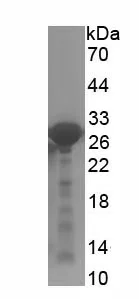 |
Greater than 95% as determined by reducing SDS-PAGE. |
靶点信息 Target Information
| 分子别名Alternative Names | IP3RIP3R1Insp3r1SCA15SCA16Spinocerebellar Ataxia 15IP3 receptor isoform 1Type 1 inositol 1,4,5-trisphosphate receptorType 1 InsP3 receptor |
|---|---|
| 背景介绍Background | Intracellular channel that mediates calcium release from the endoplasmic reticulum following stimulation by inositol 1,4,5-trisphosphate. Involved in the regulation of epithelial secretion of electrolytes and fluid through the interaction with AHCYL1. Plays a role in ER stress-induced apoptosis. Cytoplasmic calcium released from the ER triggers apoptosis by the activation of CaM kinase II, eventually leading to the activation of downstream apoptosis pathways. |
| 功能Function | Intracellular channel that mediates calcium release from the endoplasmic reticulum following stimulation by inositol 1,4,5-trisphosphate. Involved in the regulation of epithelial secretion of electrolytes and fluid through the interaction with AHCYL1. Plays a role in ER stress-induced apoptosis. Cytoplasmic calcium released from the ER triggers apoptosis by the activation of CaM kinase II, eventually leading to the activation of downstream apoptosis pathways. |
| 亚细胞定位Subcellular Location | Endoplasmic reticulum membrane; Multi-pass membrane protein. Cytoplasmic vesicle, secretory vesicle membrane; Multi-pass membrane protein. Cytoplasm, perinuclear region. |
| 数据库链接Databases |
基因功能参考文献50 条
- Tespa1 functions in T cell development and the regulation of TCR-induced Ca(2+) signalling through IP3R1 PMID: 28598420 : 28598420
- Data show that native IP3 receptors (IP3Rs) are scaffolded into small clusters within endoplasmic reticulum (ER) membranes. PMID: 29138405 : 29138405
- ITPR1 homozygous pathogenic variant is associated with Gillespie syndrome presenting a cardiac defect (pulmonary valve stenosis) and a genitourinary malformation. PMID: 29169895 : 29169895
- MICU2 restricts spatial crosstalk between InsP3R and MCU channels by regulating threshold and gain of MICU1-mediated inhibition and activation of MCU. PMID: 29241542 : 29241542
- Findings show that a pathogenic gain-of-function missense mutation within the suppressor region of ITPR1 causes SCA29 without cerebellar atrophy or other neuroimaging abnormalities; the Arg36Cys variant results in enhanced Ca2+ release due to alterations in the Ca2+ signal patterns from transient to sigmoidal, supporting a gain-of-function disease mechanism. PMID: 28620721 : 28620721
- we provide a detailed phenotypic description of a family with a missense mutation in ITPR1 PMID: 28826917 : 28826917
- High ITPR1 expression is associated with cervical carcinoma. PMID: 27588468 : 27588468
- We also observed that acetylcholine attenuated the formation of NCX1-TRPC3-IP3R1 complexes and maintained calcium homeostasis in cells treated with TNF-alpha. PMID: 28395930 : 28395930
- wogonoside promotes the expression of PLSCR1 and enhances its nuclear translocation and binding to the 1, 4, 5-trisphosphate receptor 1 (IP3R1) promoter in AML patient-derived primary cells. Wogonoside activates IP3R1, in turn, promotes release of Ca(2+) from endoplasmic reticulum, and eventually leads to cell differentiation PMID: 28492556 : 28492556
- study broadens the mutational spectrum of ITPR1 and also emphasizes the importance of considering ITPR1 mutations as a potential cause of inherited cerebellar ataxias PMID: 29186133 : 29186133
- predominant role of P2Y1 receptors in human embryonic stem cells and a transition of P2Y-IP3R coupling in derived cardiovascular progenitor cells are responsible for the differential Ca(2+) mobilization between these cells. PMID: 27098757 : 27098757
- we broadened the spectrum of ITPR1-related ataxias by identifying a de novo missense mutations in a patient with very severe hypoplasia of cerebellum and pons, mimicking PCH. PMID: 27862915 : 27862915
- Homozygous ITPR1 missense variant [c.5360T>C; p.(L1787P)] segregated with cerebellar hypoplasia. Heterozygous carriers were asymptomatic. PMID: 28488678 : 28488678
- increased mitochondrial calcium due to the gain-of-function enhancement of IP3R channels in the cells expressing PS1-M146L leads to the opening of permeability transition pore in high conductance state. PMID: 27184076 : 27184076
- Data suggest that ADRB2 (beta2 adrenergic receptor) activation (as illustrated by epinephrine and nor epinephrine) leads to robust calcium ion mobilization from intracellular stores in endoplasmic reticulum via activation of phosphoinositide phospholipase C (PLC) and opening of inositol trisphosphate receptor (IP3R). PMID: 28442571 : 28442571
- Data indicate that unlike ryanodine receptor RyRs, inositol 145-trisphosphate receptor IP3Rs are present and continually functional at early stages of cardiomyocyte differentiation. PMID: 27430888 : 27430888
- ITPR1 is the SCA15 causative gene. PMID: 27908616 : 27908616
- results demonstrate biallelic and monoallelic ITPR1 mutations as the underlying genetic defects for Gillespie syndrome, further extending the spectrum of ITPR1-related diseases PMID: 27108797 : 27108797
- Dominant De Novo ITPR1 Mutations Cause Gillespie Syndrome. PMID: 27108798 : 27108798
- Studies indicate that four IP3-binding sites within the tetrameric inositol 1,4,5-trisphosphate receptors (IP3Rs) must bind inositol 145-trisphosphate (IP3) before the channel can open for intracellular Ca2+ signals. PMID: 27048564 : 27048564
- Data show that inositol 145-trisphosphate receptor type 1 (IP3R1) -with a single inositol 145-trisphosphate (IP3) binding-deficient subunit lack activity. PMID: 27048566 : 27048566
- SNPs in ITPR1 and CNTN4 are involved in the regulation of serum uric acid concentrations in Mexican Americans PMID: 27039371 : 27039371
- concluded that the HERPUD1-mediated cytoprotective effect against oxidative stress depends on the ITPR and Ca(2+) transfer from the endoplasmic reticulum to mitochondria PMID: 26616647 : 26616647
- Studies indicate that the ryanodine receptors (RyRs: RyR1, RyR2, RyR3) and inositol 1,4,5-trisphosphate receptors (IP3Rs: IP3R1, IP3R2, IP3R3) are the major Ca(2+) release channels (CRCs) on the endo/sarcoplasmic reticulum (ER/SR). PMID: 25966694 : 25966694
- ITPR1 missense mutations cause infantile-onset cerebellar ataxia. PMID: 25794864 : 25794864
- cAMP is delivered directly and at saturating concentrations to its targets, mediate sensitization of IP3R and a more slowly developing inhibition of IP3 accumulation. PMID: 25431134 : 25431134
- the ability to generate tetramers with defined wild type and mutant subunits will be useful in probing fundamental questions relating to IP3Rs (R1, R2, R3) structure and function. PMID: 26009177 : 26009177
- hyperphosphorylation contributes to prostate cancer cell resistance to androgen deprivation PMID: 25740420 : 25740420
- ITPR1 has a role in the pathogenesis of autoimmune cerebellitis in cerebellar ataxia. PMID: 25498830 : 25498830
- IT plays an essential role in the development of drug dependence. PMID: 26255430 : 26255430
- we identified two in our cohort with a diagnosis of ataxic cerebral palsy who were found to have a de novo mutation in ITPR1 PMID: 25981959 : 25981959
- Ca(2+) release mediated by IP3R1 is an essential mechanism during the early steps of myoblast differentiation. PMID: 25468730 : 25468730
- IP3R palmitoylation is a critical regulator of Ca(2+) flux in immune cells and a previously unidentified DHHC/Selk complex is responsible for this process. PMID: 25368151 : 25368151
- a pleiotropic enzyme transglutaminase type 2 targets the allosteric coupling domain of IP3R type 1 (IP3R1) and negatively regulates IP3R1-mediated calcium signaling and autophagy by locking the subunit configurations. PMID: 25201980 : 25201980
- Both ITPR1 and Beclin-1 silencing in 786-0 cells inhibited NK-induced autophagy. PMID: 25297632 : 25297632
- These data indicate that imiquimod triggers IP3 receptor-dependent Ca(2+) signaling independently of TLR7. PMID: 24971541 : 24971541
- Activation of GalR2 leads to elevation of intracellular Ca(2+) due to Ca(2+) efflux from endoplasmic reticulum through IP3R sequentially opening BK alpha channels. PMID: 24602615 : 24602615
- results indicate that in some congenital myopathy patients RYR1 deficiency concomitantly alters the expression pattern of several proteins involved in calcium homeostasis and that this may influence the manifestation of these diseases PMID: 23553787 : 23553787
- The Galphaq-protein/coupled receptor/IP3R axis modulates the electromechanical properties of the human myocardium and its propensity to develop arrhythmias. PMID: 23983250 : 23983250
- CHERP and ALG-2 participate in regulation of alternative splicing of IP3R1 pre-mRNA and provide new insights into post-transcriptional regulation of splicing variants in Ca(2+) signaling pathways. PMID: 24078636 : 24078636
- Studies indicate that three subtypes of inositol 1,4,5-trisphosphate (IP3) receptors (IP3R1, -2, and -3) are assembled to form homo- and heterotetrameric channels that mediate Ca(2+) release from intracellular stores. PMID: 23955339 : 23955339
- These results suggest an involvement of hydrogen sulfide in both IP3-induced calcium signalling and induction of apoptosis, possibly through the activation of endoplasmic reticulum stress. PMID: 23582047 : 23582047
- The inositol 1,4,5-trisphosphate receptors are not degradated until very late in apoptosis, and this is despite robust calpain activation as determined by alpha-fodrin cleavage in the presence of Z-VAD-FMK. PMID: 23122728 : 23122728
- we propose a novel regulatory mechanism of IP3R1 activity by type III intermediate filament vimentin PMID: 22929228 : 22929228
- study demonstrates that alteration of ITPR1 function cause a distinct congenital nonprogressive ataxia; highlighting heterogeneity associated with ITPR1 gene and a role of the ITPR1-related pathway in the development and maintenance of the cerebellum. PMID: 22986007 : 22986007
- Glutathionylation may represent a fundamental mechanism for regulating IP3R activity during physiological redox signalling and during pathologicalical oxidative stress PMID: 22855054 : 22855054
- These combined findings implicate IP3-gated Ca(2+) as a key regulator of TDP-43 nucleoplasmic shuttling and proteostasis and suggest pharmacologic inhibition of ITPR1 as a strategy to combat TDP-43-induced neurodegeneration in vivo. PMID: 22872699 : 22872699
- Thus, rather than involving the 5-HT3-dependent pathway, the negative effect of ondansetron on platelet aggregation is instead manifested through the attenuation of agonist-induced IP3 production and MAPK (p38 and ERK2). PMID: 22818390 : 22818390
- Type 1 inositol-1,4,5-trisphosphate receptor is a late substrate of caspases during apoptosis. PMID: 22473799 : 22473799
- Authors conclude that ITPR1 gene deletions are much rarer in Japan than in Europe. PMID: 22318346 : 22318346
蛋白复溶体积计算器缓冲液体积 = 蛋白质量 ÷ 蛋白浓度
输入任意两项,第三项自动计算 |
蛋白浓度稀释计算器初浓度 × 初体积 = 终浓度 × 终体积
输入任意三项,第四项自动计算 |



