


Recombinant Importin 11 (IPO11)(N-6His)
Alternative NamesRanBP11; SLRN; Ran-binding protein 11
规格参数 Specifications
| 纯度Purity | Greater than 95% as determined by reducing SDS-PAGE. |
|---|---|
| 内毒素Endotoxin | <1 EU/µg as determined by LAL test. |
| 蛋白构建Protein Construction |
6HisN 端标签-【Met1-Gly237】序列区间
|
| Accession | Q9UI26 |
| 表达宿主Expression Host | E.coli |
| 种属Species | Homo sapiens (Human) |
| 预测分子量Predicted MW | 30.7 kDa |
| 制剂Formulation | Lyophilized from a 0.2 μm filtered solution of PBS, pH7.4, containing 0.01% SKL, 1mM DTT, 5% Trehalose and Proclin300. |
| 运输方式Shipping | The product is shipped with ice bag. Upon receipt, store it immediately at the temperature listed below. |
| 稳定性&储存Stability & Storage | 12 months at -20°C to -80°C in lyophilized state.6 months at -20°C to -80°C under sterile conditions after reconstitution.7-10 days at 2°C to 8°C under sterile conditions after reconstitution.Please minimize freeze-thaw cycles. |
| 复溶Reconstitution | Reconstitute in 10mM PBS (pH7.4) to a concentration of 0.1-1.0 mg/mL. Do not vortex |
!
本司产品仅用于科研,不用于临床诊断和治疗。
产品图片 Product Images点击图片可查看原图
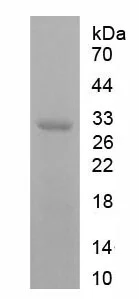 |
Greater than 95% as determined by reducing SDS-PAGE. |
靶点信息 Target Information
| 分子别名Alternative Names | RanBP11SLRNRan-binding protein 11 |
|---|---|
| 背景介绍Background | Functions in nuclear protein import as nuclear transport receptor. Serves as receptor for nuclear localization signals (NLS) in cargo substrates. Is thought to mediate docking of the importin/substrate complex to the nuclear pore complex (NPC) through binding to nucleoporin and the complex is subsequently translocated through the pore by an energy requiring, Ran-dependent mechanism. At the nucleoplasmic side of the NPC, Ran binds to the importin, the importin/substrate complex dissociates and importin is re-exported from the nucleus to the cytoplasm where GTP hydrolysis releases Ran. The directionality of nuclear import is thought to be conferred by an asymmetric distribution of the GTP- and GDP-bound forms of Ran between the cytoplasm and nucleus. Mediates the nuclear import of UBE2E3, and of RPL12. |
| 功能Function | Functions in nuclear protein import as nuclear transport receptor. Serves as receptor for nuclear localization signals (NLS) in cargo substrates. Is thought to mediate docking of the importin/substrate complex to the nuclear pore complex (NPC) through binding to nucleoporin and the complex is subsequently translocated through the pore by an energy requiring, Ran-dependent mechanism. At the nucleoplasmic side of the NPC, Ran binds to the importin, the importin/substrate complex dissociates and importin is re-exported from the nucleus to the cytoplasm where GTP hydrolysis releases Ran. The directionality of nuclear import is thought to be conferred by an asymmetric distribution of the GTP- and GDP-bound forms of Ran between the cytoplasm and nucleus. Mediates the nuclear import of UBE2E3, and of RPL12. |
| 亚细胞定位Subcellular Location | Cytoplasm. Nucleus. |
| 数据库链接Databases |
基因功能参考文献5 条
- High IPO11 expression is associated with migration, invasion, and progression of bladder cancer. PMID: 29602637 : 29602637
- IPO11 copy number amplification and importin-11 overexpression are promising biomarkers for predicting the progression and poor prognosis of patients with NMIBC. PMID: 27689332 : 27689332
- IPO11 provides protection in another way, the researchers found. The transport receptor also shuttles UBE2E1, an enzyme necessary for PTEN ubiquitination, into the nucleus. Thanks to IPO11, normal cells keep all of their UBE2E1 in the nucleus, allowing PTEN to continue functioning in the cytoplasm. In cells lacking IPO11, UBE2E1 remains in the cytoplasm and promotes the destruction of PTEN. PMID: 28258103 : 28258103
- IPO11-HTR1A is a significant risk gene region for attention deficit hyperactivity disorder in Caucasians. PMID: 26079129 : 26079129
- Data indicate that ubiquitin-conjugating enzyme UBE2E3 and importin 11 (Imp-11)promote the nuclear accumulation and activity of transcription factor NF-E2 (Nrf2) by restricting the transcription factor from partitioning to the mitochondria PMID: 25378586 : 25378586
蛋白复溶体积计算器缓冲液体积 = 蛋白质量 ÷ 蛋白浓度
输入任意两项,第三项自动计算 |
蛋白浓度稀释计算器初浓度 × 初体积 = 终浓度 × 终体积
输入任意三项,第四项自动计算 |



