


Recombinant Karyopherin Alpha 6 (KPNa6)(N-6His)
Alternative NamesIPOA7; KPNA7; Importin Alpha 7
规格参数 Specifications
| 纯度Purity | Greater than 90% as determined by reducing SDS-PAGE. |
|---|---|
| 内毒素Endotoxin | <1 EU/µg as determined by LAL test. |
| 蛋白构建Protein Construction |
6HisN 端标签-【Met1-Thr410】序列区间
|
| Accession | O60684 |
| 表达宿主Expression Host | E.coli |
| 种属Species | Homo sapiens (Human) |
| 预测分子量Predicted MW | 49.5 kDa |
| 制剂Formulation | Lyophilized from a 0.2 μm filtered solution of PBS, pH7.4, containing 0.01% SKL, 1mM DTT, 5% Trehalose and Proclin300. |
| 运输方式Shipping | The product is shipped with ice bag. Upon receipt, store it immediately at the temperature listed below. |
| 稳定性&储存Stability & Storage | 12 months at -20°C to -80°C in lyophilized state.6 months at -20°C to -80°C under sterile conditions after reconstitution.7-10 days at 2°C to 8°C under sterile conditions after reconstitution.Please minimize freeze-thaw cycles. |
| 复溶Reconstitution | Reconstitute in 10mM PBS (pH7.4) to a concentration of 0.1-1.0 mg/mL. Do not vortex. |
!
本司产品仅用于科研,不用于临床诊断和治疗。
产品图片 Product Images点击图片可查看原图
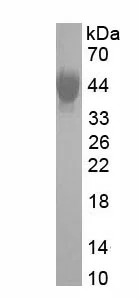 |
Greater than 90% as determined by reducing SDS-PAGE. |
靶点信息 Target Information
| 分子别名Alternative Names | IPOA7KPNA7Importin Alpha 7 |
|---|---|
| 背景介绍Background | Functions in nuclear protein import as an adapter protein for nuclear receptor KPNB1. Binds specifically and directly to substrates containing either a simple or bipartite NLS motif. Docking of the importin/substrate complex to the nuclear pore complex (NPC) is mediated by KPNB1 through binding to nucleoporin FxFG repeats and the complex is subsequently translocated through the pore by an energy requiring, Ran-dependent mechanism. At the nucleoplasmic side of the NPC, Ran binds to importin-beta and the three components separate and importin-alpha and -beta are re-exported from the nucleus to the cytoplasm where GTP hydrolysis releases Ran from importin. The directionality of nuclear import is thought to be conferred by an asymmetric distribution of the GTP- and GDP-bound forms of Ran between the cytoplasm and nucleus. |
| 功能Function | Functions in nuclear protein import as an adapter protein for nuclear receptor KPNB1. Binds specifically and directly to substrates containing either a simple or bipartite NLS motif. Docking of the importin/substrate complex to the nuclear pore complex (NPC) is mediated by KPNB1 through binding to nucleoporin FxFG repeats and the complex is subsequently translocated through the pore by an energy requiring, Ran-dependent mechanism. At the nucleoplasmic side of the NPC, Ran binds to importin-beta and the three components separate and importin-alpha and -beta are re-exported from the nucleus to the cytoplasm where GTP hydrolysis releases Ran from importin. The directionality of nuclear import is thought to be conferred by an asymmetric distribution of the GTP- and GDP-bound forms of Ran between the cytoplasm and nucleus. |
| 数据库链接Databases |
基因功能参考文献7 条
- Development of a pipeline for automated, high-throughput analysis of PSPC1 paraspeckle protein isoforms reveals specific roles for KPNA2, KPNA4 and KPNA6 proteins. PMID: 28240251 : 28240251
- the data showed that viral infection induced an elevation of the KPNA6 protein level due to an extension of the KPNA6 half-life via viral interference of the ubiquitin-proteasomal degradation of KPNA6. Notably, KPNA6 silencing or knockout dramatically reduced the replication of PRRSV and ZIKV. PMID: 29444946 : 29444946
- a decreased H7N9 influenza A virus polymerase activity when importin-alpha7 was silenced by siRNA, is reported. PMID: 28189564 : 28189564
- Bel1 fragment with residues 215-223, which bears the NLS, interacts with KPNA1, KPNA6, and KPNA7. PMID: 25272585 : 25272585
- Importin alpha1 and alpha7 are positive regulators of human-like polymerase activity and pathogenicity beyond their role in nuclear transport. PMID: 22275867 : 22275867
- Overexpression of KPNA6 facilitates KEAP1 nuclear import and attenuates NRF2 signaling, whereas knockdown of KPNA6 slows down KEAP1 nuclear import and enhances the NRF2-mediated adaptive response induced by oxidative stress. PMID: 21383067 : 21383067
- Importin alpha5 and alpha7 bind to Stat3 upon cytokine stimulation. PMID: 16298512 : 16298512
蛋白复溶体积计算器缓冲液体积 = 蛋白质量 ÷ 蛋白浓度
输入任意两项,第三项自动计算 |
蛋白浓度稀释计算器初浓度 × 初体积 = 终浓度 × 终体积
输入任意三项,第四项自动计算 |



