


Recombinant Excision Repair Cross Complementing Rodent Repair Deficiency Complementation 6 (ERCC6)(N-6His)
Alternative NamesCSB; ARMD5; CKN2; COFS; RAD26; Cockayne Syndrome B Protein; DNA excision repair protein ERCC-6; ATP-dependent helicase ERCC6; Cockayne syndrome protein CSB
规格参数 Specifications
| 纯度Purity | Greater than 90% as determined by reducing SDS-PAGE. |
|---|---|
| 内毒素Endotoxin | <1 EU/µg as determined by LAL test. |
| 蛋白构建Protein Construction |
6HisN 端标签-【Val843-Tyr1002】序列区间
|
| Accession | Q03468 |
| 表达宿主Expression Host | E.coli |
| 种属Species | Homo sapiens (Human) |
| 预测分子量Predicted MW | 22.6 kDa |
| 制剂Formulation | Lyophilized from a 0.2 μm filtered solution of PBS, pH7.4, containing 0.01% SKL, 1mM DTT, 5% Trehalose and Proclin300. |
| 运输方式Shipping | The product is shipped with ice bag. Upon receipt, store it immediately at the temperature listed below. |
| 稳定性&储存Stability & Storage | 12 months at -20°C to -80°C in lyophilized state.6 months at -20°C to -80°C under sterile conditions after reconstitution.7-10 days at 2°C to 8°C under sterile conditions after reconstitution.Please minimize freeze-thaw cycles. |
| 复溶Reconstitution | Reconstitute in ddH₂O to a concentration less than or equal to 0.1mg/mL. Do not vortex. |
!
本司产品仅用于科研,不用于临床诊断和治疗。
产品图片 Product Images点击图片可查看原图
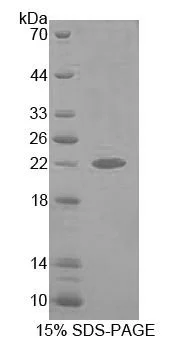 |
Greater than 90% as determined by reducing SDS-PAGE. |
靶点信息 Target Information
| 分子别名Alternative Names | CSBARMD5CKN2COFSRAD26Cockayne Syndrome B ProteinDNA excision repair protein ERCC-6ATP-dependent helicase ERCC6Cockayne syndrome protein CSB |
|---|---|
| 背景介绍Background | Essential factor involved in transcription-coupled nucleotide excision repair which allows RNA polymerase II-blocking lesions to be rapidly removed from the transcribed strand of active genes. Upon DNA-binding, it locally modifies DNA conformation by wrapping the DNA around itself, thereby modifying the interface between stalled RNA polymerase II and DNA. It is required for transcription-coupled repair complex formation. It recruits the CSA complex (DCX(ERCC8) complex), nucleotide excision repair proteins and EP300 to the sites of RNA polymerase II-blocking lesions. Plays an important role in regulating the choice of the DNA double-strand breaks (DSBs) repair pathway and G2/M checkpoint activation; DNA-dependent ATPase activity is essential for this function. Regulates the DNA repair pathway choice by inhibiting non-homologous end joining (NHEJ), thereby promoting the homologous recombination (HR)-mediated repair of DSBs during the S/G2 phases of the cell cycle. Mediates the activation of the ATM- and CHEK2-dependent DNA damage responses thus preventing premature entry of cells into mitosis following the induction of DNA DSBs. Acts as a chromatin remodeler at DSBs; DNA-dependent ATPase-dependent activity is essential for this function. Remodels chromatin by evicting histones from chromatin flanking DSBs, limiting RIF1 accumulation at DSBs thereby promoting BRCA1-mediated HR. Required for stable recruitment of ELOA and CUL5 to DNA damage sites. Involved in UV-induced translocation of ERCC8 to the nuclear matrix. Essential for neuronal differentiation and neuritogenesis; regulates transcription and chromatin remodeling activities required during neurogenesis. |
| 功能Function | Essential factor involved in transcription-coupled nucleotide excision repair which allows RNA polymerase II-blocking lesions to be rapidly removed from the transcribed strand of active genes. Upon DNA-binding, it locally modifies DNA conformation by wrapping the DNA around itself, thereby modifying the interface between stalled RNA polymerase II and DNA. It is required for transcription-coupled repair complex formation. It recruits the CSA complex (DCX(ERCC8) complex), nucleotide excision repair proteins and EP300 to the sites of RNA polymerase II-blocking lesions. Plays an important role in regulating the choice of the DNA double-strand breaks (DSBs) repair pathway and G2/M checkpoint activation; DNA-dependent ATPase activity is essential for this function. Regulates the DNA repair pathway choice by inhibiting non-homologous end joining (NHEJ), thereby promoting the homologous recombination (HR)-mediated repair of DSBs during the S/G2 phases of the cell cycle. Mediates the activation of the ATM- and CHEK2-dependent DNA damage responses thus preventing premature entry of cells into mitosis following the induction of DNA DSBs. Acts as a chromatin remodeler at DSBs; DNA-dependent ATPase-dependent activity is essential for this function. Remodels chromatin by evicting histones from chromatin flanking DSBs, limiting RIF1 accumulation at DSBs thereby promoting BRCA1-mediated HR. Required for stable recruitment of ELOA and CUL5 to DNA damage sites. Involved in UV-induced translocation of ERCC8 to the nuclear matrix. Essential for neuronal differentiation and neuritogenesis; regulates transcription and chromatin remodeling activities required during neurogenesis. |
| 亚细胞定位Subcellular Location | Nucleus. |
| 数据库链接Databases |
基因功能参考文献50 条
- Case Reports: Cockayne Syndrome patients with a novel splice site ERCC6 mutation (c.2382+2T>G), and a previously described nonsense ERCC6 mutation (c.3259C>T, p.Arg1087X) in a biallelic state. PMID: 29944916 : 29944916
- CSB interacts via its newly identified winged helix domain with RIF1, an effector of 53BP1, and that this interaction mediates CSB recruitment to DSBs in S phase. At double strand breaks, CSB remodels chromatin by evicting histones, which limits RIF1 and its effector MAD2L2 but promotes BRCA1 accumulation. PMID: 29203878 : 29203878
- UV-induced dissociation of CSB domain interactions is a necessary step in repairing UV-induced DNA damage and that the WHD (winged helix domain) of CSB plays a key role in this dissociation. PMID: 29957539 : 29957539
- CSB recruitment to DSBs is dependent upon an interaction between CSB's newly described winged-helix domain and the NHEJ factor RIF1, but subsequent remodelling activity undertaken by CSB following DSB induction inhibits RIF1 accumulation while promoting BRCA1-mediated HR repair. In vivo remodelling assays are used to demonstrate that CSB evicts histones following generation of DSBs in a manner controlled by ATM and CDK1. PMID: 29203878 : 29203878
- CSB regulates double strand break repair choice by recruiting HR factors BRCA1, RPA and Rad51 while suppressing NHEJ factors at damaged chromatin in S/G2 cells. Loss of CSB impairs activation of ATM and downstream targets following induction of double strand breaks, and promotes premature exit from the G2/M checkpoint. PMID: 25820262 : 25820262
- ERCC6 rs1917799, ERCC8 rs158572 and rs158916 demonstrated pairwise epistatic interactions to associate with chronic atrophic gastritis and gastric cancer risk. The ERCC6 rs1917799-ERCC8 rs158572 pair significantly influence ERCC6 and ERCC6-ERCC8 expression. PMID: 28562347 : 28562347
- Let-7c-5p acted as a tumor suppressor in breast cancer possibly by negatively regulating ERCC6. PMID: 28731186 : 28731186
- Loss of Cockayne syndrome group A protein (CSA) or Cockayne syndrome group B protein (CSB) leads to polymerase stalling at non-B DNA in a neuroblastoma cell line, in particular at G-quadruplex structures. PMID: 27791127 : 27791127
- The present study reported two novel causative mutations on ERCC6 loci, and the clinical characteristics are described. These results add to clinical and molecular data for elucidating genotype-phenotype correlations in CS PMID: 28440418 : 28440418
- Gene analysis showed mutations in exons 4 and 18 of the ERCC6 gene. Multiple ocular abnormalities were observed in a patient with Cockayne syndrome. A detailed ophthalmic evaluation of children with Cockayne syndrome is advised. PMID: 27186691 : 27186691
- The role of ERCC6 in regulating response to 5-fluorouracil and drug resistance in colorectal cancer.Elevated expression of ERCC6 is associated with poor colorectal cancer patient survival. PMID: 28665687 : 28665687
- NAP1L1 increases CSB processivity by decreasing the pausing probability during translocation. Our study, therefore, uncovers the different steps of CSB-mediated chromatin remodeling that can be regulated by NAP1L1. PMID: 28369616 : 28369616
- pro-apoptotic effects observed after CSB ablation PMID: 28253359 : 28253359
- the Elongin A ubiquitin ligase and the CSB protein function together in a common pathway in response to Pol II stalling and DNA damage PMID: 28292928 : 28292928
- The discovery has been described that G1/G0 cells exhibit Cockayne syndrome B-dependent assembly of homologous recombination factors at double strand break sites within actively transcribed regions. (Review) PMID: 27233112 : 27233112
- No significant association exists between ERCC6 polymorphisms and bladder cancer risk. PMID: 27791261 : 27791261
- CSB plays a role in the homeostasis and function of human neurons. CSB-deficient neural networks displayed altered electrophysiological activity, including decreased synchrony, and reduced synapse density. PMID: 26755826 : 26755826
- Study found that ERCC6 transcription may be epigenetically regulated in lens epithelial cells of age-related nuclear cataract leading to its repression. PMID: 27231489 : 27231489
- Mutation of Cockayne syndrome B (CSB) affects neuronal gene expression and differentiation, so we attempted to bypass its function by expressing downstream target genes. PMID: 26972010 : 26972010
- new role of VCP/p97 segregase in the timely processing of ubiquitinated CSB from damaged chromatin. PMID: 26826127 : 26826127
- CSB and CTCF can regulate each other's chromatin association, thereby modulating chromatin structure and coordinating gene expression in response to oxidative stress. PMID: 26578602 : 26578602
- Transcription inhibition reduced accumulation of CSB at sites of monoadducts and interstrand crosslinks, but it did not affect recruitment to (although slightly affected retention at) oxidative DNA damage. PMID: 26616585 : 26616585
- Data suggest that both the most C-terminal region and SUMOylation of a lysine residue in N-terminal region are important for functions of CSB/ERCC6 in transcription-coupled nucleotide excision repair following DNA breakage from UV light. PMID: 26620705 : 26620705
- ERCC6 dysfunction presenting as progressive neurological decline with brain hypomyelination. This report expands the disease spectrum associated with ERCC6 mutations. PMID: 25251875 : 25251875
- 33 proteins that were not previously known to interact with CSB. PMID: 26030138 : 26030138
- Data indicate that Cockayne syndrome group B protein CSB function is necessary for the recruitment of recombinational factors. PMID: 26100862 : 26100862
- These studies have provided significant functional and mechanistic insights of Rad26p/CSB in regulation of gene expression and genome integrity as described here. PMID: 25484185 : 25484185
- The present report describes a case of Cockayne syndrome in a Chinese family, with the patients carrying two missense mutations (c.1595A>G, p.Asp532Gly and c.1607T>G, p.Leu536Trp) in the ERCC6 gene in an apparently compound heterozygote. PMID: 25463447 : 25463447
- new splicing ERCC6 defect causal of Cockayne syndrome. PMID: 25376329 : 25376329
- Data indicate that Cockayne syndrome group B protein CSB is required for transdifferentiation of fibroblasts to neurons. PMID: 25249633 : 25249633
- CSB-mutated cells, but not UVSSA-deficient cells, have increased levels of intramitochondrial reactive oxygen species (ROS), especially when mitochondrial complex I is inhibited by rotenone. PMID: 25136123 : 25136123
- CSB has a crucial role in coordinated regulation of transcription and chromatin remodeling activities that are required during neurogenesis. PMID: 24874740 : 24874740
- An interaction effect of pri-let-7a-1 rs10739971 polymorphism with ERCC6 rs1917799 polymorphism was observed for the risk of gastric cancer. PMID: 24586594 : 24586594
- Decreased CSB occupancy of TPA-response elements when c-Jun levels were diminished. PMID: 24743307 : 24743307
- CSB protein stimulates NEIL2 DNA glycosylase activity PMID: 24406253 : 24406253
- ERCC6 rs1917799 polymorphism is associated with gastric cancer risk. PMID: 24289633 : 24289633
- Double heterozygote for mutations of ERCC6 is associated with Cockayne syndrome. PMID: 24928003 : 24928003
- Mitochondrial CSA and CSB: protein interactions and protection from ageing associated DNA mutations. PMID: 23562423 : 23562423
- The role of CSA and CSB protein in the oxidative stress response. PMID: 23562424 : 23562424
- CSB has been shown to regulate processes such as the transcriptional recovery after DNA damage, the p53 transcriptional response, the response to hypoxia, the response IGF-1, transactivation of nuclear receptors, transcription of housekeeping genes PMID: 23562425 : 23562425
- Structure, function and regulation of CSB PMID: 23422418 : 23422418
- The review focuses on the participation of the CSB and CSA proteins in many different protein interactions and complexes, and how these interactions inform us about pathways that are defective in the disease. PMID: 23583689 : 23583689
- CSB and PCAF play cooperative roles to establish the active state of rRNA genes by histone acetylation PMID: 23667505 : 23667505
- In CSB-deficient cells ATF3 remains bound to the promoter, thereby preventing the arrival of polymerase II and the restart of transcription. PMID: 23733932 : 23733932
- In tumor cell lines, CSB is overexpressed and controls cell proliferation and apoptosis. PMID: 23419237 : 23419237
- CSB modulates the CPT-induced formation of discrete p53-binding protein 1 (53BP1) nuclear foci at sites of transcription-mediated DNA strand breaks PMID: 23229313 : 23229313
- Eighteen polymorphisms in four DNA repair genes were genotyped in 789 age related cataract patients and 531 normal controls from the Jiangsu Eye Study. PMID: 23322570 : 23322570
- Involvement of CSB and XPC in the repair of oxidative DNA lesions independent of the remainder of the nucleotide excision repair reaction. PMID: 23253478 : 23253478
- Patient-derived CSB-deficient cells exhibited a defect in efficient mitochondrial transcript production and that CSB specifically promoted elongation by the mitochondrial RNA polymerase in vitro. PMID: 22743267 : 22743267
- CSB-PGBD3 fusion protein is important in both health and disease, and could play a role in Cockayne syndrome. PMID: 22483866 : 22483866
蛋白复溶体积计算器缓冲液体积 = 蛋白质量 ÷ 蛋白浓度
输入任意两项,第三项自动计算 |
蛋白浓度稀释计算器初浓度 × 初体积 = 终浓度 × 终体积
输入任意三项,第四项自动计算 |



