


Recombinant Excision Repair Cross Complementing Rodent Repair Deficiency Complementation 8 (ERCC8)(N-GST-6His)
Alternative NamesCKN1; CSA; Cockayne Syndrome 1; Cockayne syndrome WD repeat protein CSA; DNA excision repair protein ERCC-8
规格参数 Specifications
| 纯度Purity | Greater than 90% as determined by reducing SDS-PAGE. |
|---|---|
| 内毒素Endotoxin | <1 EU/µg as determined by LAL test. |
| 蛋白构建Protein Construction |
6HisN 端标签-GSTN 端标签-【Met1-Gly396】序列区间
|
| Accession | Q13216 |
| 表达宿主Expression Host | E.coli |
| 种属Species | Homo sapiens (Human) |
| 预测分子量Predicted MW | 74.1 kDa |
| 制剂Formulation | Lyophilized from a 0.2 μm filtered solution of PBS, pH7.4, containing 0.01% SKL, 1mM DTT, 5% Trehalose and Proclin300. |
| 运输方式Shipping | The product is shipped with ice bag. Upon receipt, store it immediately at the temperature listed below. |
| 稳定性&储存Stability & Storage | 12 months at -20°C to -80°C in lyophilized state.6 months at -20°C to -80°C under sterile conditions after reconstitution.7-10 days at 2°C to 8°C under sterile conditions after reconstitution.Please minimize freeze-thaw cycles. |
| 复溶Reconstitution | Reconstitute in 10mM PBS (pH7.4) to a concentration of 0.1-1.0 mg/mL. Do not vortex. |
!
本司产品仅用于科研,不用于临床诊断和治疗。
产品图片 Product Images点击图片可查看原图
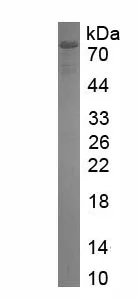 |
Greater than 90% as determined by reducing SDS-PAGE. |
靶点信息 Target Information
| 分子别名Alternative Names | CKN1CSACockayne Syndrome 1Cockayne syndrome WD repeat protein CSADNA excision repair protein ERCC-8 |
|---|---|
| 背景介绍Background | Substrate-recognition component of the CSA complex, a DCX (DDB1-CUL4-X-box) E3 ubiquitin-protein ligase complex, involved in transcription-coupled nucleotide excision repair. The CSA complex (DCX(ERCC8) complex) promotes the ubiquitination and subsequent proteasomal degradation of ERCC6 in a UV-dependent manner; ERCC6 degradation is essential for the recovery of RNA synthesis after transcription-coupled repair. It is required for the recruitment of XAB2, HMGN1 and TCEA1/TFIIS to a transcription-coupled repair complex which removes RNA polymerase II-blocking lesions from the transcribed strand of active genes. Plays a role in DNA single-strand and double-strand breaks (DSSBs) repair; involved in repair of DSSBs by non-homologous end joining (NHEJ). |
| 功能Function | Substrate-recognition component of the CSA complex, a DCX (DDB1-CUL4-X-box) E3 ubiquitin-protein ligase complex, involved in transcription-coupled nucleotide excision repair. The CSA complex (DCX(ERCC8) complex) promotes the ubiquitination and subsequent proteasomal degradation of ERCC6 in a UV-dependent manner; ERCC6 degradation is essential for the recovery of RNA synthesis after transcription-coupled repair. It is required for the recruitment of XAB2, HMGN1 and TCEA1/TFIIS to a transcription-coupled repair complex which removes RNA polymerase II-blocking lesions from the transcribed strand of active genes. Plays a role in DNA single-strand and double-strand breaks (DSSBs) repair; involved in repair of DSSBs by non-homologous end joining (NHEJ). |
| 亚细胞定位Subcellular Location | Nucleus. Nucleus matrix. |
| 数据库链接Databases |
基因功能参考文献27 条
- Pathogenic nucleotide variant NG_009289.1(NM_000082.3):c.173+1119G>C was identified in two siblings with severe but long-term survival Cockayne syndrome. PMID: 29422660 : 29422660
- A complex intragenic rearrangement of ERCC8 in Chinese siblings with Cockayne syndrome has been reported. PMID: 28333167 : 28333167
- ERCC6 rs1917799, ERCC8 rs158572 and rs158916 demonstrated pairwise epistatic interactions to associate with chronic atrophic gastritis and gastric cancer risk. The ERCC6 rs1917799-ERCC8 rs158572 pair significantly influence ERCC6 and ERCC6-ERCC8 expression. PMID: 28562347 : 28562347
- Loss of Cockayne syndrome group A protein (CSA) or Cockayne syndrome group B protein (CSB) leads to polymerase stalling at non-B DNA in a neuroblastoma cell line, in particular at G-quadruplex structures. PMID: 27791127 : 27791127
- The role of CSA in oxidative stress PMID: 28302478 : 28302478
- Although the absence of CSA had no effect on CSB recruitment, CSA itself localized at sites of interstrand crosslinks, double-strand breaks and monoadducts but not at oxidative DNA lesions. PMID: 26616585 : 26616585
- Our findings suggested that ERCC8 rs158572 and rs158916, alone or together with environmental factors, might be associated with gastric cancer and atrophic gastritis susceptibility. PMID: 26130415 : 26130415
- A novel function of Cockayne syndrome A protein as transcription factor of RNA polymerase I in the nucleolus is shown. PMID: 24781187 : 24781187
- Mitochondrial CSA and CSB: protein interactions and protection from ageing associated DNA mutations. PMID: 23562423 : 23562423
- The role of CSA and CSB protein in the oxidative stress response. PMID: 23562424 : 23562424
- The role of CSA protein in TC-NER is described in this review PMID: 23571135 : 23571135
- The review focuses on the participation of the CSB and CSA proteins in many different protein interactions and complexes, and how these interactions inform us about pathways that are defective in the disease. PMID: 23583689 : 23583689
- KIAA1530 protein is recruited by Cockayne syndrome complementation group protein A (CSA) to participate in transcription-coupled repair (TCR). PMID: 22902626 : 22902626
- CSA and CSB are identified as the key elements of a regulatory mechanism that equilibrate beneficial and detrimental effects of p53 activity upon cellular stress. PMID: 22032989 : 22032989
- crystals of CSA-DDB1 had unit-cell parameters a = b = 142.03, c = 250.19 A and diffracted to 2.9 A resolution on beamline ID14-1 PMID: 22232169 : 22232169
- Studies indicate the modular architecture of DDB1-CUL4 in complex with DDB2, CSA and CDT2 in DNA repair of UV-induced DNA lesions. PMID: 21550341 : 21550341
- High carriers frequency of an apparently ancient founder mutation p.Tyr322X in the ERCC8 gene responsible for Cockayne syndrome among Christian Arabs in northern Israel is reported. PMID: 21108394 : 21108394
- role in protect from aging- and stress-induced mtDNA mutations and apoptosis-mediated loss of subcutaneous fat, a hallmark of aging PMID: 20100872 : 20100872
- The 45 published mutations in CSA and CSB to date and 43 new mutations in these genes together with the corresponding clinical data, are reported. PMID: 19894250 : 19894250
- We found that CSA protein is rapidly translocated to the nuclear matrix after UV irradiation PMID: 11782547 : 11782547
- DDB2 and CSA are each integrated into nearly identical complexes via interaction with DDB1. Both complexes contain cullin 4A and Roc1 and display ubiquitin ligase activity. PMID: 12732143 : 12732143
- The Mutation of Cockayne syndrome type A can also cause defective transcription-coupled repair and Cockayne syndrome. PMID: 16246722 : 16246722
- examines functional relationship between CSA and CSB in Cockayne syndrome PMID: 16751180 : 16751180
- Cockayne Syndrome A and B proteins (CSA) and (CSB) display differential roles in recruitment of transcription-coupled repair (TCR)-specific factors and assembly for TCR occurs without disruption of the UV-stalled RNA polymerase II (RNAPIIo). PMID: 16916636 : 16916636
- Alterations of chromatin at the RNA polymerase II stall site, which depend on CSB and TFIIH at least, are necessary for the UV-induced translocation of CSA to the nuclear matrix. PMID: 17242193 : 17242193
- CSA protein contributes to prevent accumulation of various oxidized DNA bases and underline specific functions of CSB not shared with CSA. PMID: 17297471 : 17297471
- CSA is not required for the ubiquitylation of human RNA polymerase II. PMID: 17996703 : 17996703
蛋白复溶体积计算器缓冲液体积 = 蛋白质量 ÷ 蛋白浓度
输入任意两项,第三项自动计算 |
蛋白浓度稀释计算器初浓度 × 初体积 = 终浓度 × 终体积
输入任意三项,第四项自动计算 |



