


Recombinant Sphingosine 1 Phosphate Lyase 1 (SGPL1)(N-6His)
Alternative NamesSPL; S1PL; Sphingosine-1-phosphate aldolase
规格参数 Specifications
| 纯度Purity | Greater than 95% as determined by reducing SDS-PAGE. |
|---|---|
| 内毒素Endotoxin | <1 EU/µg as determined by LAL test. |
| 蛋白构建Protein Construction |
6HisN 端标签-【Gln239-Arg493】序列区间
|
| Accession | O95470 |
| 表达宿主Expression Host | E.coli |
| 种属Species | Homo sapiens (Human) |
| 预测分子量Predicted MW | 29.6 kDa |
| 制剂Formulation | Lyophilized from a 0.2 μm filtered solution of 100mMNaHCO<sub>3</sub>, 500mMNaCl, pH8.3, containing 1mM EDTA, 1mM DTT, 0.01% SKL, 5% Trehalose and Proclin300. |
| 运输方式Shipping | The product is shipped with ice bag. Upon receipt, store it immediately at the temperature listed below. |
| 稳定性&储存Stability & Storage | 12 months at -20°C to -80°C in lyophilized state.6 months at -20°C to -80°C under sterile conditions after reconstitution.7-10 days at 2°C to 8°C under sterile conditions after reconstitution.Please minimize freeze-thaw cycles. |
| 复溶Reconstitution | Reconstitute in ddH₂O to a concentration of 0.1-1.0 mg/mL. Do not vortex. |
!
本司产品仅用于科研,不用于临床诊断和治疗。
产品图片 Product Images点击图片可查看原图
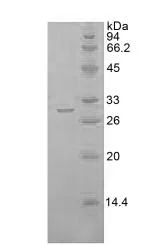 |
Greater than 95% as determined by reducing SDS-PAGE. |
靶点信息 Target Information
| 分子别名Alternative Names | SPLS1PLSphingosine-1-phosphate aldolase |
|---|---|
| 背景介绍Background | Cleaves phosphorylated sphingoid bases (PSBs), such as sphingosine-1-phosphate, into fatty aldehydes and phosphoethanolamine. Elevates stress-induced ceramide production and apoptosis. Required for global lipid homeostasis in liver and cholesterol homeostasis in fibroblasts. Involved in the regulation of pro-inflammatory response and neutrophil trafficking. Modulates neuronal autophagy via phosphoethanolamine production which regulates accumulation of aggregate-prone proteins such as APP. Seems to play a role in establishing neuronal contact sites and axonal maintenance. |
| 功能Function | Cleaves phosphorylated sphingoid bases (PSBs), such as sphingosine-1-phosphate, into fatty aldehydes and phosphoethanolamine. Elevates stress-induced ceramide production and apoptosis. Required for global lipid homeostasis in liver and cholesterol homeostasis in fibroblasts. Involved in the regulation of pro-inflammatory response and neutrophil trafficking. Modulates neuronal autophagy via phosphoethanolamine production which regulates accumulation of aggregate-prone proteins such as APP. Seems to play a role in establishing neuronal contact sites and axonal maintenance. |
| 亚细胞定位Subcellular Location | Endoplasmic reticulum membrane; Single-pass type III membrane protein; Cytoplasmic side. |
| 数据库链接Databases |
基因功能参考文献24 条
- describe the sequential expression and localization of the endogenous S1P regulators SGPP-1 and SGPL-1 and highlight their contribution to the sphingolipid rheostat in inflammation. PMID: 29375197 : 29375197
- Study verifies the role of a high-ranked gene in dysregulation of sphingolipid metabolism in the disease and demonstrate that inhibiting the enzyme, sphingosine-1-phosphate lyase 1 (SPL), has neuroprotective effects in Huntington's disease models. PMID: 28931805 : 28931805
- Loss of SGPL1 function is associated with congenital nephrotic syndrome (CNS), adrenal calcifications, and hypogonadism. PMID: 28181337 : 28181337
- results demonstrate that Sphingosine 1-phosphate lyase (SPL) is a host factor that augments type I IFN responses during influenza A virus infection; study delineates the relationship between IKKepsilon and SPL, which provides a mechanistic understanding of the pro-IFN activity of SPL PMID: 28600291 : 28600291
- Mutations in sphingosine-1-phosphate lyase cause nephrosis with ichthyosis and adrenal insufficiency PMID: 28165339 : 28165339
- Sphingosine-1-phosphate lyase mutations cause primary adrenal insufficiency and steroid-resistant nephrotic syndrome. PMID: 28165343 : 28165343
- Overexpression of sphingosine-1-phosphate lyase 1 (SGPL1), reverse the interleukin-8 (IL-8) secretion enhancing effect of microRNA miR-125b in trophoblast cell line HTR8/SVneo cells. PMID: 27935985 : 27935985
- Report a candidate gene (SGPL1) for autosomal recessive Charcot-Marie-Tooth disease with atypical disease course. Studies in patient-derived biosamples suggested that this phenotype is due to partial loss of SGPL1 function. Neuron-specific downregulation of the Drosophila orthologue impaired the morphology of the neuromuscular junction and caused progressive neurodegeneration PMID: 28077491 : 28077491
- SPHK1:SGPL1 ratio correlated with increased cellular sphingosine-1-phosphate (S1P), and S1P correlated with drug resistance (IC50). PMID: 26493335 : 26493335
- Results show that dissociation of SHP-1 from spinophilin is followed by an increase in the binding of spinophilin to PP1. PMID: 25785436 : 25785436
- Sphingosine-1-phosphate lyase downregulation promotes colon carcinogenesis through STAT3-activated microRNAs. PMID: 25347472 : 25347472
- S1P lyase - by facilitating S1P1 receptor recycling - is essential for S1P-mediated sustained signaling PMID: 24704119 : 24704119
- results highlight the importance of S1P in AD suggesting the existence of a global deregulation of S1P signaling in this disease from its synthesis by SphK1 and degradation by SPL to its signaling by the S1P1 receptor. PMID: 24468113 : 24468113
- The cells expressing SGPL1 in the parenchyma were CD68(+) APCs. PMID: 24825162 : 24825162
- Data show that a easy assay for 2-hydroxyacyl-CoA lyase (HACL1) and sphingosine-1-phosphate lyase (SGPL1) activities was developed. PMID: 24323699 : 24323699
- SPL expression and activity are downregulated in cancerous tissues, there is a relationship between loss of SPL expression and prostate cancer aggressiveness. PMID: 22784711 : 22784711
- S1P(ext) mediated endothelial cell motility is dependent on intracellular S1P production, which is regulated, in part, by SphK1 and S1PL. PMID: 21304987 : 21304987
- S1P lyase regulates DNA damage responses through a sphingolipid feedback mechanism. PMID: 21368890 : 21368890
- high SPL transcription of H1155 cells was regulated by Sp1 and GATA-4/Sp1 complex formation, both of which bind to Sp1 sites of the 5'-SPL promoter. PMID: 21184844 : 21184844
- Overexpression of sphingosine 1-phosphate lyase (SPL), which induces the degradation of sphingosine 1-phosphate, interfered with the amplification of infectious influenza virus. PMID: 20519401 : 20519401
- sphingosine-1-phosphate lyase is a dual modulator of sphingosine 1-phosphate and ceramide metabolism as well as a regulator of cell fate decisions PMID: 14570870 : 14570870
- genetic or epigenetic changes affecting intestinal sphingosine-1-phosphate metabolism may correlate with and potentially contribute to carcinogenesis PMID: 17090686 : 17090686
- extracellular S1P is dephosphorylated and subsequently converted by cells, which appears to be important for clearance of the signaling molecule S1P in the local tissue environment after infections or injuries PMID: 18172856 : 18172856
- Data suggest that lymphocyte trafficking is particularly sensitive to variations in sphingosine 1-phosphate lyase (S1PL) activity and suggest that there is a window in which partial inhibition of S1PL could produce therapeutic levels of immunosuppression. PMID: 19119317 : 19119317
蛋白复溶体积计算器缓冲液体积 = 蛋白质量 ÷ 蛋白浓度
输入任意两项,第三项自动计算 |
蛋白浓度稀释计算器初浓度 × 初体积 = 终浓度 × 终体积
输入任意三项,第四项自动计算 |



