


Recombinant Selenoprotein N1 (SEPN1)(N-6His)
Alternative NamesRSS; MDRS1; RSMD1; SELN; SEP-N1; Rigid Spine Muscular Dystrophy 1
规格参数 Specifications
| 纯度Purity | Greater than 95% as determined by reducing SDS-PAGE. |
|---|---|
| 内毒素Endotoxin | <1 EU/µg as determined by LAL test. |
| 蛋白构建Protein Construction |
6HisN 端标签-【Leu79-His291】序列区间
|
| Accession | Q9NZV5 |
| 表达宿主Expression Host | E.coli |
| 种属Species | Homo sapiens (Human) |
| 预测分子量Predicted MW | 27.6 kDa |
| 制剂Formulation | Lyophilized from a 0.2 μm filtered solution of PBS, pH7.4, containing 0.01% SKL, 1mM DTT, 5% Trehalose and Proclin300. |
| 运输方式Shipping | The product is shipped with ice bag. Upon receipt, store it immediately at the temperature listed below. |
| 稳定性&储存Stability & Storage | 12 months at -20°C to -80°C in lyophilized state.6 months at -20°C to -80°C under sterile conditions after reconstitution.7-10 days at 2°C to 8°C under sterile conditions after reconstitution.Please minimize freeze-thaw cycles. |
| 复溶Reconstitution | Reconstitute in 10mM PBS (pH7.4) to a concentration of 0.1-1.0 mg/mL. Do not vortex. |
!
本司产品仅用于科研,不用于临床诊断和治疗。
产品图片 Product Images点击图片可查看原图
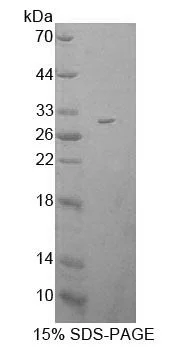 |
Greater than 95% as determined by reducing SDS-PAGE. |
靶点信息 Target Information
| 分子别名Alternative Names | RSSMDRS1RSMD1SELNSEP-N1Rigid Spine Muscular Dystrophy 1 |
|---|---|
| 背景介绍Background | Plays an important role in cell protection against oxidative stress and in the regulation of redox-related calcium homeostasis. Regulates the calcium level of the ER by protecting the calcium pump ATP2A2 against the oxidoreductase ERO1A-mediated oxidative damage. Within the ER, ERO1A activity increases the concentration of H(2)O(2), which attacks the luminal thiols in ATP2A2 and thus leads to cysteinyl sulfenic acid formation (-SOH) and SEPN1 reduces the SOH back to free thiol (-SH), thus restoring ATP2A2 activity. Acts as a modulator of ryanodine receptor (RyR) activity: protects RyR from oxidation due to increased oxidative stress, or directly controls the RyR redox state, regulating the RyR-mediated calcium mobilization required for normal muscle development and differentiation.; Essential for muscle regeneration and satellite cell maintenance in skeletal muscle. |
| 功能Function | Plays an important role in cell protection against oxidative stress and in the regulation of redox-related calcium homeostasis. Regulates the calcium level of the ER by protecting the calcium pump ATP2A2 against the oxidoreductase ERO1A-mediated oxidative damage. Within the ER, ERO1A activity increases the concentration of H(2)O(2), which attacks the luminal thiols in ATP2A2 and thus leads to cysteinyl sulfenic acid formation (-SOH) and SEPN1 reduces the SOH back to free thiol (-SH), thus restoring ATP2A2 activity. Acts as a modulator of ryanodine receptor (RyR) activity: protects RyR from oxidation due to increased oxidative stress, or directly controls the RyR redox state, regulating the RyR-mediated calcium mobilization required for normal muscle development and differentiation.; Essential for muscle regeneration and satellite cell maintenance in skeletal muscle. |
| 亚细胞定位Subcellular Location | [Isoform 2]: Endoplasmic reticulum membrane. |
| 数据库链接Databases |
基因功能参考文献17 条
- Case Report: rigid spine muscular dystrophy 1 in a compound heterozygote with two novel mutations in SEPN1 gene; a novel missense mutation (c.1384T>C; p.Sec462Arg) and a novel nonsense mutation (c.1525C>T; p.Gln509Ter), inherited from his father and mother respectively. PMID: 27863379 : 27863379
- We report two previously undescribed mutations in SEPN1. Our study adds two novel homozygous mutations to the number of reported pathogenic SEPN1 variants. PMID: 26780752 : 26780752
- The physiological function of SelN in muscle tissue and the pathogenesis leading to SEPN1-related myopathies. [Review] PMID: 22527882 : 22527882
- Data show that the spectrum of severity of SEPN1-related myopathiesis wider than previously reported. PMID: 21670436 : 21670436
- Data show that Argonaute 2 expression is critical for stem cells to escape senescence by downregulating miR10b and miR23b, and that selenoprotein N1 is also involved in ATSC survival and self-renewal through ROS-mediated p38 MAPK inactivation. PMID: 21241449 : 21241449
- this series of patients illustrates the clinical, histopathological and MRI findings of SEPN1-related myopathy. It also adds new mutations to the limited number of fully described pathogenic SEPN1 variants. PMID: 20937510 : 20937510
- Mutations of the selenoprotein N gene, which is implicated in rigid spine muscular dystrophy, cause the classical phenotype of multiminicore disease PMID: 12192640 : 12192640
- A new SEPN1 point mutation, 943g->A causing G315S was found in a rigid spine muscular dystrophy patient with cor pulmonale. PMID: 15668457 : 15668457
- SEPN1 mutation analysis revealed that the patient was a compound heterozygote: a previously described insertion (713-714 insA), and a novel nonsense mutation (R439stop). PMID: 15792869 : 15792869
- Two patients with 'Dropped head syndrome' due to mutations in SEPN1 genes. PMID: 15961312 : 15961312
- SEPN1 is the second genetic cause of CFTD and the first cause of autosomal recessive CFTD to be identified to our knowledge. CFTD is the fourth clinicopathological presentation that can be associated with mutations in SEPN1. PMID: 16365872 : 16365872
- identification of this mutation affecting a conserved base in the selenocysteine insertion sequence functional motif thereby reveals the structural basis for a novel pathological mechanism leading to SEPN1-related myopathy PMID: 16498447 : 16498447
- We report on the possible molecular mechanism behind these mutations in SEPN1. Our study clarifies molecular mechanisms of this muscular disorder. PMID: 16779558 : 16779558
- SEPN1 and RYR1 are required for the same cellular differentiation events and are needed for normal calcium fluxes PMID: 18713863 : 18713863
- Data highlights the importance of the SRE element during SelN expression and illustrates a novel molecular mechanism by which point mutations may lead to SEPN1-related myopathy. PMID: 19067361 : 19067361
- SelN plays a key role in redox homeostasis and human cell protection against oxidative stress. PMID: 19557870 : 19557870
- The Alu-derived exon 3 of human SEPN1 acquired its muscle-specific splicing activity after the divergence of humans and chimpanzees, suggesting its potential role in human evolution. PMID: 18841251 : 18841251
蛋白复溶体积计算器缓冲液体积 = 蛋白质量 ÷ 蛋白浓度
输入任意两项,第三项自动计算 |
蛋白浓度稀释计算器初浓度 × 初体积 = 终浓度 × 终体积
输入任意三项,第四项自动计算 |



