


Recombinant Protein Inhibitor Of Activated STAT 3 (PIAS3)(N-GST-6His)
Alternative NamesZMIZ5; Zinc Finger,MIZ-Type Containing 5; E3 SUMO-protein ligase PIAS3
规格参数 Specifications
| 纯度Purity | Greater than 90% as determined by reducing SDS-PAGE. |
|---|---|
| 内毒素Endotoxin | <1 EU/µg as determined by LAL test. |
| 蛋白构建Protein Construction |
6HisN 端标签-GSTN 端标签-【Val11-Leu280】序列区间
|
| Accession | Q9Y6X2 |
| 表达宿主Expression Host | E.coli |
| 种属Species | Homo sapiens (Human) |
| 预测分子量Predicted MW | 59.9 kDa |
| 制剂Formulation | Lyophilized from a 0.2 μm filtered solution of PBS, pH7.4, containing 0.01% SKL, 1mM DTT, 5% Trehalose and Proclin300. |
| 运输方式Shipping | The product is shipped with ice bag. Upon receipt, store it immediately at the temperature listed below. |
| 稳定性&储存Stability & Storage | 12 months at -20°C to -80°C in lyophilized state.6 months at -20°C to -80°C under sterile conditions after reconstitution.7-10 days at 2°C to 8°C under sterile conditions after reconstitution.Please minimize freeze-thaw cycles. |
| 复溶Reconstitution | Reconstitute in 10mM PBS (pH7.4) to a concentration of 0.1-1.0 mg/mL. Do not vortex. |
!
本司产品仅用于科研,不用于临床诊断和治疗。
产品图片 Product Images点击图片可查看原图
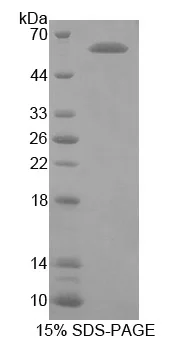 |
Greater than 90% as determined by reducing SDS-PAGE. |
靶点信息 Target Information
| 分子别名Alternative Names | ZMIZ5Zinc Finger,MIZ-Type Containing 5E3 SUMO-protein ligase PIAS3 |
|---|---|
| 背景介绍Background | Functions as an E3-type small ubiquitin-like modifier (SUMO) ligase, stabilizing the interaction between UBE2I and the substrate, and as a SUMO-tethering factor. Plays a crucial role as a transcriptional coregulation in various cellular pathways, including the STAT pathway and the steroid hormone signaling pathway. Involved in regulating STAT3 signaling via inhibiting STAT3 DNA-binding and suppressing cell growth. Enhances the sumoylation of MTA1 and may participate in its paralog-selective sumoylation. Sumoylates CCAR2 which promotes its interaction with SIRT1. Diminishes the sumoylation of ZFHX3 by preventing the colocalization of ZFHX3 with SUMO1 in the nucleus. |
| 功能Function | Functions as an E3-type small ubiquitin-like modifier (SUMO) ligase, stabilizing the interaction between UBE2I and the substrate, and as a SUMO-tethering factor. Plays a crucial role as a transcriptional coregulation in various cellular pathways, including the STAT pathway and the steroid hormone signaling pathway. Involved in regulating STAT3 signaling via inhibiting STAT3 DNA-binding and suppressing cell growth. Enhances the sumoylation of MTA1 and may participate in its paralog-selective sumoylation. Sumoylates CCAR2 which promotes its interaction with SIRT1. Diminishes the sumoylation of ZFHX3 by preventing the colocalization of ZFHX3 with SUMO1 in the nucleus. |
| 亚细胞定位Subcellular Location | Cytoplasm. Nucleus. Nucleus speckle. |
| 数据库链接Databases |
基因功能参考文献46 条
- PAI-1 interacted with PIAS3 to regulate Stat3-dependent gene expression and miR-34a was transcriptionally suppressed by Stat3 to form a positive regulatory loop through Stat3 signaling in non-small cell lung cancer cells. PMID: 28988111 : 28988111
- Levels of PIAS3 are significantly lower, in contrast with phosphorylation of STAT3, in women with endometriosis compared to women without endometriosis. PMID: 27226311 : 27226311
- TRIM8 activates STAT3 by suppressing the expression of PIAS3, an inhibitor of STAT3, most likely through E3-mediated ubiquitination and proteasomal degradation. PMID: 28100038 : 28100038
- Low PIAS3 expression is associated with breast cancer organoid invasiveness. PMID: 28423498 : 28423498
- SHP2, SOCS3 and PIAS3 levels are reduced in medulloblastomas in vivo and in vitro, of which PIAS3 downregulation is more reversely correlated with STAT3 activation. In resveratrol-suppressed medulloblastoma cells with STAT3 downregulation and decreased incidence of STAT3 nuclear translocation, PIAS3 is upregulated, the SHP2 level remains unchanged and SOCS3 is downregulated. PMID: 28035977 : 28035977
- The results revealed that although the expression levels of SOCS1, SOCS3 and, in particular, pSHP2, tend to decrease in the four types of astrocytomas, PIAS3 downregulation is more negatively correlated with STAT3 activation in the stepwise progress of astrocytomas and would indicate an unfavorable outcome. PMID: 28035384 : 28035384
- 3-Formylchromone inhibits proliferation and induces apoptosis of multiple myeloma cells by abrogating STAT3 signaling through the induction of PIAS3. PMID: 27324722 : 27324722
- PIAS3 may serve as a biomarker for predicting hormone therapy stratification, although it is limited to those breast cancer patients receiving hormone therapy. PMID: 26768588 : 26768588
- Taken together, these results suggest that PIAS3 functions as a positive regulator of HIF-1alpha-mediated transcription by increasing its protein stability. PMID: 26697750 : 26697750
- PIAS3 suppression may be protective against joint destruction in rheumatoid arthritis by regulating synoviocyte migration, invasion, and activation. PMID: 26667168 : 26667168
- PIAS3 primes ATR for checkpoint activation. PMID: 26565033 : 26565033
- PIAS3 expression in squamous cell lung cancer is low and predicts overall survival PMID: 25573684 : 25573684
- Adenovirus E4-ORF3 targets PIAS3 and together with E1B-55K remodels SUMO2/SUMO3 Interactions in the nucleus and at virus genome replication domains. PMID: 26223632 : 26223632
- Statistically significant positive correlation has been found between STAT5B and COX-2, and significant negative correlation between STAT5B and PIAS3. PMID: 25137041 : 25137041
- Low PIAS3 expression in malignant mesothelioma is associated with increased STAT3 activation and poor patient survival. PMID: 25124686 : 25124686
- this newly identified p53PIAS3 interaction through the 1-52 amino acid region of p53, reduces p53MDM2 complex formation, which not only increases the half-life of p53, but also its transactivation of target genes. PMID: 24584189 : 24584189
- PIAS3 may be a potential biomarker target for early cancer detection and therapeutic of human colorectal cancer. PMID: 24120699 : 24120699
- PIAS3 activates the intrinsic apoptotic pathway in non-small cell lung cancer cells independent of p53 status. PMID: 23959540 : 23959540
- Downregulation of PIAS3 is associated with gastric adenocarcinogenesis. PMID: 23322197 : 23322197
- PIAS3 expression is closely related to the invasion properties of glioma TJ905 cells. PMID: 21733403 : 21733403
- NF-kappaB is regulated through a novel negative feedback mechanism by SUMOylation, where the RelA subunit of NF-kappaB is SUMOylated by PIAS3. PMID: 22649547 : 22649547
- PIAS3 is a novel regulator of ErbB4 receptor tyrosine kinase, controlling its nuclear sequestration and function. PMID: 22584572 : 22584572
- Squamous cell carcinoma of the lung commonly lacks PIAS3 protein expression. PMID: 21497567 : 21497567
- novel transcription factor binding partners for PIAS3 including ETS, EGR1, NR1I2, and GATA1 were identified. PMID: 21532337 : 21532337
- Identification of vimentin (vimentin354), a nuclear component in glioblastoma multiforme cells, as the main target of sumoylation promoted by PIAS3. PMID: 21317457 : 21317457
- SOCS-3 and PIAS-3 upregulation impairs IL-12-mediated interferon-gamma response in CD56 T cells in HCV-infected heroin users PMID: 20231901 : 20231901
- These findings indicate that TRIM8 enhances the STAT3-dependent signal pathway by inhibiting the function of PIAS3. PMID: 20516148 : 20516148
- we selected one coding single nucleotide polymorphism in PIAS3 for association analyses in patients with breast cancer PMID: 19760037 : 19760037
- there is an interaction between Zimp7 and PIAS proteins with higher preference for PIAS3, in androgen receptor-mediated transcription PMID: 20159969 : 20159969
- data suggest an important role for the negative regulatory effect of PIAS3 on STAT3 in EGF-driven tumors PMID: 19903771 : 19903771
- AR and PIAS3 regulate the STAT3-mediated transcriptional activity by their physical protein-protein competition on STAT3 PMID: 12804609 : 12804609
- Up-regulation of protein inhibitor of activated STAT3 protein is associated with adult T-cell leukemia PMID: 14630083 : 14630083
- PIAS3 and Smad3 interact with each other at the endogenous protein level in mammalian cells and also in vitro, and the association occurs through the C-terminal domain of Smad3. PMID: 14691252 : 14691252
- In conclusion, ATBF1 can suppress the IL-6-mediated cellular response by acting together with PIAS3. PMID: 14715251 : 14715251
- Increased PIAS3 expression is associated with human cancers including lung, breast, prostate, colon-rectum, and brain tumors PMID: 15138572 : 15138572
- PIAS3 may function in vivo as a modulator in suppressing the transcriptional activity of p65 PMID: 15140884 : 15140884
- End-stage hepatitis c and alcoholic liver cirrhosis is characterized by impaired Stat3 DNA-binding possibly through up-regulation of Pias3. PMID: 16098628 : 16098628
- Mechanisms of PIAS3 activity could pave the way toward the formulation of an antioncogenic agent for the inhibition of both STAT3 and MITF. PMID: 16368885 : 16368885
- overexpression of PIAS3 in lung cancer cells contributed to growth suppression and restored the drug sensitivity of the cells PMID: 17032498 : 17032498
- PIAS3 is a new regulator of ATF1 that regulates the ARE-mediated transcription of the ferritin H gene PMID: 17565989 : 17565989
- Both SUMO E2 conjugating enzyme Ubc9 and E3 ligase protein inhibitor of activated STAT3 (Pias3) are targets for S-nitrosation PMID: 17987106 : 17987106
- PIAS3 binds to Tel and stimulates sumoylation of K11 in the nucleus.PIAS3 may have a dual, context-dependent influence on Tel; it mediates Tel sumoylation, but it also augments Tel's repressive function in a sumoylation-independent fashion. PMID: 18212042 : 18212042
- parvovirus B19 NS1 protein modulates inflammatory signaling by activation of STAT3/PIAS3 in human endothelial cells PMID: 18550668 : 18550668
- This study suggests a link between PIAS3 and nuclear pyruvate kinase. PMID: 19308990 : 19308990
- PIAS3 is expressed in NSCLC cell lines and its over-expression decreased STAT3 transcriptional activity, decreased proliferation of NSCLC cells and when used in conjunction with EGFR inhibitors, increased the anti-proliferative effects. PMID: 19569236 : 19569236
- Pias3 associates and colocalizes with Trim32, a Ubiquitin E3 ligase. PMID: 17987106 : 17987106
蛋白复溶体积计算器缓冲液体积 = 蛋白质量 ÷ 蛋白浓度
输入任意两项,第三项自动计算 |
蛋白浓度稀释计算器初浓度 × 初体积 = 终浓度 × 终体积
输入任意三项,第四项自动计算 |



