


Recombinant Solute Carrier Family 26, Member 6 (SLC26A6)(N-GST-6His)
Alternative NamesPendrin-Like Protein 1; Sulfate Anion Transporter; Anion Transporter 1; Anion exchange transporter
规格参数 Specifications
| 纯度Purity | Greater than 90% as determined by reducing SDS-PAGE. |
|---|---|
| 内毒素Endotoxin | <1 EU/µg as determined by LAL test. |
| 蛋白构建Protein Construction |
6HisN 端标签-GSTN 端标签-【Leu493-Leu759】序列区间
|
| Accession | Q9BXS9 |
| 表达宿主Expression Host | E.coli |
| 种属Species | Homo sapiens (Human) |
| 预测分子量Predicted MW | 59.6 kDa |
| 制剂Formulation | Lyophilized from a 0.2 μm filtered solution of PBS, pH7.4, containing 0.01% SKL, 1mM DTT, 5% Trehalose and Proclin300. |
| 运输方式Shipping | The product is shipped with ice bag. Upon receipt, store it immediately at the temperature listed below. |
| 稳定性&储存Stability & Storage | 12 months at -20°C to -80°C in lyophilized state.6 months at -20°C to -80°C under sterile conditions after reconstitution.7-10 days at 2°C to 8°C under sterile conditions after reconstitution.Please minimize freeze-thaw cycles. |
| 复溶Reconstitution | Reconstitute in 10mM PBS (pH7.4) to a concentration of 0.1-1.0 mg/mL. Do not vortex. |
!
本司产品仅用于科研,不用于临床诊断和治疗。
产品图片 Product Images点击图片可查看原图
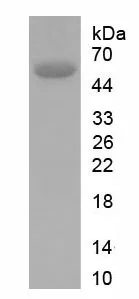 |
Greater than 90% as determined by reducing SDS-PAGE. |
靶点信息 Target Information
| 分子别名Alternative Names | Pendrin-Like Protein 1Sulfate Anion TransporterAnion Transporter 1Anion exchange transporter |
|---|---|
| 背景介绍Background | Apical membrane anion-exchanger with wide epithelial distribution that plays a role as a component of the pH buffering system for maintaining acid-base homeostasis. Acts as a versatile DIDS-sensitive inorganic and organic anion transporter that mediates the uptake of monovalent anions like chloride, bicarbonate, formate and hydroxyl ion and divalent anions like sulfate and oxalate. Functions in multiple exchange modes involving pairs of these anions, which include chloride-bicarbonate, chloride-oxalate, oxalate-formate, oxalate-sulfate and chloride-formate exchange. Apical membrane chloride-bicarbonate exchanger that mediates luminal chloride absorption and bicarbonate secretion by the small intestinal brush border membrane and contributes to intracellular pH regulation in the duodenal upper villous epithelium during proton-coupled peptide absorption, possibly by providing a bicarbonate import pathway. Mediates also intestinal chloride absorption and oxalate secretion, thereby preventing hyperoxaluria and calcium oxalate urolithiasis. Transepithelial oxalate secretion, chloride-formate, chloride-oxalate and chloride-bicarbonate transport activities in the duodenum are inhibited by PKC activation in a calcium-independent manner. The apical membrane chloride-bicarbonate exchanger provides also a major route for fluid and bicarbonate secretion into the proximal tubules of the kidney as well as into the proximal part of the interlobular pancreatic ductal tree, where it mediates electrogenic chloride-bicarbonate exchange with a chloride-bicarbonate stoichiometry of 1:2, and hence will dilute and alkalinize protein-rich acinar secretion. Mediates also the transcellular sulfate absorption and oxalate secretion across the apical membrane in the duodenum and the formate ion efflux at the apical brush border of cells in the proximal tubules of kidney. Plays a role in sperm capacitation by increasing intracellular pH.; Apical membrane chloride-bicarbonate exchanger. Its association with carbonic anhydrase CA2 forms a bicarbonate transport metabolon; hence maximizes the local concentration of bicarbonate at the transporter site. |
| 功能Function | Apical membrane anion-exchanger with wide epithelial distribution that plays a role as a component of the pH buffering system for maintaining acid-base homeostasis. Acts as a versatile DIDS-sensitive inorganic and organic anion transporter that mediates the uptake of monovalent anions like chloride, bicarbonate, formate and hydroxyl ion and divalent anions like sulfate and oxalate. Functions in multiple exchange modes involving pairs of these anions, which include chloride-bicarbonate, chloride-oxalate, oxalate-formate, oxalate-sulfate and chloride-formate exchange. Apical membrane chloride-bicarbonate exchanger that mediates luminal chloride absorption and bicarbonate secretion by the small intestinal brush border membrane and contributes to intracellular pH regulation in the duodenal upper villous epithelium during proton-coupled peptide absorption, possibly by providing a bicarbonate import pathway. Mediates also intestinal chloride absorption and oxalate secretion, thereby preventing hyperoxaluria and calcium oxalate urolithiasis. Transepithelial oxalate secretion, chloride-formate, chloride-oxalate and chloride-bicarbonate transport activities in the duodenum are inhibited by PKC activation in a calcium-independent manner. The apical membrane chloride-bicarbonate exchanger provides also a major route for fluid and bicarbonate secretion into the proximal tubules of the kidney as well as into the proximal part of the interlobular pancreatic ductal tree, where it mediates electrogenic chloride-bicarbonate exchange with a chloride-bicarbonate stoichiometry of 1:2, and hence will dilute and alkalinize protein-rich acinar secretion. Mediates also the transcellular sulfate absorption and oxalate secretion across the apical membrane in the duodenum and the formate ion efflux at the apical brush border of cells in the proximal tubules of kidney. Plays a role in sperm capacitation by increasing intracellular pH.; Apical membrane chloride-bicarbonate exchanger. Its association with carbonic anhydrase CA2 forms a bicarbonate transport metabolon; hence maximizes the local concentration of bicarbonate at the transporter site. |
| 亚细胞定位Subcellular Location | Cell membrane; Multi-pass membrane protein. Membrane; Multi-pass membrane protein. Apical cell membrane; Multi-pass membrane protein. Cytoplasmic vesicle membrane; Multi-pass membrane protein. Microsome.; [Isoform 4]: Cell membrane; Multi-pass membrane protein. Apical cell membrane; Multi-pass membrane protein. Basolateral cell membrane; Multi-pass membrane protein. Note=Localizes to the apical and basolateral surfaces of tubular wall cells in kidney and in the brush border of pancreatic duct cells.; [Isoform 5]: Cell membrane; Multi-pass membrane protein.; [Isoform 6]: Cell membrane; Multi-pass membrane protein. |
| 数据库链接Databases |
基因功能参考文献19 条
- IL13 increases pendrin abundance to the cell surface via Rho/actin signaling, an effect reversed by theophylline. PMID: 28378089 : 28378089
- Results indicate that the variant G539R in the SLC26A6 gene is associated with kidney stone risk, providing a clear clue to further achieve insight into oxalate transport in kidney stone formation. PMID: 26812303 : 26812303
- Results indicate the involvement of SLC26A6 along with SLC26A3 in transporting HCO3(-) essential for embryo cleavage, possibly working in concert with CFTR through a Cl(-) recycling pathway. PMID: 27346053 : 27346053
- Endogenous oestrogen upregulates the expressions and functional activities of CFTR and SLC26A6 in duodenal mucosa. PMID: 27615377 : 27615377
- IL-4 induces demethylation of specific CpG sites within the pendrin promoter. These epigenetic alterations are cell type specific, and may in part dictate pendrin mRNA transcription PMID: 28365704 : 28365704
- Helicobacter pylori infection impairs the expressions and functional activities of duodenal mucosal bicarbonate transport proteins, CFTR and SLC26A6, which contributes to the development of duodenal ulcer. PMID: 27004488 : 27004488
- Molecular dynamics simulations of the STAS domains of rat prestin and human pendrin reveal conformational motions in conserved flexible regions. PMID: 24603188 : 24603188
- Data show that SLC26A6 variants do not alter the risk for the development of chronic pancreatitis. PMID: 26372434 : 26372434
- In the intestinal epithelium, PAT-1 (SLC26A6) could mediate apical oxalate influx or apical oxalate efflux depending on the magnitude and direction prevailing counterion driver gradients as well as the relative affinities of the transported anions. PMID: 20501439 : 20501439
- lysophosphatidic acid stimulates apical Cl(-)/OH(-) exchange activity and surface levels of SCL26A3 and SCL26A6 in intestinal epithelial cells PMID: 19910524 : 19910524
- orthologous mouse and human SLC26A6 proteins differ in anion selectivity, transport mechanism, and acute regulation, but both mediate electroneutral Cl(-)/HCO(3)(-) exchange PMID: 15548529 : 15548529
- In human kidney SLC26A6 and A7 have a distinct, partially overlapping expression in distal segments of nephrons. The distribution partly differs from that found previously in rodent kidneys. PMID: 15956810 : 15956810
- findings indicate that slc26a6 functions as a coupled 1Cl-/2HCO3- exchanger PMID: 16606687 : 16606687
- Mouse Slc26a6 and human SLC26A6 each mediated electroneutral Cl-/HCO3- and Cl-/OH- exchange. But, whereas Cl-/oxalate exchange by mouse Slc26a6 was electrogenic, that mediated by human SLC26A6 appeared electroneutral. PMID: 17120764 : 17120764
- No mutation was found in the coding regions and intron-exon boundaries of the genes for CA II, CA IV, CA XIV, kNCB1, NHE3, NHE8, NHRF1, NHRF2 and SLC26A6 amplified from genomic DNA of family members with pRTA. PMID: 17881426 : 17881426
- Low extracellular Cl(-) affinity and electroneutrality of oxalate efflux characterizing human SLC26A6 explain the high human susceptibility to nephrolithiasis relative to mice. SLC26A6 sequence variant(s) are candidate risk modifiers for nephrolithiasis. PMID: 18174209 : 18174209
- involvement of IRF-1 in the regulation of SLC26A6 gene expression by IFNgamma in the human intestine PMID: 18655181 : 18655181
- SLC26A6 was effectively ruled out as the disease gene in this non-PH1/PH2 cohort. Phenotypic and functional analysis excluded a significant effect of identified variants on oxalate excretion. PMID: 18951670 : 18951670
- Though the SLC26A6 206M polymorphism did not correlate with kidney stone development in primary hyperparathyroidism, PHPT stone-formers harbouring the M allele had a lower hypercalciuria PMID: 19029225 : 19029225
蛋白复溶体积计算器缓冲液体积 = 蛋白质量 ÷ 蛋白浓度
输入任意两项,第三项自动计算 |
蛋白浓度稀释计算器初浓度 × 初体积 = 终浓度 × 终体积
输入任意三项,第四项自动计算 |



