


Recombinant Uncoupling Protein 4, Mitochondrial (UCP4)(N-6His)
Alternative NamesSLC25A27; Solute Carrier Family 25 Member 27
规格参数 Specifications
| 纯度Purity | Greater than 90% as determined by reducing SDS-PAGE. |
|---|---|
| 内毒素Endotoxin | <1 EU/µg as determined by LAL test. |
| 蛋白构建Protein Construction |
6HisN 端标签-【Ser21-Met317 (Accession # O95847)】序列区间
|
| Accession | O95847 |
| 表达宿主Expression Host | E.coli |
| 种属Species | Homo sapiens (Human) |
| 预测分子量Predicted MW | 36.8 kDa |
| 制剂Formulation | Lyophilized from a 0.2 μm filtered solution of PBS, pH7.4, containing 0.01% SKL, 1mM DTT, 5% Trehalose and Proclin300. |
| 运输方式Shipping | The product is shipped with ice bag. Upon receipt, store it immediately at the temperature listed below. |
| 稳定性&储存Stability & Storage | 12 months at -20°C to -80°C in lyophilized state.6 months at -20°C to -80°C under sterile conditions after reconstitution.7-10 days at 2°C to 8°C under sterile conditions after reconstitution.Please minimize freeze-thaw cycles. |
| 复溶Reconstitution | Reconstitute in 10mM PBS (pH7.4) to a concentration of 0.1-1.0 mg/mL. Do not vortex. |
!
本司产品仅用于科研,不用于临床诊断和治疗。
产品图片 Product Images点击图片可查看原图
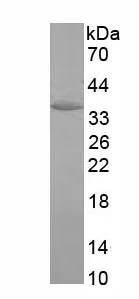 |
Greater than 90% as determined by reducing SDS-PAGE. |
靶点信息 Target Information
| 分子别名Alternative Names | SLC25A27Solute Carrier Family 25 Member 27 |
|---|---|
| 背景介绍Background | UCP are mitochondrial transporter proteins that create proton leaks across the inner mitochondrial membrane, thus uncoupling oxidative phosphorylation from ATP synthesis. As a result, energy is dissipated in the form of heat. May play a role in thermoregulatory heat production and metabolism in brain. |
| 功能Function | UCP are mitochondrial transporter proteins that create proton leaks across the inner mitochondrial membrane, thus uncoupling oxidative phosphorylation from ATP synthesis. As a result, energy is dissipated in the form of heat. May play a role in thermoregulatory heat production and metabolism in brain. |
| 亚细胞定位Subcellular Location | Mitochondrion inner membrane; Multi-pass membrane protein. |
| 数据库链接Databases |
基因功能参考文献13 条
- This study found that the variability of UCP4 does affect the individual susceptibility to Late-Onset Alzheimer's Disease. PMID: 26923023 : 26923023
- UCP4 mRNA of cartilage tissues was decreased in osteoarthritis patients, which was negatively correlated with synovial fluid (SF) leptin concentration. PMID: 26934480 : 26934480
- UCP4 is a target effector gene of the NF-kappaB c-Rel prosurvival pathway to mitigate the effects of oxidative stress. PMID: 22580300 : 22580300
- Neuronal UCP4 exhibits transmembrane chloride transport activity. PMID: 22524567 : 22524567
- Findings show how UCP4 overexpression increases ATP synthesis by specifically interacting with Complex II. PMID: 22427795 : 22427795
- UCP4 expression correlated with lymph node metastases, positive estrogen/progesterone receptor expression, and positivity for p53 and Ki-67 in breast carcinomas. PMID: 21621926 : 21621926
- A homozygous genetic variant of mitochondrial uncoupling protein 4 affects the occurrence of leukoaraiosis.( PMID: 20545631 : 20545631
- the association found between the ultra-resistant schizophrenia group and the UCP4 haplotype is noteworthy as it may influence treatment outcome in schizophrenia. PMID: 21332312 : 21332312
- has a significant role in NF-kappaB-mediated prosurvival signaling and cell protection against neurotoxins PMID: 20385226 : 20385226
- Results suggest that mitochondrial UCP4 mediates an adaptive shift in energy metabolism and increases the resistance of neurons to metabolic and oxidative stress. PMID: 16775390 : 16775390
- The stabilization of Ca(2+) homeostasis and preservation of mitochondrial function by UCP4 was correlated with reduced mitochondrial reactive oxygen species generation and oxidative stress. PMID: 17035241 : 17035241
- overexpression increases neural cell survival by inducing oxidative phosphorylation, preserving ATP synthesis and mitochondrial membrane potential, and reducing oxidative stress. PMID: 19150400 : 19150400
- Data describe how variants of mitochondrial uncoupling protein 4 (mUCP4) may contibute to development of multiple sclerosis, since mUCP4 is presumed to be of importance in regulation of the mitochondrial membrane potential and cellular energy metabolism. PMID: 19536655 : 19536655
蛋白复溶体积计算器缓冲液体积 = 蛋白质量 ÷ 蛋白浓度
输入任意两项,第三项自动计算 |
蛋白浓度稀释计算器初浓度 × 初体积 = 终浓度 × 终体积
输入任意三项,第四项自动计算 |



