


Recombinant Solute Carrier Family 1, Member 5 (SLC1A5)(N-GST-6His)
Alternative NamesSLC1A5; AAAT; ASCT2; ATBO; M7V1; M7VS1; R16; RDRC; Neutral Amino Acid Transporter B(0); Baboon M7 virus receptor; Sodium-dependent neutral amino acid transporter type 2
规格参数 Specifications
| 纯度Purity | Greater than 97% as determined by reducing SDS-PAGE. |
|---|---|
| 内毒素Endotoxin | <1 EU/µg as determined by LAL test. |
| 蛋白构建Protein Construction |
6HisN 端标签-GSTN 端标签-【Leu327-Met541】序列区间
|
| Accession | Q15758 |
| 表达宿主Expression Host | E.coli |
| 种属Species | Homo sapiens (Human) |
| 预测分子量Predicted MW | 52.8 kDa |
| 制剂Formulation | Lyophilized from a 0.2 μm filtered solution of 20mM Tris, 150mM NaCl, pH8.0, containing 1mM EDTA, 1mM DTT, 0.01% SKL, 5% Trehalose and Proclin300. |
| 运输方式Shipping | The product is shipped with ice bag. Upon receipt, store it immediately at the temperature listed below. |
| 稳定性&储存Stability & Storage | 12 months at -20°C to -80°C in lyophilized state.6 months at -20°C to -80°C under sterile conditions after reconstitution.7-10 days at 2°C to 8°C under sterile conditions after reconstitution.Please minimize freeze-thaw cycles. |
| 复溶Reconstitution | Reconstitute in 20mM Tris, 150mM NaCl (pH8.0) to a concentration of 0.1-1.0 mg/mL. Do not vortex. |
!
本司产品仅用于科研,不用于临床诊断和治疗。
产品图片 Product Images点击图片可查看原图
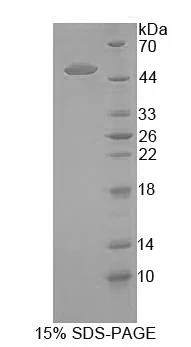 |
Greater than 97% as determined by reducing SDS-PAGE. |
靶点信息 Target Information
| 分子别名Alternative Names | SLC1A5AAATASCT2ATBOM7V1M7VS1R16RDRCNeutral Amino Acid Transporter B(0)Baboon M7 virus receptorSodium-dependent neutral amino acid transporter type 2 |
|---|---|
| 背景介绍Background | Sodium-dependent amino acids transporter that has a broad substrate specificity, with a preference for zwitterionic amino acids. It accepts as substrates all neutral amino acids, including glutamine, asparagine, and branched-chain and aromatic amino acids, and excludes methylated, anionic, and cationic amino acids. Through binding of the fusogenic protein syncytin-1/ERVW-1 may mediate trophoblasts syncytialization, the spontaneous fusion of their plasma membranes, an essential process in placental development.; (Microbial infection) Acts as a cell surface receptor for Feline endogenous virus RD114.; (Microbial infection) Acts as a cell surface receptor for Baboon M7 endogenous virus.; (Microbial infection) Acts as a cell surface receptor for type D simian retroviruses. |
| 功能Function | Sodium-dependent amino acids transporter that has a broad substrate specificity, with a preference for zwitterionic amino acids. It accepts as substrates all neutral amino acids, including glutamine, asparagine, and branched-chain and aromatic amino acids, and excludes methylated, anionic, and cationic amino acids. Through binding of the fusogenic protein syncytin-1/ERVW-1 may mediate trophoblasts syncytialization, the spontaneous fusion of their plasma membranes, an essential process in placental development.; (Microbial infection) Acts as a cell surface receptor for Feline endogenous virus RD114.; (Microbial infection) Acts as a cell surface receptor for Baboon M7 endogenous virus.; (Microbial infection) Acts as a cell surface receptor for type D simian retroviruses. |
| 亚细胞定位Subcellular Location | Cell membrane; Multi-pass membrane protein. Melanosome. Note=Identified by mass spectrometry in melanosome fractions from stage I to stage IV. |
| 数据库链接Databases |
基因功能参考文献50 条
- Data suggest that amino acid uptake via ASCT2/SLC1A5 is required for cell proliferation/tumor growth independently of LAT1/SLC7A5; in part, these studies were conducted in lung and colon adenocarcinoma cell lines and involved gene knockout techniques. (ASCT2/SLC1A5 = solute carrier family-1 member-5; LAT1/SLC7A5 = solute carrier family-7 member-5) PMID: 29326164 : 29326164
- This study provides the metabolic molecule SLC1A5 as a potential therapeutic target to increase the efficacy of cetuximab on colorectal cancer PMID: 29363109 : 29363109
- Results demonstrated that ASCT2 and pmTOR protein levels were significantly higher in epithelial ovarian cancer (EOC) tissues and predicting a poor prognosis. The expression levels of ASCT2 and pmTOR in EOC were positively correlated indicating a synergistic effect on the growth and development of early EOC. PMID: 30272366 : 30272366
- intronic variants of the ASCT2 gene have roles in hampering the splicing process and in longevity PMID: 28885889 : 28885889
- These data collectively establish that in an in vitro context, human epithelial and mesenchymal hepatocellular carcinoma cell lines adapt to ASCT2 or LAT1 knockout. PMID: 30029480 : 30029480
- SLC1A5 expression is increased in tumor samples from esophageal cancer patients, and downregulation of SLC1A5 inhibited cell cycle progression and esophageal cancer growth. PMID: 30071532 : 30071532
- Our results indicate that overexpression of SLC1a5 is associated with shorter overall survival in non-small cell lung cancer PMID: 29455869 : 29455869
- the experimental data allowed identifying C467 residue as crucial for substrate binding and for transport activity modulation of hASCT2. PMID: 29495336 : 29495336
- ASCT2 was significantly overexpressed in the gastric cancer (GC) samples compared with adjacent non-cancerous gastric mucosa, in contrast, a significantly higher level of glutamine synthetase (GS) expression was observed in normal tissues than in GC samples compared with adjacent non-cancerous gastric mucosa. PMID: 29435734 : 29435734
- These results indicated that ASCT2 (SLC1A5) could be a novel therapeutic target against KRAS-mutant colorectal cancer. PMID: 28749408 : 28749408
- AR signaling promoted glutamine metabolism by increasing the expression of the glutamine transporters SLC1A4 and SLC1A5, genes commonly overexpressed in prostate cancer. Correspondingly, gene expression signatures of AR activity correlated with SLC1A4 and SLC1A5 mRNA levels in clinical cohorts. PMID: 28507054 : 28507054
- Results provide evidence that ASCT2 enhances glutamine uptake in glycolipid-enriched microdomain/rafts in GD2(+) small-cell lung cancer cells, leading to the enhancement of cell proliferation and migration. PMID: 29151270 : 29151270
- High ASCT2 expression is associated with head and neck squamous cell carcinoma. PMID: 28823958 : 28823958
- this study shows that IL-2-induced expression of SLC1A5 is a prerequisite for NKG2D-mediated activation of NK cells PMID: 28784848 : 28784848
- Data suggest that both heterogeneous nuclear ribonucleoprotein type M (HNRPM) and solute carrier 1A5 (SLC1A5) have role in the pathogenesis of ovarian cancer. PMID: 28609484 : 28609484
- Both stable and inducible shRNA-mediated ASCT2 knockdown confirmed that inhibiting ASCT2 function was sufficient to prevent cellular proliferation and induce rapid cell death in TN basal-like breast cancer cells, but not in luminal cells. PMID: 26455325 : 26455325
- ASCT2 is an EGFR-associated protein that can be co-targeted by cetuximab, leading to sensitization of cetuximab-treated cells to ROS-induced apoptosis. PMID: 27450723 : 27450723
- The tumor metabolism status determined by expression of GLUT1 and ASCT2. PMID: 28036362 : 28036362
- Data show that SERT associates with ASCT2 (alanine-serine-cysteine-threonine 2), a member of the solute carrier 1 family co-expressed with SERT in serotonergic neurons and involved in the transport of small neutral amino acids across the plasma membrane. PMID: 27143784 : 27143784
- In the absence of SLC1A5 there is a crucial role of SNAT1 in supplying glutamine for glutaminolysis with SNAT2 acting as a "backup" for glutamine transport. PMID: 27129276 : 27129276
- High expression of LAT1 and ASCT2 correlates with metastasis and invasion in esophageal squamous cell carcinoma. PMID: 26936531 : 26936531
- LAT1, 4F2hc and ASCT2 were highly expressed in patients with advanced laryngeal cancer. PMID: 26024742 : 26024742
- Cys is a potent competitive inhibitor of hASCT2 but is not a substrate PMID: 26492990 : 26492990
- Genetic Variants in ASCT2 Gene are Associated with response to therapy in Hepatocelluar Carcinoma PMID: 25987094 : 25987094
- ASCT2 expression plays an important role in tumour cell growth, and is a promising pathological marker for predicting a worse outcome in pancreatic cancer. PMID: 24845232 : 24845232
- The results demonstrate that N-glycosylation of SLC1A5 is critical for trafficking. PMID: 25862406 : 25862406
- ASCT2-mediated glutamine uptake is essential for multiple pathways regulating the cell cycle and cell growth. PMID: 25693838 : 25693838
- ASCT-2 is expressed in human oocytes.ASCT-2 is localized at the acrosomal region and equatorial segment of the spermatozoa. PMID: 24687878 : 24687878
- Report the differential expression of SLC1A5 in human colorectal cancer and normal tissues, and a functional link between SLC1A5 expression and growth and survival of colorectal cancer. PMID: 25337245 : 25337245
- analysis of the kinetic mechanism of the transport catalyzed by the human glutamine/neutral amino acid transporter hASCT2 PMID: 25052780 : 25052780
- ASCT2 expression, which correlates with that of N-Myc and ATF4, is markedly elevated in high-stage neuroblastoma PMID: 25142020 : 25142020
- the expression of LAT1 and ASCT2 is significantly increased in human melanoma. The importance of ASCT2 expression in melanoma was confirmed by shRNA knockdown, which inhibited glutamine uptake, mTORC1 signaling and cell proliferation. PMID: 24531984 : 24531984
- ASC amino-acid transporter 2 expression has a crucial role in the metastasis of pulmonary AC, and is a potential molecular marker for predicting poor prognosis after surgery. PMID: 24603303 : 24603303
- HER2- type breast cancer had the highest expression of stromal GLS1, tumoral GDH, stromal GDH, and tumoral ASCT, while TNBC had the lowest tumoral GDH expression. PMID: 23507704 : 23507704
- stromal expression of the glutamine-metabolism-related proteins GLS1, GDH, ASCT2 increases with worsening histological phyllodes tumor grade. PMID: 23636801 : 23636801
- SLC1A5 plays a key role in Gln transport controlling lung cancer cells' metabolism, growth, and survival. PMID: 23213057 : 23213057
- These data suggest that intracellular replication of Francisella tularensis depends on the function of host cell SLC1A5. PMID: 22804921 : 22804921
- Cx43-mediated GJIC and SLC1A5 interaction play important functional roles in trophoblast cell fusion. PMID: 22238282 : 22238282
- level of amino acid transporter B(0)(ACST2) mRNA expression was lower in forskolin treated BeWo cells PMID: 12175968 : 12175968
- in the six unrelated Hartnup pedigrees studied, examination of linkage at 19q13.3, polymorphisms in the coding sequence and quantitation of expression of SLC1A5 did not suffice to explain the defect in neutral amino acid transport PMID: 12555937 : 12555937
- Hypoxia alters expression and function of syncytin and its receptor (amino acid transport system B(0)) during trophoblast cell fusion of human placental BeWo cells: implications for impaired trophoblast syncytialisation in pre-eclampsia. PMID: 12757936 : 12757936
- ASCT2 messenger RNA was not altered significantly in hypoxia in cytotrophoblasts or in perfused placental cotyledons. PMID: 14520239 : 14520239
- up-regulation of ASCT2 by S-nitroso-N-acetyl-DL-penicillamine might be partially associated with an increase in the density of transporter protein via de novo synthesis PMID: 15848195 : 15848195
- analysis of SLC1A5 mutations on 19q13 in cystinuria patients PMID: 16435221 : 16435221
- evaluation of the interaction of the HERV-W envelope with the hASCT2 receptor; a region consisting of the N-terminal 124 amino acids of the mature glycoprotein surface subunit was determined as the minimal receptor-binding domain PMID: 16820059 : 16820059
- ASCT2 silencing inhibits mTORC1 (mTOR/raptor) signaling and leads to growth repression, followed by enhanced survival signaling via mTORC2 (mTOR/rictor comples) and apoptosis of hepatoma cells. PMID: 17329400 : 17329400
- Localisation and distribution of RDR/ASCT2 in human placental villi suggests that the fusion of placental trophoblast cells is not regulated by local or temporal variations of RDR/ASCT2 expression in villous cytotrophoblast cells. PMID: 17676482 : 17676482
- In human entrocytes, glutamine transport and ASCT2 surface expression induced by short-term EGF are MAPK, PI3K, and Rho-dependent. PMID: 18157695 : 18157695
- SLC1A5 gene is associated with schizophrenia. PMID: 18638388 : 18638388
- In primary term human trophoblasts, ASCT2 mRNA levels were preserved at normoxia and downregulated at 1% O(2) after 48 h. PMID: 19321927 : 19321927
蛋白复溶体积计算器缓冲液体积 = 蛋白质量 ÷ 蛋白浓度
输入任意两项,第三项自动计算 |
蛋白浓度稀释计算器初浓度 × 初体积 = 终浓度 × 终体积
输入任意三项,第四项自动计算 |



