


Recombinant Excitatory Amino Acid Transporter 3 (EAAT3)(N-6His)
Alternative NamesSLC1A1; EAAC1; Solute Carrier 1 Member 1; Sodium-dependent glutamate/aspartate transporter 3; Excitatory amino-acid carrier 1; Neuronal and epithelial glutamate transporter
规格参数 Specifications
| 纯度Purity | Greater than 97% as determined by reducing SDS-PAGE. |
|---|---|
| 内毒素Endotoxin | <1 EU/µg as determined by LAL test. |
| 蛋白构建Protein Construction |
6HisN 端标签-【Ser115-Gly209】序列区间
|
| Accession | P43005 |
| 表达宿主Expression Host | E.coli |
| 种属Species | Homo sapiens (Human) |
| 预测分子量Predicted MW | 14.3 kDa |
| 制剂Formulation | Lyophilized from a 0.2 μm filtered solution of PBS, pH7.4, containing 0.01% SKL, 1mM DTT, 5% Trehalose and Proclin300. |
| 运输方式Shipping | The product is shipped with ice bag. Upon receipt, store it immediately at the temperature listed below. |
| 稳定性&储存Stability & Storage | 12 months at -20°C to -80°C in lyophilized state.6 months at -20°C to -80°C under sterile conditions after reconstitution.7-10 days at 2°C to 8°C under sterile conditions after reconstitution.Please minimize freeze-thaw cycles. |
| 复溶Reconstitution | Reconstitute in 10mM PBS (pH7.4) to a concentration of 0.1-1.0 mg/mL. Do not vortex. |
!
本司产品仅用于科研,不用于临床诊断和治疗。
产品图片 Product Images点击图片可查看原图
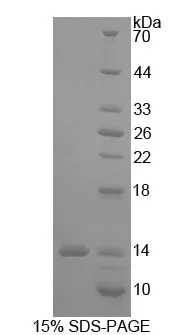 |
Greater than 97% as determined by reducing SDS-PAGE. |
靶点信息 Target Information
| 分子别名Alternative Names | SLC1A1EAAC1Solute Carrier 1 Member 1Sodium-dependent glutamate/aspartate transporter 3Excitatory amino-acid carrier 1Neuronal and epithelial glutamate transporter |
|---|---|
| 背景介绍Background | Sodium-dependent, high-affinity amino acid transporter that mediates the uptake of L-glutamate and also L-aspartate and D-aspartate. Can also transport L-cysteine. Functions as a symporter that transports one amino acid molecule together with two or three Na(+) ions and one proton, in parallel with the counter-transport of one K(+) ion. Mediates Cl(-) flux that is not coupled to amino acid transport; this avoids the accumulation of negative charges due to aspartate and Na(+) symport. Plays an important role in L-glutamate and L-aspartate reabsorption in renal tubuli. Plays a redundant role in the rapid removal of released glutamate from the synaptic cleft, which is essential for terminating the postsynaptic action of glutamate. Contributes to glutathione biosynthesis and protection against oxidative stress via its role in L-glutamate and L-cysteine transport. Negatively regulated by ARL6IP5. |
| 功能Function | Sodium-dependent, high-affinity amino acid transporter that mediates the uptake of L-glutamate and also L-aspartate and D-aspartate. Can also transport L-cysteine. Functions as a symporter that transports one amino acid molecule together with two or three Na(+) ions and one proton, in parallel with the counter-transport of one K(+) ion. Mediates Cl(-) flux that is not coupled to amino acid transport; this avoids the accumulation of negative charges due to aspartate and Na(+) symport. Plays an important role in L-glutamate and L-aspartate reabsorption in renal tubuli. Plays a redundant role in the rapid removal of released glutamate from the synaptic cleft, which is essential for terminating the postsynaptic action of glutamate. Contributes to glutathione biosynthesis and protection against oxidative stress via its role in L-glutamate and L-cysteine transport. Negatively regulated by ARL6IP5. |
| 亚细胞定位Subcellular Location | Cell membrane; Multi-pass membrane protein. Apical cell membrane; Multi-pass membrane protein. Cell junction, synapse, synaptosome. Early endosome membrane. Late endosome membrane. Recycling endosome membrane. |
| 数据库链接Databases |
基因功能参考文献50 条
- mir-26a and SLC1A1 may play a role in the Multiple Sclerosis pathogenesis, and may be potential targets for the development of new biomarkers and/or therapeutic tools. PMID: 28962897 : 28962897
- SLC1A1 and DPF3 were strongly associated with idiopathic male infertility and were significantly correlated with semen quality alterations PMID: 27232852 : 27232852
- results suggest that six common SNPs of SLC1A1 may not contribute to the development of obsessive compulsive disorder, but may contribute to certain aspect of trait empathy such as personal distress PMID: 29304071 : 29304071
- observations of EAAT3 regulation in patients is giving us insight into the endogenous function of this transporter, as well as the consequences of altered function--{REVIEW} PMID: 27233497 : 27233497
- Our study showed a lack of association between SLC1A1 variants and normal tension glaucoma in Japanese patients, suggesting that the SLC1A1 gene does not play a critical role in the development of the disorder in this patient population. PMID: 26771863 : 26771863
- Numb is a pivotal adaptor protein that mediates the subcellular localization of EAAT3 through binding the YxNxxF (where x stands for any amino acid) motif. PMID: 27358480 : 27358480
- observations provide insights into the molecular basis of hot water epilepsy and show the role of SLC1A1 variants in this intriguing neurobehavioral disorder PMID: 28324217 : 28324217
- This study demonstrated that Variations within SLC1A1 are associated with risk of epileptogenesis following posttraumatic brain injury. PMID: 27153812 : 27153812
- Lithium-sensitive GSK3ss is a powerful regulator of excitatory amino acid transporters EAAT3 and EAAT4. PMID: 27978527 : 27978527
- Data suggest that EAAC1 transporters present on NST dendrites may play a minor role if any in glutamate clearance. PMID: 25515313 : 25515313
- SPAK and OSR1 are negative regulators of EAAT3 activity PMID: 26112741 : 26112741
- Excitatory amino acid carrier 1 (EAAC1) plays a pivotal role in neuronal glutathione synthesis to maintain cellular redox homeostasis. PMID: 26007177 : 26007177
- Transport of either L-glutamate or L-selenocysteine by EAAT3 decreased intracellular pH, whereas transport of cysteine resulted in cytoplasmic alkalinization. PMID: 25275463 : 25275463
- Rs301430 is a T/C functional polymorphism that influences ago of onset in obsessive-compulsive disorder. PMID: 24768158 : 24768158
- variability within the SLC1A1 gene impacts both the presence and severity of posttraumatic stress disorder among a sample of combat-exposed veterans. PMID: 25445080 : 25445080
- Our data suggest that SLC1A1 is unlikely to be a major susceptibility gene for schizophrenia in Han Chinese PMID: 23931931 : 23931931
- Results indentify plausible candidates include non-recurrent deletions at the glutamate transporter gene SLC1A1, a CNV locus recently suggested to be involved in schizophrenia through linkage analysis, and duplications at 1p36.33 and CGNL1. PMID: 24163246 : 24163246
- internalization of EAAT3 triggered by amphetamine increases glutamatergic signaling and thus contributes to the effects of amphetamine on neurotransmission. PMID: 25033183 : 25033183
- EAAT3/EAAC1 expression is altered in pathological conditions, such as hypoxia/ischemia, multiple sclerosis, schizophrenia, and epilepsy. (Review) PMID: 24162932 : 24162932
- SLC1A1, GRIN2B, and interactions between the two may potentially confer a susceptibility to obsessive-compulsive symptoms in schizophrenia patients receiving clozapine. PMID: 23660601 : 23660601
- This study demonistrated that SLC!A1 no association with obsessive-compulsive disorder in Han Chinese population. PMID: 23411042 : 23411042
- A single-marker association study of several single-nucleotide polymorphisms in the SLC1A1 genomic region was performed. PMID: 22776887 : 22776887
- Individuals with schizophrenia carrying at least one C allele of rs35753505 (SNP8NRG221533) show decreased expression of SLC1A6 in the molecular layer of both cerebellar hemispheres, compared to individuals homozygous for the T allele. PMID: 22424243 : 22424243
- This study demonisrrated that glutamate aspartate transporter (GLAST) within the human cochlea in patient with Meniere's disease. PMID: 23850643 : 23850643
- P259R alters EAAT3 transport functions by decelerating conformational changes associated with sodium binding. PMID: 24214974 : 24214974
- isoforms negatively modulate glutamate uptake and are differentially expressed in subjects with obsessive-compulsive disorder PMID: 23695234 : 23695234
- The study provided suggestive evidence that the SLC1A1 rs10491734 was significantly associated with early-onset OCD in the Han Chinese population. PMID: 23564280 : 23564280
- revealed weak association between OCD and one of nine tested SLC1A1 polymorphisms PMID: 23606572 : 23606572
- A deletion at the SLC1A1 glutamate transporter gene originally identified as a copy number variant exclusively carried by members of a 5-generation Palauan family, was investigated. PMID: 23341099 : 23341099
- The function of the one SLC1A1 missense variant reported previously in obsessive-compulsive disorder, Thr164Ala, was characterized and found that the Ala164 allele leads to decreased Vmax and Km. PMID: 22617815 : 22617815
- Three single nucleotide polymorphisms in SLC1A1 (rs2228622, rs3780412 and rs3780413), which had been associated with second-generation antipsychotic agents-induced obsessive-compulsive symptoms, were investigated. PMID: 22531293 : 22531293
- rapid extracellular K(+) application to EAAC1 under single turnover conditions (K(+) inside) resulted in outward transient current. We propose a charge compensation mechanism, in which the C-terminal transport domain bears overall negative charge of -1.23 PMID: 22707712 : 22707712
- interaction of NCX1 and EAAC1 transporters leads to glutamate-enhanced ATP production in brain mitochondria PMID: 22479505 : 22479505
- Neutralizing aspartate 83 modifies substrate translocation of excitatory amino acid transporter 3 (EAAT3) glutamate transporters. PMID: 22532568 : 22532568
- mTOR is a novel powerful regulator of EAAT3 and may thus contribute to protection against neuroexcitotoxicity. PMID: 22483750 : 22483750
- These findings suggest the involvement of SLC1A1 in the pathogenesis of schizophrenia. PMID: 22095641 : 22095641
- This study provides suggestive evidence that DLGAP3 and its interactive effect with SLC1A1 might be involved in susceptibility to developing OC symptoms in schizophrenia patients receiving AAP treatment. PMID: 21990008 : 21990008
- genotyped an additional 111 SNPs in or near SLC1A1, covering from 9 kb upstream to 84 kb downstream of the gene at average spacing of 1.7 kb per SNP, and conducted family-based association analyses in 1,576 participants in 377 families PMID: 21445956 : 21445956
- SLC1A1 mutations leading to substitution of arginine to tryptophan at position 445 (R445W) and deletion of isoleucine at position 395 (I395del) cause dicarboxylic aminoaciduria, an autosomal recessive disorder of urinary glutamate and aspartate transport PMID: 21123949 : 21123949
- SLC1A1 alleles may have a role in obsessive-compulsive disorder PMID: 19569082 : 19569082
- Cysteine uptake by EAAC1 is important for zinc homeostasis and neuronal antioxidant function following transient cerebral ischemia. PMID: 21084597 : 21084597
- association of SNP rs301430 with severity of repetitive behaviors and anxiety in autism spectrum disorder PMID: 20155310 : 20155310
- suggests that T370S also alters the cation selectivity of this cation-binding site, as expected if T370 forms part of a cation-binding site in EAAT3. PMID: 20634426 : 20634426
- the side chain of EAAC1 Met-367 fulfills a steric role in the positioning of the substrate in the binding pocket in a step subsequent to its initial binding PMID: 20424168 : 20424168
- analysis of cation binding to the glutamate transporter EAAC1 probed with mutation of the conserved amino acid residue Thr10 PMID: 20378543 : 20378543
- PIP5K2A is a novel signaling element in the regulation of EAAT3 activity PMID: 19644675 : 19644675
- Dynamic equilibrium between coupled and uncoupled modes of a neuronal glutamate transporter PMID: 11823462 : 11823462
- data show specific localization of glutamate transporters EAAT1, EAAT2 and EAAT3 in the human placenta during development PMID: 15135231 : 15135231
- EAAT3 has a big extracellular vestibule, but does not undergo a large-scale motion to another state. Short channels connect the intracellular solution to the vestibule. Small conformational changes & glutamate uptake, occur independently in each subunit. PMID: 15716409 : 15716409
- enhanced expression of glutamate transporters in multiple sclerosis constitutes a regulatory response of glial cells to toxic levels of glutamate in the CNS during inflammation and neurodegeneration PMID: 16061389 : 16061389
蛋白复溶体积计算器缓冲液体积 = 蛋白质量 ÷ 蛋白浓度
输入任意两项,第三项自动计算 |
蛋白浓度稀释计算器初浓度 × 初体积 = 终浓度 × 终体积
输入任意三项,第四项自动计算 |



