


Recombinant Synaptic Ras GTPase Activating Protein 1 (SYNGAP1)(N-6His)
Alternative NamesRASA1; RASA5; SYNGAP; Ras/Rap GTPase-activating protein SynGAP; Neuronal RasGAP
规格参数 Specifications
| 纯度Purity | Greater than 90% as determined by reducing SDS-PAGE. |
|---|---|
| 内毒素Endotoxin | <1 EU/µg as determined by LAL test. |
| 蛋白构建Protein Construction |
6HisN 端标签-【Gly443-Asn635】序列区间
|
| Accession | Q96PV0 |
| 表达宿主Expression Host | E.coli |
| 种属Species | Homo sapiens (Human) |
| 预测分子量Predicted MW | 25.7 kDa |
| 制剂Formulation | Lyophilized from a 0.2 μm filtered solution of 20mM Tris, 150mM NaCl, pH8.0, containing 1mM EDTA, 1mM DTT, 0.01% SKL, 5% Trehalose and Proclin300. |
| 运输方式Shipping | The product is shipped with ice bag. Upon receipt, store it immediately at the temperature listed below. |
| 稳定性&储存Stability & Storage | 12 months at -20°C to -80°C in lyophilized state.6 months at -20°C to -80°C under sterile conditions after reconstitution.7-10 days at 2°C to 8°C under sterile conditions after reconstitution.Please minimize freeze-thaw cycles. |
| 复溶Reconstitution | Reconstitute in 20mM Tris, 150mM NaCl (pH8.0) to a concentration of 0.1-1.0 mg/mL. Do not vortex. |
!
本司产品仅用于科研,不用于临床诊断和治疗。
产品图片 Product Images点击图片可查看原图
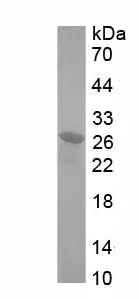 |
Greater than 90% as determined by reducing SDS-PAGE. |
靶点信息 Target Information
| 分子别名Alternative Names | RASA1RASA5SYNGAPRas/Rap GTPase-activating protein SynGAPNeuronal RasGAP |
|---|---|
| 背景介绍Background | Major constituent of the PSD essential for postsynaptic signaling. Inhibitory regulator of the Ras-cAMP pathway. Member of the NMDAR signaling complex in excitatory synapses, it may play a role in NMDAR-dependent control of AMPAR potentiation, AMPAR membrane trafficking and synaptic plasticity. Regulates AMPAR-mediated miniature excitatory postsynaptic currents. Exhibits dual GTPase-activating specificity for Ras and Rap. May be involved in certain forms of brain injury, leading to long-term learning and memory deficits. |
| 功能Function | Major constituent of the PSD essential for postsynaptic signaling. Inhibitory regulator of the Ras-cAMP pathway. Member of the NMDAR signaling complex in excitatory synapses, it may play a role in NMDAR-dependent control of AMPAR potentiation, AMPAR membrane trafficking and synaptic plasticity. Regulates AMPAR-mediated miniature excitatory postsynaptic currents. Exhibits dual GTPase-activating specificity for Ras and Rap. May be involved in certain forms of brain injury, leading to long-term learning and memory deficits. |
| 数据库链接Databases |
基因功能参考文献11 条
- De novo, heterozygous, loss-of-function mutations in SYNGAP1 cause a syndromic form of intellectual disability. PMID: 26079862 : 26079862
- This is the first description of a special electroencephalogram phenomenon (normalization with eye opening) in association with SYNGAP1 mutations. PMID: 26110312 : 26110312
- Syngap transgenic mice exhibited alterations in long-term depression and dendritic spine morphology. PMID: 26558778 : 26558778
- Phosphorylation of synaptic GTPase-activating protein (synGAP) by Ca2+/calmodulin-dependent protein kinase II (CaMKII) and cyclin-dependent kinase 5 (CDK5) alters the ratio of its GAP activity toward Ras and Rap GTPases. PMID: 25533468 : 25533468
- Reduced cognition in mutant Syngap1 transgenic mice is caused by isolated damage to developing forebrain neurons. PMID: 24945774 : 24945774
- De novo CHD2 and SYNGAP1 mutations are new causes of epileptic encephalopathies, accounting for 1.2% and 1% of cases, respectively. PMID: 23708187 : 23708187
- De novo missense mutations, p.R579X, and possibly all the other truncating mutations in SYNGAP1 result in a loss of its function, causing intellectual disability, autism, and a specific form of epilepsy. PMID: 23161826 : 23161826
- SYNGAP1 is a brain-specific protein that interacts with key components of the proteins involved in experience-dependent changes in glutamate synapses involved in learning. PMID: 21480541 : 21480541
- We provide evidence that truncating mutations in SYNGAP1 are common in nonsyndromic intellectual disability and can be also associated with autism. PMID: 21237447 : 21237447
- The C2 domain of SynGAP is essential for stimulation of the Rap GTPase reaction. PMID: 18323856 : 18323856
- Results indicate that SYNGAP1 disruption is a cause of autosomal dominant nonsyndromic mental retardation. PMID: 19196676 : 19196676
蛋白复溶体积计算器缓冲液体积 = 蛋白质量 ÷ 蛋白浓度
输入任意两项,第三项自动计算 |
蛋白浓度稀释计算器初浓度 × 初体积 = 终浓度 × 终体积
输入任意三项,第四项自动计算 |



