


Recombinant Human ZBP1 (C-6His)
Alternative NamesZ-DNA-Binding Protein 1; Tumor Stroma and Activated Macrophage Protein DLM; ZBP1; C20orf183; DLM1
规格参数 Specifications
| 纯度Purity | Greater than 95% as determined by reducing SDS-PAGE |
|---|---|
| 内毒素Endotoxin | <1 EU/µg as determined by LAL test. |
| 蛋白构建Protein Construction |
【Met1-Ser149】序列区间-6HisC 端标签
|
| Accession | Q9H171 |
| 表达宿主Expression Host | E. coli |
| 种属Species | Human |
| 预测分子量Predicted MW | 17.5 kDa |
| 制剂Formulation | Lyophilized from a 0.2 μm filtered solution of PBS, pH 7.4. |
| 运输方式Shipping | The product is shipped with ice bag. Upon receipt, store it immediately at the temperature listed below. |
| 稳定性&储存Stability & Storage | 12 months at -20°C to -80°C in lyophilized state.6 months at -20°C to -80°C under sterile conditions after reconstitution.7-10 days at 2°C to 8°C under sterile conditions after reconstitution.Please minimize freeze-thaw cycles. |
| 复溶Reconstitution | Always centrifuge tubes before opening. Do not mix by vortex or pipetting. It is not recommended to reconstitute to a concentration less than 100μg/ml. Dissolve the lyophilized protein in distilled water. Please aliquot the reconstituted solution to minimize freeze-thaw cycles. |
!
本司产品仅用于科研,不用于临床诊断和治疗。
产品图片 Product Images点击图片可查看原图
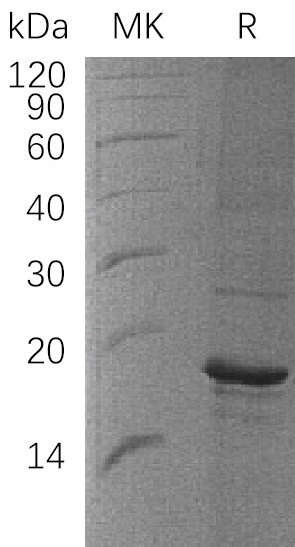 |
Greater than 90% as determined by reducing SDS-PAGE. |
靶点信息 Target Information
| 分子别名Alternative Names | Z-DNA-Binding Protein 1Tumor Stroma and Activated Macrophage Protein DLMZBP1C20orf183DLM1 |
|---|---|
| 功能Function | Key innate sensor that recognizes and binds Z-RNA structures, which are produced by a number of viruses, such as herpesvirus, orthomyxovirus or flavivirus, and triggers different forms of cell death. Once activated upon Z-RNA-binding, ZBP1 interacts with RIPK3, inducing the complementary pathways of apoptosis, necroptosis and pyroptosis. Acts as a key activator of necroptosis, a programmed cell death process in response to death-inducing TNF-alpha family members: ZBP1-dependent necroptosis involves RIPK3 stimulation, which phosphorylates and activates MLKL, triggering execution of programmed necrosis. In addition to TNF-induced necroptosis, necroptosis can also take place in the nucleus in response to orthomyxoviruses infection: ZBP1 recognizes and binds Z-RNA structures that are produced in infected nuclei by orthomyxoviruses, such as the influenza A virus (IAV), leading to ZBP1 activation, RIPK3 stimulation and subsequent MLKL phosphorylation, triggering disruption of the nuclear envelope and leakage of cellular DNA into the cytosol. ZBP1-dependent cell death in response to IAV infection promotes interleukin-1 alpha (IL1A) induction in an NLRP3-inflammasome-independent manner: IL1A expression is required for the optimal interleukin-1 beta (IL1B) production, and together, these cytokines promote infiltration of inflammatory neutrophils to the lung, leading to the formation of neutrophil extracellular traps. In some cell types, also able to restrict viral replication by promoting cell death-independent responses. In response to Zika virus infection in neurons, promotes a cell death-independent pathway that restricts viral replication: together with RIPK3, promotes a death-independent transcriptional program that modifies the cellular metabolism via up-regulation expression of the enzyme ACOD1/IRG1 and production of the metabolite itaconate. Itaconate inhibits the activity of succinate dehydrogenase, generating a metabolic state in neurons that suppresses replication of viral genomes.; (Microbial infection) In case of herpes simplex virus 1/HHV-1 infection, forms hetero-amyloid structures with HHV-1 protein RIR1/ICP6 which may inhibit ZBP1-mediated necroptosis, thereby preventing host cell death pathway and allowing viral evasion. |
| 亚细胞定位Subcellular Location | Cytoplasm. Nucleus.; [Isoform 7]: Cytoplasm. Nucleus. |
| 数据库链接Databases |
基因功能参考文献18 条
- this paper reviews the history and emergence of ZBP1 as a pathogen sensor and a central regulator of cell death and inflammatory responses PMID: 29236673 : 29236673
- PUMA promotes the cytosolic release of mitochondrial DNA and activation of the DNA sensors DAI/Zbp1 and STING, leading to enhanced RIP3 and MLKL phosphorylation in a positive feedback loop. PMID: 29581256 : 29581256
- There is a correlation between the decrease in DAI-1 receptor expression and the severity of disease progression in preeclampsia. PMID: 29127557 : 29127557
- Our results show that HSV2 is detected by a plethora of PRRs including DAI protein which trigger cytokine secretion to protect the host. PMID: 24080302 : 24080302
- DAI could function as a DNA sensor and a regulator in DNA-induced macrophage M2b polarization and lupus nephritis. PMID: 23553627 : 23553627
- Collectively, these results demonstrate that DAI can suppress HSV-1 growth independent of DNA sensing through mechanisms involving suppression of viral genomes and regulation of ICP0. PMID: 23283962 : 23283962
- The data of this study suggest that RNA-binding proteins can be used as a tool to identify the post-transcriptional regulation of gene expression in the establishment and function of neural circuits involved in addiction behaviors. PMID: 22240322 : 22240322
- these data indicate that ZBP1 may function as an adapter to export the Ro/Y3 RNA complex from nuclei. PMID: 22114317 : 22114317
- Solution structure of the Zbeta domain of human DNA-dependent activator of IFN-regulatory factors and its binding modes to B- and Z-DNAs. PMID: 21471454 : 21471454
- hZbeta(DAI) binds to Z-DNA via an active-di B-Z transition mechanism. PMID: 21296080 : 21296080
- These results suggest that activation of DAI might contribute to augment HIV-1 replication through DAI- NF-kappaB pathway. PMID: 20599623 : 20599623
- identify ZBP1 as being essential for IRF3 activation and interferon beta expression triggered by HCMV, as well as being sufficient to enhance HCMV-stimulated beta interferon transcription and secretion. PMID: 19846511 : 19846511
- molecular cloning and structure analysis PMID: 11842111 : 11842111
- Z-DNA binding activities of two Zalpha domains in the human ZBP1, hZalpha(ZBP1) and hZbeta(ZBP1)were characterized. PMID: 16448869 : 16448869
- In conclusion, intracellular bacteria and cytosolic poly(dA-dT) activate IFNbeta responses in different human cells without requiring human ZBP1. PMID: 18771559 : 18771559
- DAI binds to and colocalizes with endogenous adaptor receptor-interacting protein kinase (RIP)1 at characteristic cytoplasmic granules. PMID: 18941233 : 18941233
- binding 2 DAIs to 1 dsDNA brings about dimerization of DAI that might facilitate DNA-mediated innate immune activation. PMID: 19095800 : 19095800
- These data suggest that repression of ZBP1 by blocking beta-catenin binding at the ZBP1 promoter deregulates its associated mRNAs, leading to the phenotypic changes of breast cancers. PMID: 19461076 : 19461076
蛋白复溶体积计算器缓冲液体积 = 蛋白质量 ÷ 蛋白浓度
输入任意两项,第三项自动计算 |
蛋白浓度稀释计算器初浓度 × 初体积 = 终浓度 × 终体积
输入任意三项,第四项自动计算 |



