


Recombinant Human USP14 (N-6His)
Alternative NamesUbiquitin Carboxyl-Terminal Hydrolase 14; Deubiquitinating Enzyme 14; Ubiquitin Thioesterase 14; Ubiquitin-Specific-Processing Protease 14; USP14; TGT
规格参数 Specifications
| 纯度Purity | Greater than 95% as determined by reducing SDS-PAGE |
|---|---|
| 内毒素Endotoxin | <1 EU/µg as determined by LAL test. |
| 蛋白构建Protein Construction |
6HisN 端标签-【Asp91-Gln494】序列区间
|
| Accession | P54578 |
| 表达宿主Expression Host | E. coli |
| 种属Species | Human |
| 预测分子量Predicted MW | 48.45 kDa |
| 制剂Formulation | Lyophilized From a 0.2 μm filtered solution of 20mM Tris-HCl, 100mM NaCl, 20% Glycerol, pH 8.0. |
| 运输方式Shipping | The product is shipped with ice bag. Upon receipt, store it immediately at the temperature listed below. |
| 稳定性&储存Stability & Storage | 12 months at -20°C to -80°C in lyophilized state.6 months at -20°C to -80°C under sterile conditions after reconstitution.7-10 days at 2°C to 8°C under sterile conditions after reconstitution.Please minimize freeze-thaw cycles. |
!
本司产品仅用于科研,不用于临床诊断和治疗。
产品图片 Product Images点击图片可查看原图
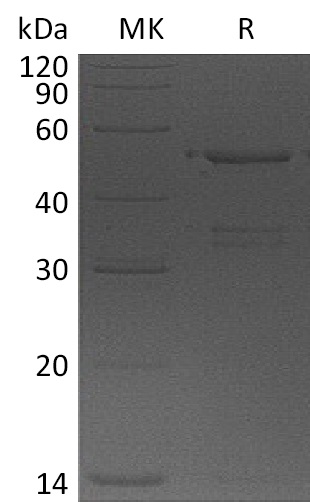 |
Greater than 85% as determined by reducing SDS-PAGE. |
靶点信息 Target Information
| 分子别名Alternative Names | Ubiquitin Carboxyl-Terminal Hydrolase 14Deubiquitinating Enzyme 14Ubiquitin Thioesterase 14Ubiquitin-Specific-Processing Protease 14USP14TGT |
|---|---|
| 功能Function | Proteasome-associated deubiquitinase which releases ubiquitin from the proteasome targeted ubiquitinated proteins. Ensures the regeneration of ubiquitin at the proteasome. Is a reversibly associated subunit of the proteasome and a large fraction of proteasome-free protein exists within the cell. Required for the degradation of the chemokine receptor CXCR4 which is critical for CXCL12-induced cell chemotaxis. Serves also as a physiological inhibitor of endoplasmic reticulum-associated degradation (ERAD) under the non-stressed condition by inhibiting the degradation of unfolded endoplasmic reticulum proteins via interaction with ERN1. Indispensable for synaptic development and function at neuromuscular junctions (NMJs). Plays a role in the innate immune defense against viruses by stabilizing the viral DNA sensor CGAS and thus inhibiting its autophagic degradation. |
| 亚细胞定位Subcellular Location | Cytoplasm. Cell membrane; Peripheral membrane protein. |
| 数据库链接Databases |
基因功能参考文献30 条
- By displacing USP14, TRIM11 changes proteasome composition and suppresses both catalytic and non-catalytic effects of USP14 PMID: 29581427 : 29581427
- Usp14 and Ube3c cycle together on and off proteasomes, and the presence of ubiquitinated substrates promotes their association. This mechanism enables proteasome activity to adapt to the supply of substrates. PMID: 28396413 : 28396413
- Study detected elevated USP14 expression at both mRNA and protein levels, and was significantly associated with distant metastasis. PMID: 28509417 : 28509417
- These findings suggested that USP14 induces NF-kappaB activity and ERK1/2 phosphorylation triggered by microbial infection. PMID: 28364380 : 28364380
- Ubiquitin-specific protease 14 regulates cell proliferation and apoptosis in oral squamous cell carcinoma PMID: 27592452 : 27592452
- our report demonstrates significant value in targeting USP14/UCHL5 with VLX1570 in drug-resistant Waldenstrom macroglobulinemia (WM) and carries a high potential for clinical translation PMID: 27813535 : 27813535
- USP14 promotes prostate cancer progression. PMID: 28151478 : 28151478
- without a ubiquitinated substrate present, Usp14 suppresses multiple proteasomal activities, especially basal ATP consumption and degradation of non-ubiquitinated proteins. These allosteric effects thus reduce ATP hydrolysis by inactive proteasomes and nonspecific proteolysis and enhance proteasomal specificity for ubiquitinated proteins. PMID: 28416611 : 28416611
- USP14 regulates autophagy by negatively controlling K63 ubiquitination of Beclin 1 PMID: 27542828 : 27542828
- USP14 plays an important role in the progression and metastasis of esophageal squamous cell carcinoma. PMID: 27629392 : 27629392
- USP14 participates in CAM-DR of MM through acting as a bridge between Bcl-xl apoptotic pathway and Wnt-signaling pathways and may be represented as a good candidate for pursuing clinical trials in MM. PMID: 26710889 : 26710889
- Results show that USP14 mRNA is overexpressed in hepatocellular carcinoma (HCC) tissues and inversely correlates with miR-4782-3p level which binds to USP14 3'UTR to regulate its expression. PMID: 26782643 : 26782643
- Results found USP14 amplification and overexpression in many different cancers. Its overexpression in low-expression cell lines promoted cell proliferation and migration, whereas its downregulation suppressed tumor cell proliferation, increased apoptosis rate, and decreased cell migration and invasion suggesting an oncogenic role in various types of cancer. PMID: 26938858 : 26938858
- Increased USP14 expression in patients with breast cancer was associated with a poorer prognosis. PMID: 26712154 : 26712154
- Akt-mediated phosphorylation of USP14 at Ser432, which normally blocks its catalytic site in the inactive conformation, activates its deubiquitinating activity in vitro and in cells. PMID: 26523394 : 26523394
- our findings suggested that USP14 is involved in the progression of hepatocellular carcinoma(HCC) and may be a useful therapeutic target in HCC PMID: 26397990 : 26397990
- Cell surface ubiquitination precedes endocytosis, after which USP14 acts as an ubiquitin-binding protein that targets the ubiquitinated GABA B receptor to lysosomal degradation and promotes its deubiquitination. PMID: 26817839 : 26817839
- USP14 shows a marked preference for ubiquitin-cyclin B conjugates that carry more than one ubiquitin modification or chain PMID: 27074503 : 27074503
- our findings suggest that USP14 is involved in the progression of epithelial ovarian cancer PMID: 25429837 : 25429837
- Downregulation of USP14 expression arrested the cell cycle, which may be related to beta-catenin degradation. PMID: 23702845 : 23702845
- b-AP15 is an inhibitor of deubiquitylating enzyme USP14 and UCHL5 induces apoptosis in multiple myeloma and overcomes bortezomib resistance. PMID: 24319254 : 24319254
- overexpression of HA-USP14 increased the LPS-, TNFalpha-, or Escherichia coli-induced IL-8 release in human lung epithelial cells. PMID: 23615914 : 23615914
- the decrease in proteolysis of proteasomal substrates during aging is independent of the increased USP14 activity and that the reciprocal regulation of USP14 and proteasomal catalytic activity may be necessary to maintain cellular ubiquitin homeostasis. PMID: 23291607 : 23291607
- High Ubiquitin-specific protease 14 expression associated with intrahepatic cholangiocarcinoma cell differentiation. PMID: 21627382 : 21627382
- the catalytic cleft leading to the active site of USP14 is blocked by two surface loops. Binding by ubiquitin induces a significant conformational change thereby allowing access of the ubiquitin C-terminus to the active site. PMID: 16211010 : 16211010
- Results show the overall survival rate was worse in patients with a high USP14/TGT60 kD expression level and suggest that USP14/TGT60 kD also controls the fate of proteins that regulate tumor invasion and metastasis. PMID: 16465409 : 16465409
- Neuronal expression of full-length USP14 is able to restore the levels of monomeric ubiquitin in the brains of transgenic ataxia mice. PMID: 17079671 : 17079671
- USP14 were over-expressed in ovarian serous cystadenocarcinoma tissues, suggesting that the activity of ubiquitin-proteasome system is obviously enhanced in ovarian cancer. PMID: 17553343 : 17553343
- These findings suggest that USP14 is a novel player in the unfolded protein response by serving as a physiological inhibitor of ER-associated degradation under the non-stressed condition. PMID: 19135427 : 19135427
- Data from transgenic mice define a critical role for Usp14 at mammalian synapses and suggest a requirement for local ubiquitin recycling by the proteasome to control the development and function of neuromuscular junctions. PMID: 19726649 : 19726649
蛋白复溶体积计算器缓冲液体积 = 蛋白质量 ÷ 蛋白浓度
输入任意两项,第三项自动计算 |
蛋白浓度稀释计算器初浓度 × 初体积 = 终浓度 × 终体积
输入任意三项,第四项自动计算 |



