


Recombinant Human TIM (N-6His)
Alternative NamesTriosephosphate Isomerase; TIM; Triose-Phosphate Isomerase; TPI1; TPI
规格参数 Specifications
| 纯度Purity | Greater than 95% as determined by reducing SDS-PAGE |
|---|---|
| 内毒素Endotoxin | <1 EU/µg as determined by LAL test. |
| 蛋白构建Protein Construction |
6HisN 端标签-【Met1-Gln249】序列区间
|
| Accession | P60174 |
| 表达宿主Expression Host | E. coli |
| 种属Species | Human |
| 预测分子量Predicted MW | 28.8 kDa |
| 制剂Formulation | Lyophilized From a 0.2 μm filtered solution of 20mM Tris-HCl, 1mM DTT, 10% Glycerol, pH 8.0. |
| 运输方式Shipping | The product is shipped with ice bag. Upon receipt, store it immediately at the temperature listed below. |
| 稳定性&储存Stability & Storage | 12 months at -20°C to -80°C in lyophilized state.6 months at -20°C to -80°C under sterile conditions after reconstitution.7-10 days at 2°C to 8°C under sterile conditions after reconstitution.Please minimize freeze-thaw cycles. |
!
本司产品仅用于科研,不用于临床诊断和治疗。
产品图片 Product Images点击图片可查看原图
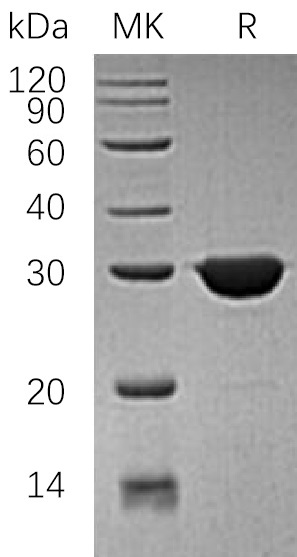 |
Greater than 95% as determined by reducing SDS-PAGE. |
靶点信息 Target Information
| 分子别名Alternative Names | Triosephosphate IsomeraseTIMTriose-Phosphate IsomeraseTPI1TPI |
|---|---|
| 功能Function | Triosephosphate isomerase is an extremely efficient metabolic enzyme that catalyzes the interconversion between dihydroxyacetone phosphate (DHAP) and D-glyceraldehyde-3-phosphate (G3P) in glycolysis and gluconeogenesis.; It is also responsible for the non-negligible production of methylglyoxal a reactive cytotoxic side-product that modifies and can alter proteins, DNA and lipids. |
| 亚细胞定位Subcellular Location | Cytoplasm. |
| 数据库链接Databases |
基因功能参考文献33 条
- Disease-associated variants change well-conserved residues in the protein's sequence and affect protein stability. PMID: 28341520 : 28341520
- A guide to the effects of a large portion of the residues of triosephosphate isomerase on catalysis, stability, druggability, and human disease has been presented. (Review) PMID: 28378917 : 28378917
- Results revealed that TPI expression might be considered as a novel prognostic factor to evaluate gastric cancer patients' survival PMID: 28489783 : 28489783
- TPI1 functions as a tumor suppressor in hepatocellular carcinoma and might serve as a potential therapeutic target for the treatment of HCC PMID: 27908734 : 27908734
- our findings are the first to identify, to our knowledge, a functional synaptic defect in TPI deficiency derived from molecular changes in the TPI dimer interface. PMID: 27031109 : 27031109
- Polyvinylpyrrolidone stabilised silver nanoparticles (60 nM; 2-6 nm diameter) selectively inhibited PfTIM with a 7-fold decrease in enzyme catalytic efficiency (K(cat)/K(m)) over hTIM. PMID: 26353595 : 26353595
- results suggest amyloid-beta oligomers induce neuronal death by triggering methylglyoxal(MG) production; increased release of MG is a direct consequence of triosephosphate isomerase nitrotyrosination due to amyloid-beta peptide action at the 2 tyrosines associated with the catalytic center PMID: 24614897 : 24614897
- TPI-PEP co-crystal structure, demonstrating that PEP directly binds into the catalytic pocket of TPI. PMID: 24598263 : 24598263
- E104D mutant is highly susceptible to proteolysis, which in all likelihood contributes to the pathogenesis of enzymopathy. In addition, the proteolysis data on wild type HsTIM illustrate an asymmetric conduct of the two monomers. PMID: 24056040 : 24056040
- Data suggest that exchange reactions during gluconeogenesis catalyzed by triose-phosphate isomerase and transaldolase do not differ between subjects with type 2 diabetes and control subjects under fasting or hyperglycemic conditions. PMID: 23736541 : 23736541
- we review the relationship between modified TPI and Alzheimer disease (AD), highlighting the relevance of this protein in AD pathology PMID: 23233058 : 23233058
- study found promoter SNPs of CKB and TPI1 were weakly associated with schizophrenia;in addition, IFNG polymorphisms were associated with schizophrenia; results suggest that IFNG and proteins affected by IFNG may play a role in the pathogenesis of schizophrenia PMID: 22623148 : 22623148
- [Review] The activity of glycolytic enzyme TPI reveals a mechanistic link between energy metabolism and age-related proteostatic dysfunction which can suppress generation of altered proteins that characterize the aged phenotype in cells and tissues. PMID: 21651995 : 21651995
- A patient with triosephosphate isomerase-deficiency was found to be homozygous for a Val231Met mutation. PMID: 21215915 : 21215915
- A proteomic approach for identification and localization of the pericellular components of chondrocytes. PMID: 21698479 : 21698479
- structural changes rather than abnormal catalysis may play an important role in the clinical manifestations of TPI deficiency; the postulated high aggregation ability of the unstable Glu104Asp mutant would lead to more serious symptoms PMID: 20546019 : 20546019
- TPI1 were up-regulated with the malignancy of prostate cancer cell lines and have their potential as serum biomarkers for indicating the developmental stage of prostate cancer. PMID: 20233700 : 20233700
- of two previously undescribed mutations: c.722 T>C (Phe240Ser) and c.28 insG; each of the two unrelated patients showed the new mutation in compound heterozygosity with the most common variant Glu104Asp, resulting in a very severe clinical pattern. PMID: 20374271 : 20374271
- the dimerization behavior of TPI is influenced by the particular mutations investigated, and by the use of a potential alternative translation initiation site in the TPI gene PMID: 17183658 : 17183658
- kinetic, thermodynamic, structural and ultrastructural data for characterization of mutant isomerase structures and for the TPI-related metabolic processes in normal and deficient cells PMID: 12023819 : 12023819
- Minor structural changes in a mutated human melanoma antigen (TPI) correspond to dramatically enhanced stimulation of a CD4+ tumor-infiltrating lymphocyte line. PMID: 12051920 : 12051920
- A patient with triosephosphate isomerase (TPI) deficiency exhibited worsening of abnormal involuntary movements of the dystonic type and developed psychiatric symptoms while on selegiline. PMID: 14743370 : 14743370
- IgG-type anti-TPI autoantibodies were detected in 24.7% of the serum samples and 24.1% of the synovial fluid samples from the patients with osteoarthritis PMID: 15146421 : 15146421
- anti-TPI antibodies are closely associated with neuropsychiatric lupus PMID: 15358119 : 15358119
- We found that a low TPI activity in the mutant cells (lower than predicted from the protein level and specific activity of the purified recombinant enzyme) is coupled with an increase in the activities of glycolytic kinases PMID: 16086671 : 16086671
- Mutations causing TPI deficiency in humans are characterized by progressive neurological dysfunction, neurodegeneration, and early death. PMID: 17008404 : 17008404
- TPI and GAPDH may be candidate Ags for an autoimmune response to neurons and axons in multiple sclerosis. PMID: 17015754 : 17015754
- anti-TPI form immune complexes in CSF and contribute to the pathogenesis of neuropsychiatric lupus by activating the complement system PMID: 17064784 : 17064784
- Triosephosphate isomerase (TPI), a glycolytic pathway enzyme, was identified as a downregulated protein in SGC7901/VCR cells PMID: 18309519 : 18309519
- TPI variants occur less frequent than expected and inactive alleles are not enriched in German centenarians PMID: 18510744 : 18510744
- human triosephosphate isomerase mutation E104D is related to alterations of a conserved water network at the dimer interface PMID: 18562316 : 18562316
- Population samples from Angola, Mozambique and S. Tome e Principe has 3 haplotypes of the TPI gene promoter variants -5A-8G-24T,-5G-8G-24T and -5G-8A-24T in malaria-infected individuals. PMID: 18792062 : 18792062
- This protein has been found differentially expressed in the Wernicke's Area from patients with schizophrenia. PMID: 19405953 : 19405953
蛋白复溶体积计算器缓冲液体积 = 蛋白质量 ÷ 蛋白浓度
输入任意两项,第三项自动计算 |
蛋白浓度稀释计算器初浓度 × 初体积 = 终浓度 × 终体积
输入任意三项,第四项自动计算 |



