


Recombinant Human PEA15
Alternative NamesAstrocytic Phosphoprotein PEA-15; 15 kDa Phosphoprotein Enriched in Astrocytes; Phosphoprotein Enriched in Diabetes; PED; PEA15
规格参数 Specifications
| 纯度Purity | Greater than 95% as determined by reducing SDS-PAGE |
|---|---|
| 内毒素Endotoxin | <1 EU/µg as determined by LAL test. |
| 蛋白构建Protein Construction |
【Met1-Ala130】序列区间
|
| Accession | Q15121 |
| 表达宿主Expression Host | E. coli |
| 种属Species | Human |
| 预测分子量Predicted MW | 15.3 kDa |
| 制剂Formulation | Lyophilized from a 0.2 μm filtered solution of 20mM PB, 150mM NaCl, pH 7.4. |
| 运输方式Shipping | The product is shipped with ice bag. Upon receipt, store it immediately at the temperature listed below. |
| 稳定性&储存Stability & Storage | 12 months at -20°C to -80°C in lyophilized state.6 months at -20°C to -80°C under sterile conditions after reconstitution.7-10 days at 2°C to 8°C under sterile conditions after reconstitution.Please minimize freeze-thaw cycles. |
| 复溶Reconstitution | Always centrifuge tubes before opening. Do not mix by vortex or pipetting. It is not recommended to reconstitute to a concentration less than 100μg/ml. Dissolve the lyophilized protein in distilled water. Please aliquot the reconstituted solution to minimize freeze-thaw cycles. |
!
本司产品仅用于科研,不用于临床诊断和治疗。
产品图片 Product Images点击图片可查看原图
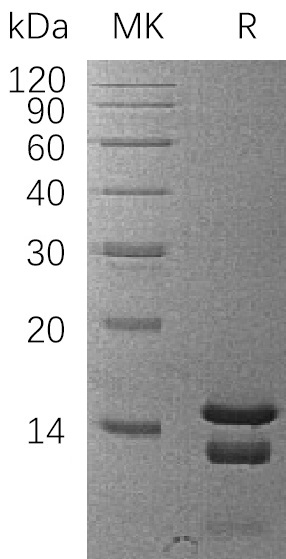 |
Greater than 95% as determined by reducing SDS-PAGE. |
靶点信息 Target Information
| 分子别名Alternative Names | Astrocytic Phosphoprotein PEA-1515 kDa Phosphoprotein Enriched in AstrocytesPhosphoprotein Enriched in DiabetesPEDPEA15 |
|---|---|
| 功能Function | Blocks Ras-mediated inhibition of integrin activation and modulates the ERK MAP kinase cascade. Inhibits RPS6KA3 activities by retaining it in the cytoplasm. Inhibits both TNFRSF6- and TNFRSF1A-mediated CASP8 activity and apoptosis. Regulates glucose transport by controlling both the content of SLC2A1 glucose transporters on the plasma membrane and the insulin-dependent trafficking of SLC2A4 from the cell interior to the surface. |
| 亚细胞定位Subcellular Location | Cytoplasm. Note=Associated with microtubules. |
| 数据库链接Databases |
基因功能参考文献50 条
- Data suggest that PED has a prominent role in HCC biology. It acts particularly on promoting cell migration and confers resistance to sorafenib treatment. PMID: 29072691 : 29072691
- PP4 regulates breast cancer cell survival and identifies a novel PP4c-PEA15 signalling axis in the control of breast cancer cell survival. PMID: 27317964 : 27317964
- PEA15 expression was not significantly correlated with ovarian cancer antineoplastic drug resistance. PMID: 27669502 : 27669502
- Data suggest the role of the phospholipase C epsilon-Protein kinase D-PEA15 protein-ribosomal S6 kinase-IkappaB-NF-kappa B pathway in facilitating inflammation and inflammation-associated carcinogenesis in the colon. PMID: 27053111 : 27053111
- Integrin alpha5beta1 and p53 convergent pathways in the control of anti-apoptotic proteins PEA-15 and survivin in high-grade glioma. PMID: 26470725 : 26470725
- High PED expression is associated with esophageal carcinoma. PMID: 25775393 : 25775393
- The nuclear translocation of SApErk1/ 2 apart from PEA-15 as an important mechanism to reverse senescence phenotype. PMID: 25725291 : 25725291
- Latent HCMV infection of CD34 + cells protects cells from FAS-mediated apoptosis through the cellular IL-10/PEA-15 pathway. PMID: 25957098 : 25957098
- New therapeutic targets based around PEA-15 and its associated interactions are now being uncovered and could provide novel avenues for treatment strategies in multiple diseases. PMID: 24657708 : 24657708
- PED/PEA-15 overexpression is sufficient to block hydrogen peroxide-induced apoptosis in Ins-1E cells through a PLD-1 mediated mechanism PMID: 25489735 : 25489735
- Omi/HtrA2 overexpression promotes hepatocellular carcinoma cell apoptosis and the ped/pea-15 expression level causes this difference of the Omi/HtrA2 pro-apoptotic marker in the various hepatocellular carcinoma cell lines PMID: 25484138 : 25484138
- Results suggest that neurochemical adaptations of brain FADD, as well as its interaction with PEA-15, could play a major role to counteract the known activation of the mitochondrial apoptotic pathway in major depression PMID: 25075716 : 25075716
- Data show that phosphoprotein enriched in astrocytes of 15 kDa (PEA-15) influences dephosphorylation of epidermal growth factor receptor (EGFR) via extracellular signal-regulated kinases ERK1/2 sequestration in the cytoplasm. PMID: 25796184 : 25796184
- Tumor suppressor PEA15 is a regulator of genome integrity and is an integral component of the DNA damage response pathway. PMID: 24710276 : 24710276
- Up-regulated chaperone-mediated autophagy activity characteristic of most types of cancer cell enhances oncogenesis by shifting the balance of PED function toward tumor promotion. PMID: 24477641 : 24477641
- Our findings highlight the importance of pPEA-15 as a promising target for improving the efficacy of paclitaxel-based therapy in ovarian cancer. PMID: 23543364 : 23543364
- PEA-15 binding protects ERK2 from dephosphorylation, thus setting the stage for immediate ERK activity upon its release from the PEA-15 inhibitory complex PMID: 23575685 : 23575685
- study demonstrates that the PEA-15 protein decreases proliferation, clonogenicity, and invasiveness, but increases resistance to apoptosis in colorectal carcinoma cells PMID: 23481023 : 23481023
- The article hypothesizes that only unphosphorylated PEA-15 can act as a tumor-suppressor and that phosphorylation alters the interaction with binding partners to promote tumor development. PMID: 22694972 : 22694972
- NMR chemical shift perturbation and backbone dynamic studies at the fast ps-ns timescale of PED/PEA-15, in its free form and in the complex with ERK2. PMID: 22820249 : 22820249
- The 67 kD laminin receptor is a novel PED/PEA-15 interacting protein. PED/PEA-15 overexpression increases 67LR-mediated cell adhesion and migration to laminin and extracellular matrix invasion. PMID: 21895963 : 21895963
- the solution death effector domain (DED) structure of the PED/PEA-15 protein, a representative member of DED subfamily, using traditional NMR restraints with the addition of residual dipolar coupling restraints was refined. PMID: 22732408 : 22732408
- PEA15 impairs cell migration and correlates with clinical features predicting good prognosis in neuroblastoma PMID: 22213050 : 22213050
- Data show that knockdown of PEA-15 expression resulted in reversal of selumetinib-sensitive cells to resistant cells, implying that PEA-15 contributes to selumetinib sensitivity. PMID: 22144664 : 22144664
- Vitamin D3 signalling in the brain enhances the function of phosphoprotein enriched in astrocytes--15 kD (PEA-15) PMID: 19382910 : 19382910
- The protective effect of melatonin is likely mediated, in part, by inhibition of peroxynitrate-mediated nitrosative stress, which in turn relieves imbalance of mitochondrial HtrA2-PED signaling and endothelial cell death. PMID: 21198825 : 21198825
- There was no significant difference in the frequency of three marker haplotype in the PEA15 gene in patient with schizophrenia. PMID: 20537721 : 20537721
- The expressions of PED/PEA-15 and XIAP are elevated in hepatocellular carcinoma as compared with adjacent tissues and normal tissues. PMID: 20979872 : 20979872
- PED/PEA-15 modulates Coxsackievirus-adenovirus receptor expression and adenoviral entry, by sequestering ERK1/2. PMID: 20406097 : 20406097
- provide molecular basis of the PED/PEA-15 functional interactions and detailed surface for the design and development of PED/PEA-15 binders PMID: 20825483 : 20825483
- Data show that PED and Rac1 interact and that this interaction modulates cell migration/invasion processes in cancer cells through ERK1/2 pathway. PMID: 20648624 : 20648624
- The results show that HNF-4alpha serves as a scaffold protein for histone deacetylase activities, thereby inhibiting liver expression of genes including PED. PMID: 20396999 : 20396999
- PEA-15 promotes autophagy in glioma cells in a JNK-dependent manner PMID: 20452983 : 20452983
- Data show that PEA-15 prevents ERK1/2 localization to the plasma membrane, thereby inhibiting ERK1/2-dependent threonine phosphorylation of FRS2alpha to promote activation of the ERK1/2 MAP kinase pathway. PMID: 20032303 : 20032303
- Results suggest that PEA-15 expression is likely to be associated with the tumorigenesis of alignant pleural mesothelioma. PMID: 19771552 : 19771552
- role of mitogen-activated protein kinase family members in anti-apoptotic function PMID: 11790785 : 11790785
- role in modulating tumor necrosis factor-related apoptosis-inducing ligand-induced death-inducing signaling complex PMID: 11976344 : 11976344
- interaction with p90 ribosomal S6 kinase isoenzyme regulates its activity PMID: 12796492 : 12796492
- phosphorylation by Akt regulates the antiapoptotic function of PED/PEA-15 at least in part by controlling the stability of PED/PEA-15 PMID: 12808093 : 12808093
- apoptosis following Omi/HtrA2 mitochondrial release is mediated by reduction in ped/pea-15 cellular levels PMID: 15328349 : 15328349
- PEA-15 is inhibited by adenovirus E1A and has a role in ERK nuclear export and Ras-induced senescence PMID: 15331596 : 15331596
- The mechanism controlling PEA-15 binding to ERK/MAPK or FADD, and its subsequent role in cell proliferation and apoptosis is reported. PMID: 15916534 : 15916534
- Raised expression of the antiapoptotic protein pea-15 increases susceptibility to chemically induced skin tumor development PMID: 16044159 : 16044159
- Human breast cancer cells express high levels of PED and that AKT activity regulates PED protein levels. AKT-dependent increase of PED expression levels represents a key molecular mechanism for chemoresistance in breast cancer. PMID: 16061647 : 16061647
- cytoplasmic sequestration of the activated form of ERK by PEA15 enables the action of E1A in ovarian neoplasms PMID: 16170361 : 16170361
- Akt overactivation prevents the nuclear translocation of ERK1/2 and the AngII-induced proliferation through interaction with and stabilization of endogenous PEA-15. PMID: 16822839 : 16822839
- These data reveal a new function for PEA-15 in the inhibitory control of astrocyte motility through a PKC delta-dependent pathway involving the constitutive expression of a catalytic fragment of PKC delta. PMID: 16987961 : 16987961
- PEA15 overexpression represents a common defect in first degree relatives of patients with type 2 diabetes and is correlated with reduced insulin sensitivity in these individuals. PMID: 17021921 : 17021921
- TPA increases PED/PEA-15 expression at the post-translational level by inducing phosphorylation at serine 116 and preventing ubiquitinylation and proteosomal degradation PMID: 17227770 : 17227770
- In addition to sequestering protein kinases ERK1/2 in the cytoplasm, PEA-15 has the potential to modulate the activity of ERK2 in cells by competing directly with proteins that contain D-recruitment sites. PMID: 17658892 : 17658892
蛋白复溶体积计算器缓冲液体积 = 蛋白质量 ÷ 蛋白浓度
输入任意两项,第三项自动计算 |
蛋白浓度稀释计算器初浓度 × 初体积 = 终浓度 × 终体积
输入任意三项,第四项自动计算 |



