


| 纯度Purity | Greater than 95% as determined by reducing SDS-PAGE. |
|---|---|
| 内毒素Endotoxin | Please contact with the lab for this information |
| 蛋白构建Protein Construction |
【Gly21-Val142】序列区间
|
| Accession | P28325 |
| 表达宿主Expression Host | E.coli |
| 种属Species | Homo sapiens (Human) |
| 预测分子量Predicted MW | 17.5 kDa |
| 制剂Formulation | Lyophilized from a 0.2 μm filtered solution of PBS, pH7.4, containing 0.01% SKL, 1mM DTT, 5% Trehalose and Proclin300. |
| 运输方式Shipping | The product is shipped with ice bag. Upon receipt, store it immediately at the temperature listed below. |
| 稳定性&储存Stability & Storage | 12 months at -20°C to -80°C in lyophilized state.6 months at -20°C to -80°C under sterile conditions after reconstitution.7-10 days at 2°C to 8°C under sterile conditions after reconstitution.Please minimize freeze-thaw cycles. |
| 复溶Reconstitution | Reconstitute in 10mM PBS (pH7.4) to a concentration of 0.1-1.0 mg/mL. Do not vortex. |
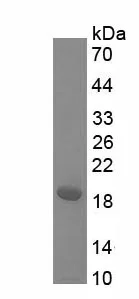 |
Greater than 95% as determined by reducing SDS-PAGE. |
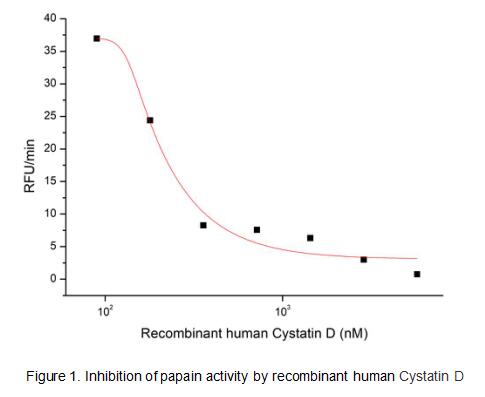 |
Cystatin D is a member of family 2 of the cystatin superfamily. In contrast to other members of family 2, Cystatin D has restricted tissue distribution and has been found only in saliva and tears. Two allelic variants (Arg46 and Cys46) are known in the human protein and they are not significantly different in their inhibitory activity against papain and cathepsins B, H, L and S. Recombinant Human Cystatin D corresponds to the Arg46 variant. The functions of Cystatin D are largely unknown. However, Cystatin D has been shown to inhibit coronavirus replication at its physiological concentration (0.12 1.9 μM) and has been suggested to play a protective role against proteases present in the oral cavity. The activity of recombinant human Cystatin D was measured by its ability to inhibit papain cleavage of a fluorogenic peptide substrate Z-FR-AMC in the assay buffer 50 mM Tris, pH 7.0. Papain was diluted to 500 ug/ml in activation buffer 50 mM Tris, 5 mM DTT, pH 7.0 and incubated at room temperature for 15 minutes. The activated papain was diluted to 100 ug/ml in the assay buffer and 20 ul different concentrations of recombinant human Cystatin D (MW: 17.45 KD) was incubated with 20 ul 100 ug/ml papain at 37 ℃ for 10 minutes. Loading 50 µL of the incubated mixtures which were diluted five-fold in assay buffer into empty wells of a plate, and start the reaction by adding 50 µL of 200 µM substrate. Include a substrate blank containing 50 µL of assay buffer and 50 µL of 200 µM substrate. Then read at excitiation and emission wavelengths of 380 nm and 460 nm, respectively, in kinetic mode for 5 minutes. The result was shown in Figure 1 and it was obvious that recombinant human Cystatin D significantly decreased papain activity. The inhibition IC50 was <200 nM. |
| 分子别名Alternative Names | Cystatin D |
|---|---|
| 背景介绍Background | Cysteine proteinase inhibitor that possibly plays a protective role against proteinases present in the oral cavity. The order of preference for inhibition is cathepsin S > cathepsin H > cathepsin L > cathepsin B. |
| 功能Function | Cysteine proteinase inhibitor that possibly plays a protective role against proteinases present in the oral cavity. The order of preference for inhibition is cathepsin S > cathepsin H > cathepsin L > cathepsin B. |
| 亚细胞定位Subcellular Location | Secreted. |
| 数据库链接Databases |
基因功能参考文献4 条
- Results imply CST5 as an important mediator of tumor suppression by p53 in colorectal cancer. PMID: 26158294 : 26158294
- These results support an unanticipated role of cystatin D in the cell nucleus, controlling the transcription of specific genes involved in crucial cellular functions, which may mediate its protective action in colon cancer. PMID: 26364852 : 26364852
- Compared with its homologues, cystatin D presents an unusual inhibition profile with a preferential inhibition cathepsin S > cathepsin H > cathepsin L and no inhibition of cathepsin B or pig legumain. PMID: 15728581 : 15728581
- Cystatin D is a candidate tumor suppressor gene induced by vitamin D in human colon cancer cells. PMID: 19662683 : 19662683
蛋白复溶体积计算器缓冲液体积 = 蛋白质量 ÷ 蛋白浓度
输入任意两项,第三项自动计算 |
蛋白浓度稀释计算器初浓度 × 初体积 = 终浓度 × 终体积
输入任意三项,第四项自动计算 |



