


| 纯度Purity | Greater than 80% as determined by reducing SDS-PAGE. |
|---|---|
| 内毒素Endotoxin | Please contact with the lab for this information |
| 蛋白构建Protein Construction |
【Gly25-Gln131】序列区间
|
| Accession | Q16674 |
| 表达宿主Expression Host | E.coli |
| 种属Species | Homo sapiens (Human) |
| 预测分子量Predicted MW | 16.4 kDa |
| 制剂Formulation | Lyophilized from a 0.2 μm filtered solution of PBS, pH7.4, containing 0.01% SKL, 1mM DTT, 5% Trehalose and Proclin300. |
| 运输方式Shipping | The product is shipped with ice bag. Upon receipt, store it immediately at the temperature listed below. |
| 稳定性&储存Stability & Storage | 12 months at -20°C to -80°C in lyophilized state.6 months at -20°C to -80°C under sterile conditions after reconstitution.7-10 days at 2°C to 8°C under sterile conditions after reconstitution.Please minimize freeze-thaw cycles. |
| 复溶Reconstitution | Reconstitute in 10mM PBS (pH7.4) to a concentration of 0.1-1.0 mg/mL. Do not vortex. |
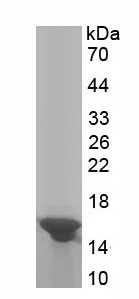 |
Greater than 80% as determined by reducing SDS-PAGE. |
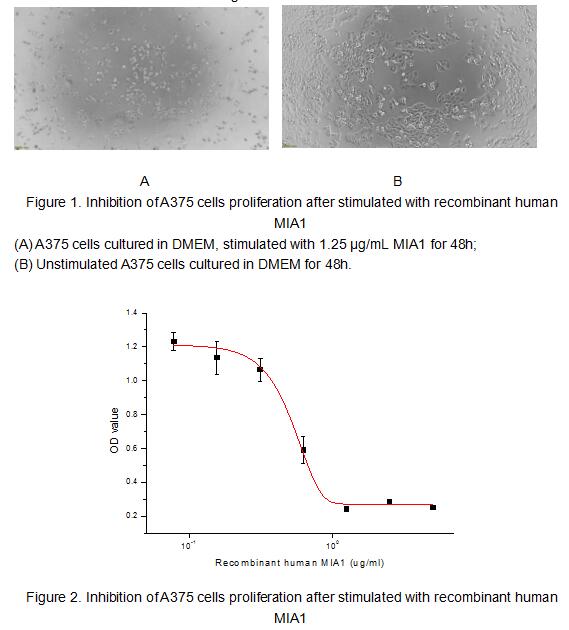 |
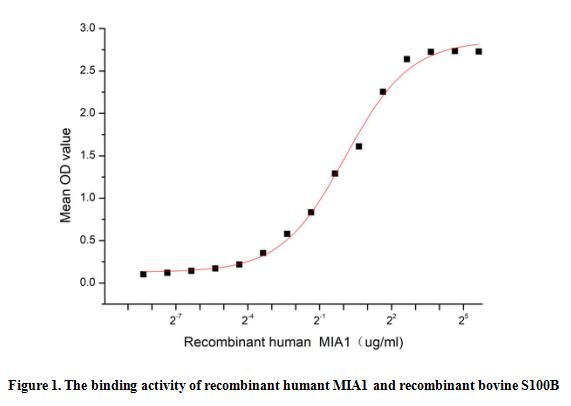
Melanoma inhibitory activity (MIA), also known as cartilage-derived retinoic acid-sensitive protein (CD-RAP), is a 12-kDa protein that is secreted from both chondrocytes and malignant melanoma cells. MIA has been reported to have effects on cell growth and adhesion, and it may play a role in melanoma metastasis and cartilage development. In the presence of MIA, we observed enhanced migratory ability of melanocytic cells, induction of melanoma-associated genes as well as inhibition of apoptosis due to anoikis. S100 Calcium Binding Protein B (S100B) is a high affinity ligand for MIA1, a functional binding ELISA assay was conducted to detect the interaction of recombinant human MIA1 and recombinant bovine S100B. Briefly, MIA1 was diluted serially in PBS with 0.01% BSA (pH 7.4). Duplicate samples of 100 μl were then transferred to S100B-coated microtiter wells and incubated for 1h at 37℃. Wells were washed with PBST and incubated for 1h with anti-MIA1 pAb, then aspirated and washed 3 times. After incubation with HRP labelled secondary antibody for 1h at 37℃, wells were aspirated and washed 5 times. With the addition of substrate solution, wells were incubated 15-25 minutes at 37℃. Finally, add 50 µL stop solution to the wells and read at 450/630 nm immediately. The binding activity of recombinant humant MIA1 and recombinant bovine S100B was shown in Figure 1, the EC50 for this effect is 1.1 ug/mL. To test the effect of MIA1 on cell apoptosis, A375 cells were seeded into triplicate wells of 96-well plates at a density of 4,000 cells/well and allowed to attach overnight, then the medium was replaced with various concentrations of recombinant human MIA1 diluted with 5% serum standard DMEM. After incubated for 48h, cells were observed by inverted microscope and cell viability was measured by Cell Counting Kit-8 (CCK-8). Briefly, 10 µl of CCK-8 solution was added to each well of the plate, then the absorbance at 450 nm was measured using a microplate reader after incubating the plate for 1-4 hours at 37 ℃. Apoptosis of A375 cells after incubation with MIA1 for 48h observed by inverted microscope was shown in Figure 1. Cell viability was assessed by CCK-8 assay after incubation with recombinant human MIA1 for 48h. The result was shown in Figure 2. It was obvious that MIA1 significantly decreased cell viability of A375 cells. The ED50 of recombinant human MIA1 is 0.53 ug/ml. |
 |
| 分子别名Alternative Names | CD-RAPMelanoma-derived growth regulatory protein |
|---|---|
| 背景介绍Background | Elicits growth inhibition on melanoma cells in vitro as well as some other neuroectodermal tumors, including gliomas. |
| 功能Function | Elicits growth inhibition on melanoma cells in vitro as well as some other neuroectodermal tumors, including gliomas. |
| 亚细胞定位Subcellular Location | Secreted. |
| 数据库链接Databases |
基因功能参考文献35 条
- the molecular basis of the interaction of MIA with the Hep II domain of fibronectin based on nuclear magnetic resonance spectroscopic binding assays. PMID: 28565914 : 28565914
- The frequency of MIA gene family expression was higher among squamous cell carcinomas than among other tumor types subjected to screening. MIA gene family staining was observed frequently in esophageal and lung cancers associated with nodal and/or distant metastasis. In cervical cancers, MIA and TANGO immunostaining also correlated with tumor progression and metastasis. PMID: 27145272 : 27145272
- Our results suggest that MIA-STOX2 signaling may be a useful diagnostic and therapeutic target in oral squamous cell carcinoma PMID: 27050375 : 27050375
- MIA had a slightly superior sensitivity to detect progressive disease compared to S100 and seems to be more useful in monitoring of patients with metastatic melanoma receiving immunotherapy PMID: 28870930 : 28870930
- real-time RT-PCR assays showed that expressions of MIA and MIA-RAB4B located 35 kb upstream of the deletion, were up-regulated in the polyps compared to the matched mucosa of the proband. MIA-RAB4B, the read-through long non-coding RNA (lncRNA), RAB4B, PIM2 and TAOK1 share common binding site of a microRNA, miR-24, in their 3'UTRs PMID: 28306719 : 28306719
- The effects of MIA/CD-RAP on transcriptional regulation in chondrocytes, through the regulation of p54(nrb) via YBX1 contributes to the understanding of chondrogenesis. PMID: 24349210 : 24349210
- data provide evidence for a critical role of SOX10 in melanoma cell invasion through the regulation of MIA and highlight its role as a therapeutic target in melanoma PMID: 24608986 : 24608986
- Focus on the quantitative analysis of the MIA protein as a prognostic tool because it has proven to be a useful serum marker for documenting disease progression of malignant melanoma. Review. PMID: 24372647 : 24372647
- Functional promoter analysis identified the transcription factor YBX1 as the mediator of MIA activation of p54(nrb) transcription. PMID: 23672612 : 23672612
- MIA protein is present in non-segmental vitiligo skin and may cause the detachment of melanocytes; its target is integrin alpha5beta1, which determines the breaking and/or weakening of connections among melanocytes and basal membrane PMID: 23664187 : 23664187
- Results show that S-100B, MIA and LDH levels were significantly higher in patients with advanced melanoma than in disease-free patients or healthy controls. PMID: 21858537 : 21858537
- assessed the utility of melanoma inhibitory activity (MIA) serum marker in the follow up and primary diagnosis of stage III melanoma patients PMID: 21658116 : 21658116
- Further diagnostics should be initiated in uveal melanoma patients with serum MIA above 8.3ng/ml. PMID: 21540751 : 21540751
- Data suggest that plasma markers: CEACAM, ICAM-1, osteopontin, MIA, TIMP-1 and S100B particularly when assessed in combination, can be used to monitor patients for disease recurrenc. PMID: 21487066 : 21487066
- The cell-specific production rate of MIA was quantitatively proportional to the aggrecan gene expression level in the early and middle phase of cartilage chondrocyte differentiation. PMID: 21277254 : 21277254
- MIA/CD-RAP stabilizes cartilage differentiation and inhibits differentiation into bone potentially by regulating signaling processes during differentiation. PMID: 20164682 : 20164682
- pancreatic cancer patients with high intratumoral expression are antibody-negative and have shorter survival PMID: 20514540 : 20514540
- A fluorescence polarization biological assay was developed using MIA protein-binding compounds for studies of the binding properties of this protein. PMID: 19852767 : 19852767
- The assignments, solution structure, & dynamics of human MIA were determined by heteronuclear NMR methods. The structure consists of an SH3-like subdomain with N- and C-terminal extensions of about 20 amino acids each that form a novel fold. PMID: 11991352 : 11991352
- Melanoma-inhibiting activity (MIA/CD-RAP) is expressed in a variety of malignant tumors of mainly neuroectodermal origin. PMID: 12014625 : 12014625
- expression pattern of a novel splice product MIA (splice) of malignant melanoma-derived growth-inhibiting activity (MIAY CD-RAP). PMID: 12230496 : 12230496
- Stable antisense-HMG1 expression in melanoma cells led to the reduction of melanoma inhibitory activity (MIA) promoter activity and protein expression. PMID: 12665595 : 12665595
- increased MIA production may, in turn, increase the invasive properties of the cells by modulating the attachment of human uveal melanoma cells to the extracellular matrix PMID: 15057037 : 15057037
- MIA may promote the detachment of radial and vertical growth phase melanomas. PMID: 15201995 : 15201995
- The MIA protein enhances the migration of melanocytes and promotes melanoma progression. PMID: 15208686 : 15208686
- MIA may contribute to immunosuppression frequently seen in malignant melanomas by inhibiting cellular antitumor immune reactions. PMID: 15386421 : 15386421
- MIA in homogenates of surgical specimen directly relate to a more benign clinical prognosis in patients with high-grade glioma PMID: 15547763 : 15547763
- There is a correlation between MIA expression and pigmentation and morphology of melanocytic cells. PMID: 15760338 : 15760338
- Increased levels of MIA is associated with gastric cancer PMID: 16331256 : 16331256
- When patients progressed, level of MIA increased significantly. PMID: 17348447 : 17348447
- A candidate autoantigen in rheumatoid arthritis found in synovial fluid cells. PMID: 17599744 : 17599744
- An antigen in melanoma, elevated in 22 per cent of patients, predicting recurrence. PMID: 17661202 : 17661202
- MIA serum level is the ideal test for screening the skin melanoma spread to sentinel lymph nodes. PMID: 18477894 : 18477894
- MIA expression is enhanced by the interaction of intracellular HMGB1 and NFkBp65 and MIA is closely involved in tumor progression and nodal metastasis by the increments of VEGF-C and VEGF-D in oral squamous cell carcinomas. PMID: 18616526 : 18616526
- MIA protein, binding to integrins and thus promoting detachment of cells from extracellular matrix structures, is internalized into the cell together with these cell adhesion receptors at the cell rear. PMID: 19521988 : 19521988
蛋白复溶体积计算器缓冲液体积 = 蛋白质量 ÷ 蛋白浓度
输入任意两项,第三项自动计算 |
蛋白浓度稀释计算器初浓度 × 初体积 = 终浓度 × 终体积
输入任意三项,第四项自动计算 |



