


| 纯度Purity | Greater than 90% as determined by reducing SDS-PAGE. |
|---|---|
| 内毒素Endotoxin | Please contact with the lab for this information |
| 蛋白构建Protein Construction |
【Val29-Leu361】序列区间
|
| Accession | Q16769 |
| 表达宿主Expression Host | E.coli |
| 种属Species | Homo sapiens (Human) |
| 预测分子量Predicted MW | 41.6 kDa |
| 制剂Formulation | Lyophilized from a 0.2 μm filtered solution of PBS, pH7.4, containing 0.01% SKL, 1mM DTT, 5% Trehalose and Proclin300. |
| 运输方式Shipping | The product is shipped with ice bag. Upon receipt, store it immediately at the temperature listed below. |
| 稳定性&储存Stability & Storage | 12 months at -20°C to -80°C in lyophilized state.6 months at -20°C to -80°C under sterile conditions after reconstitution.7-10 days at 2°C to 8°C under sterile conditions after reconstitution.Please minimize freeze-thaw cycles. |
| 复溶Reconstitution | Reconstitute in 10mM PBS (pH7.4) to a concentration of 0.1-1.0 mg/mL. Do not vortex. |
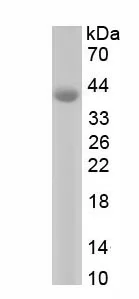 |
Greater than 90% as determined by reducing SDS-PAGE. |
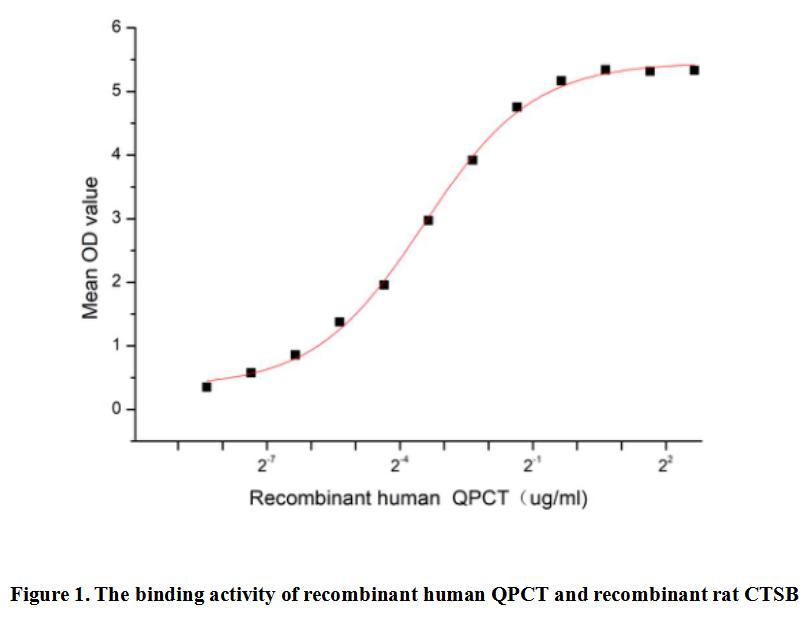 |
Glutaminyl Peptide Cyclotransferase (QPCT), also known as Glutaminyl Cyclase, is an enzyme responsible for the biosynthesis of pyroglutamyl peptides. QPCT is present in the pituitary and adrenal glands, where it is important for the generation of the N terminal pyroglutamyl groups of peptide hormones such as neurotensin and thyrotropin-releasing hormone. Besides, Cathepsin B (CTSB) has been identified as an interactor of QPCT, thus a functional binding ELISA assay was conducted to detect the interaction of recombinant human QPCT and recombinant rat CTSB. Briefly, QPCT was diluted serially in PBS with 0.01% BSA (pH 7.4). Duplicate samples of 100 μl were then transferred to CTSB-coated microtiter wells and incubated for 1h at 37℃. Wells were washed with PBST and incubated for 1h with anti-QPCT pAb, then aspirated and washed 3 times. After incubation with HRP labelled secondary antibody for 1h at 37℃, wells were aspirated and washed 5 times. With the addition of substrate solution, wells were incubated 15-25 minutes at 37℃. Finally, add 50 µL stop solution to the wells and read at 450/630 nm immediately. The binding activity of recombinant human QPCT and recombinant rat CTSB was shown in Figure 1, the EC50 for this effect is 0.09 ug/mL. |
| 分子别名Alternative Names | GCTQCECGlutaminyl CyclaseGlutaminyl-tRNA cyclotransferase |
|---|---|
| 背景介绍Background | Responsible for the biosynthesis of pyroglutamyl peptides. Has a bias against acidic and tryptophan residues adjacent to the N-terminal glutaminyl residue and a lack of importance of chain length after the second residue. Also catalyzes N-terminal pyroglutamate formation. In vitro, catalyzes pyroglutamate formation of N-terminally truncated form of APP amyloid-beta peptides [Glu-3]-amyloid-beta. May be involved in the N-terminal pyroglutamate formation of several amyloid-related plaque-forming peptides. |
| 功能Function | Responsible for the biosynthesis of pyroglutamyl peptides. Has a bias against acidic and tryptophan residues adjacent to the N-terminal glutaminyl residue and a lack of importance of chain length after the second residue. Also catalyzes N-terminal pyroglutamate formation. In vitro, catalyzes pyroglutamate formation of N-terminally truncated form of APP amyloid-beta peptides [Glu-3]-amyloid-beta. May be involved in the N-terminal pyroglutamate formation of several amyloid-related plaque-forming peptides. |
| 亚细胞定位Subcellular Location | Secreted. |
| 数据库链接Databases |
基因功能参考文献20 条
- The addition of QC activity to core diagnostic CSF biomarkers may be of specific interest in clinical cases with discordant imaging and biochemical biomarker results. PMID: 28587659 : 28587659
- these findings demonstrate a significant association between common single nucleotide polymorphism within QPCT gene and schizophrenia risk in a Han Chinese population. PMID: 26572640 : 26572640
- the genetic risk of QPCT gene for schizophrenia also exists in the Han Chinese population. PMID: 26492838 : 26492838
- observations provide evidence for an involvement of QC in Alzheimer's disease pathogenesis and cognitive decline by QC-catalyzed pGlu-Abeta formation PMID: 24164736 : 24164736
- this study demonistrated that QPCT mRNAand protein from mononuclear cells correlated with theseverity of dementia. PMID: 23207485 : 23207485
- Upregulation of QPCT expression is associated with thyroid carcinomas. PMID: 23183267 : 23183267
- This study presents a first comparison of two mammalian QCs (human and mouse) containing typical, conserved post-translational modifications. PMID: 21671571 : 21671571
- The resilts of this studt provided histopathological evidence for QC being a prerequisite for pE-Abeta pathology in vivo and further underline the therapeutic potential of QC inhibition in Alzheimer Disease. PMID: 21301857 : 21301857
- Upon binding to PBD150, a large loop movement in gQC allows the inhibitor to be tightly held in its active site primarily by hydrophobic interactions. PMID: 21288892 : 21288892
- This study demonstrated that glutaminyl cyclase expression and pE-Abeta formation in subcortical brain regions( Edinger-Westphal nucleus, locus coeruleus and nucleus basalis Meynert) affected in Alzheimer's disease. PMID: 20383514 : 20383514
- Human isoQC proteins displayed a broad substrate specificity and preference for hydrophobic substrates, similar to the related QC. PMID: 19804409 : 19804409
- Functional expression of human glutaminyl cyclase in Pichia pastoris reveals the presence of a disulfide bond with an important role in the stabilization of active protein structure. PMID: 12196024 : 12196024
- human glutaminyl cyclase is a metal-dependent transferase PMID: 14522962 : 14522962
- Glutaminyl cyclase was expressed as a fully active 37 kDa enzyme with kcat/Km values of 14.3, 9.3, and 2.4 mM(-1)s(-1) for the substrates Gln-Gln, Gln-NH(2), and Gln-t-butyl ester, respectively PMID: 14680951 : 14680951
- Genetic variations in QPCT are important factors affecting the bone mineral density of adult women that contribute to susceptibility for osteoporosis. PMID: 15231017 : 15231017
- structure of human QC in free form and bound to a substrate and three imidazole-derived inhibitors PMID: 16135565 : 16135565
- Our results suggest that QPCT may be the QTL gene at chromosome 2p for spine BMD variation in the Chinese population PMID: 17687619 : 17687619
- combined steady-state enzyme kinetic and X-ray structural analyses of 11 single-mutation human QCs to investigate the roles of the H-bond network in catalysis PMID: 18072935 : 18072935
- The computations outline the important role of Trp329 in helping the substrate binding process and stabilizing the cyclization transition state. PMID: 18470930 : 18470930
- Golgi apparatus retention implies a "housekeeping" protein maturation machinery conducting glycosylation and pyroglutamyl formation. For these isoenzymes, apparently similar strategies evolved to retain the proteins in the Golgi complex. PMID: 18486145 : 18486145
蛋白复溶体积计算器缓冲液体积 = 蛋白质量 ÷ 蛋白浓度
输入任意两项,第三项自动计算 |
蛋白浓度稀释计算器初浓度 × 初体积 = 终浓度 × 终体积
输入任意三项,第四项自动计算 |



