


| 纯度Purity | Greater than 95% as determined by reducing SDS-PAGE. |
|---|---|
| 内毒素Endotoxin | Please contact with the lab for this information |
| 蛋白构建Protein Construction |
【Met1-Pro218】序列区间
|
| Accession | Q00987 |
| 表达宿主Expression Host | E.coli |
| 种属Species | Homo sapiens (Human) |
| 预测分子量Predicted MW | 28.2 kDa |
| 制剂Formulation | Lyophilized from a 0.2 μm filtered solution of PBS, pH7.4, containing 0.01% SKL, 1mM DTT, 5% Trehalose and Proclin300. |
| 运输方式Shipping | The product is shipped with ice bag. Upon receipt, store it immediately at the temperature listed below. |
| 稳定性&储存Stability & Storage | 12 months at -20°C to -80°C in lyophilized state.6 months at -20°C to -80°C under sterile conditions after reconstitution.7-10 days at 2°C to 8°C under sterile conditions after reconstitution.Please minimize freeze-thaw cycles. |
| 复溶Reconstitution | Reconstitute in 10mM PBS (pH7.4) to a concentration of 0.1-1.0 mg/mL. Do not vortex. |
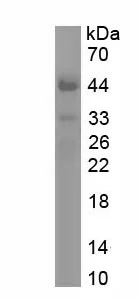 |
Greater than 95% as determined by reducing SDS-PAGE. |
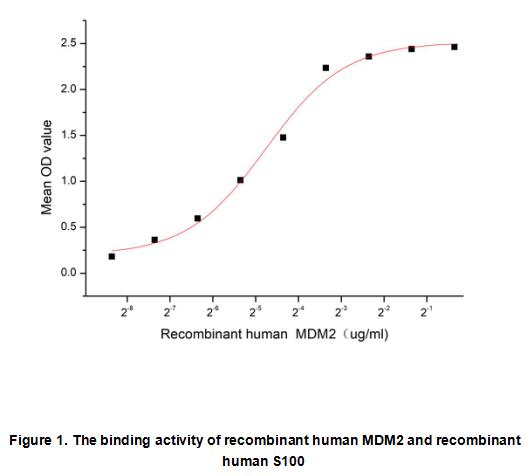 |
Mouse double minute 2 homolog (MDM2) also known as E3 ubiquitin-protein ligase. MdM2 is a cellular oncoprotein that recognizes the N-terminal trans-activation domain (TAD) of the p53 tumor suppressor and as an inhibitor of p53 transcriptional activation. The human homologue of this protein is sometimes called Hdm2. The p53 tumor suppressor is the key target of MDM2. It has been identified as a p53 interacting protein that represses p53 transcriptional activity and also acts as an E3 ubiquitin ligase, targeting both itself and p53 for degradation by the proteasome. MDM2 is capable of auto-polyubiquitination, and in complex with p300, a cooperating E3 ubiquitin ligase, is capable of polyubiquitinating p53. Besides, S100 Calcium Binding Protein (S100) has been identified as an interactor of MDM2, thus a binding ELISA assay was conducted to detect the interaction of recombinant human MDM2 and recombinant human S100. Briefly, MDM2 were diluted serially in PBS, with 0.01% BSA (pH 7.4). Duplicate samples of 100 ul were then transferred to S100-coated microtiter wells and incubated for 2h at 37℃. Wells were washed with PBST and incubated for 1h with anti-MDM2 pAb, then aspirated and washed 3 times. After incubation with HRP labelled secondary antibody, wells were aspirated and washed 3 times. With the addition of substrate solution , wells were incubated 15-25 minutes at 37℃. Finally, add 50 µL stop solution to the wells and read at 450 nm immediately. The binding activity of recombinant human MDM2 and recombinant human S100 was shown in Figure 1, the EC50 is 0.037 ug/ml. |
| 分子别名Alternative Names | HDMXhdm2Mouse Double Minute 2,Human Homolog Of p53-Binding ProteinOncoprotein Mdm2 |
|---|---|
| 背景介绍Background | E3 ubiquitin-protein ligase that mediates ubiquitination of p53/TP53, leading to its degradation by the proteasome. Inhibits p53/TP53- and p73/TP73-mediated cell cycle arrest and apoptosis by binding its transcriptional activation domain. Also acts as a ubiquitin ligase E3 toward itself and ARRB1. Permits the nuclear export of p53/TP53. Promotes proteasome-dependent ubiquitin-independent degradation of retinoblastoma RB1 protein. Inhibits DAXX-mediated apoptosis by inducing its ubiquitination and degradation. Component of the TRIM28/KAP1-MDM2-p53/TP53 complex involved in stabilizing p53/TP53. Also component of the TRIM28/KAP1-ERBB4-MDM2 complex which links growth factor and DNA damage response pathways. Mediates ubiquitination and subsequent proteasome degradation of DYRK2 in nucleus. Ubiquitinates IGF1R and SNAI1 and promotes them to proteasomal degradation. Ubiquitinates DCX, leading to DCX degradation and reduction of the dendritic spine density of olfactory bulb granule cells. Ubiquitinates DLG4, leading to proteasomal degradation of DLG4 which is required for AMPA receptor endocytosis. Negatively regulates NDUFS1, leading to decreased mitochondrial respiration, marked oxidative stress, and commitment to the mitochondrial pathway of apoptosis. Binds NDUFS1 leading to its cytosolic retention rather than mitochondrial localization resulting in decreased supercomplex assembly (interactions between complex I and complex III), decreased complex I activity, ROS production, and apoptosis. |
| 功能Function | E3 ubiquitin-protein ligase that mediates ubiquitination of p53/TP53, leading to its degradation by the proteasome. Inhibits p53/TP53- and p73/TP73-mediated cell cycle arrest and apoptosis by binding its transcriptional activation domain. Also acts as a ubiquitin ligase E3 toward itself and ARRB1. Permits the nuclear export of p53/TP53. Promotes proteasome-dependent ubiquitin-independent degradation of retinoblastoma RB1 protein. Inhibits DAXX-mediated apoptosis by inducing its ubiquitination and degradation. Component of the TRIM28/KAP1-MDM2-p53/TP53 complex involved in stabilizing p53/TP53. Also component of the TRIM28/KAP1-ERBB4-MDM2 complex which links growth factor and DNA damage response pathways. Mediates ubiquitination and subsequent proteasome degradation of DYRK2 in nucleus. Ubiquitinates IGF1R and SNAI1 and promotes them to proteasomal degradation. Ubiquitinates DCX, leading to DCX degradation and reduction of the dendritic spine density of olfactory bulb granule cells. Ubiquitinates DLG4, leading to proteasomal degradation of DLG4 which is required for AMPA receptor endocytosis. Negatively regulates NDUFS1, leading to decreased mitochondrial respiration, marked oxidative stress, and commitment to the mitochondrial pathway of apoptosis. Binds NDUFS1 leading to its cytosolic retention rather than mitochondrial localization resulting in decreased supercomplex assembly (interactions between complex I and complex III), decreased complex I activity, ROS production, and apoptosis. |
| 亚细胞定位Subcellular Location | Nucleus, nucleoplasm. Cytoplasm. Nucleus, nucleolus. Nucleus. Note=Expressed predominantly in the nucleoplasm. Interaction with ARF(P14) results in the localization of both proteins to the nucleolus. The nucleolar localization signals in both ARF(P14) and MDM2 may be necessary to allow efficient nucleolar localization of both proteins. Colocalizes with RASSF1 isoform A in the nucleus. |
| 数据库链接Databases |
基因功能参考文献50 条
- Meta-analysis suggested that MDM2 SNP309 polymorphism increased the risk of endometrial cancer significantly, especially in endometrioid and Type I endometrial cancer, indicating MDM2 could serve as a potential diagnostic factor marker for endometrial cancer. PMID: 30544386 : 30544386
- The Numb-Mdm2 interaction represents a fuzzy complex mediated by a short Numb sequence encompassing its alternatively spliced exon 3 (Ex3), which is necessary and sufficient to inhibit Mdm2 and prevent p53 degradation. PMID: 29269425 : 29269425
- It has been shown that MDM2 and MDMX are targetable vulnerabilities within TP53-wild-type T-cell lymphomas. PMID: 29789628 : 29789628
- MDM2 down-regulation attenuates the senescence-associated secretory phenotype. PMID: 29402901 : 29402901
- First evidence that DNA induction of MDM2 promotes proliferation of human renal mesangial cells and alters peripheral B cells subsets in pediatric systemic lupus erythematosus. PMID: 29324237 : 29324237
- The genotypes of MDM2 SNP309 may allow forr early detection of and predictor for colorectal cancer risk, especially among smokers and non-alcohol drinkers, but not for prognosis. PMID: 30194081 : 30194081
- Our study showed that miR-145 suppressed MDM2 expression, which subsequently influenced the p53-related cell growth pattern in pterygial epithelium. The regulatory miR-145/MDM2-p53 loop can serve as a potential target for treatment of pterygium. PMID: 29360447 : 29360447
- In contrast to other deubiquitinating enzymes (DUBs) that have been previously implicated in the regulation of Mdm2 protein stability, USP48 did not induce Mdm2 stabilization by significantly reducing Mdm2 ubiquitination levels. PMID: 28233861 : 28233861
- MDM2 rs937283 A > G variant is associated with lung and gastric cancer. PMID: 29777315 : 29777315
- No associations were found between MDM2 SNP309 and either of two FSH/LH groups. PMID: 29957069 : 29957069
- MDM2 promoter variants play a role in determining the risk of recurrence of squamous cell carcinoma of oropharynx PMID: 28045062 : 28045062
- In silico molecular docking and dynamics studies with MDM2-p53 protein revealed that HTMF was more potent compound that could inhibit the binding of MDM2 with p53 and, therefore, could trigger apoptosis in cancer cell. PMID: 29734849 : 29734849
- Our findings suggested that RBM38 may be a core contributor in stabilizing the p53-mdm2 loop function to prevent hepatocellular carcinoma (HCC) and a potential novel target to provide a therapeutic strategy for HCC by inhibiting mdm2 and rescuing p53 from inactivation. PMID: 30176896 : 30176896
- As shown in human MDM2-ALT1-expressing p53 null transgenic mice, MDM2-ALT1 can direct rhabdomyosarcoma (RMS) tumor formation recapitulating many of the histological and immunohistochemical features of fusion-negative RMS. PMID: 28892044 : 28892044
- We demonstrate that extraskeletal osteosarcoma (ESOS) may include at least two small subsets: an MDM2-amplified deep soft-tissue ESOS and an H3K27me3-deficient organ-based ESOS PMID: 29489027 : 29489027
- miR-518 acted as a new tumor suppressor by targeting MDM2 gene and trigger apoptosis in vivo and in vitro. PMID: 29793321 : 29793321
- Overexpression of miR-641 decreased the expression of MDM2 and increased the expression of p53 in lung cancer cells. PMID: 28800790 : 28800790
- The MDM2 T309G polymorphism GG genotype and the TG+GG combination may be risk factors for breast cancer in our Turkish population. PMID: 29699057 : 29699057
- Human blastocyst-secreted miR-661 reduces endometrial epithelial cell adhesion via downregulation of MDM2, regulating endometrial-blastocyst adhesion, and implantation. PMID: 28847363 : 28847363
- MDM2 is associated with giant cell tumor of bone recurrence, which might serve as biomarker for giant cell tumor of bone recurrence PMID: 29651441 : 29651441
- The ID genotype of the MDM2 I/D polymorphism was associated with a lower risk of SLE. There was no association between MDM2 T309G polymorphism and SLE. PMID: 28676527 : 28676527
- The present study demonstrated that the oncostatic effects of melatonin on SGC-7901 GC cells are mediated via the blockade of the AKT/MDM2 intracellular pathway. PMID: 29484412 : 29484412
- Nongenotoxic p53 activation suppresses mTOR activity. Moreover, p53 reactivation via RG7388, a second-generation MDM2 inhibitor, strongly enhances the in vivo antitumor activity of temsirolimus PMID: 28821555 : 28821555
- Overview of the connections between p53-MDM2 axis and human aging disorders and aging-related pathways (review). PMID: 29192902 : 29192902
- The Role of MDM2 in genome stability/instability and DNA repair is reviewed. PMID: 29065514 : 29065514
- Notch1 signaling is an essential downstream pathway of MDM2 in mediating high glucose-induced mitotic catastrophe in podocytes. PMID: 28643424 : 28643424
- our data confirmed the individual susceptibility to BC resulting from polymorphic markers of DNA repair genes (XRCC1), apoptosis genes (TP53), as well as of apoptosis inhibition genes (MDM2). PMID: 29132330 : 29132330
- In multivariate analysis, MDM2/MDM4 and EGFR alterations correlated with time-to-treatment failure (TTF)..Some patients with MDM2 family amplification or EGFR aberrations had poor clinical outcome and significantly increased rate of tumor growth after single-agent checkpoint (PD-1/PD-L1) inhibitors PMID: 28351930 : 28351930
- Results demonstrate that Mdm2 is extremely important in breast cancer metastases to the lung. Specifically, Mdm2 is important to promote cancer invasiveness via cell migration, angiogenesis, and intravasation. PMID: 28784612 : 28784612
- GG genotype of MDM2 re2279744 showed a statistically significantly increased risk of developing endometrial cancer risk in a Chinese Han population. PMID: 29096752 : 29096752
- GATA4 was a transcription factor that activated mouse double minute 2 homolog (MDM2) and B cell lymphoma 2 (BCL2) expression in ALL cells. PMID: 28849107 : 28849107
- Findings of the study confirm that L-THP resulted in p53 independent apoptosis via down-regulating XIAP protein by inhibiting MDM2 associated with proteasome-dependent pathway and increased sensitivity of EU-4 cells against doxorubicin. PMID: 28721806 : 28721806
- MDM2 promoter SNP55 (rs2870820) affects risk of colon cancer but not breast-, lung-, or prostate cancer. PMID: 27624283 : 27624283
- Importantly, these results imply that the Zika virus capsid protein interacts with mouse double-minute-2 homolog (MDM2), which is involved in the P53-mediated apoptosis pathway, activating the death of infected neural cells. PMID: 28775961 : 28775961
- The expression levels of Bcl11a and Mdm2, Pten in B-ALL patients with CR were decreased significantly when compared with the healthy control (P < 0.05). PMID: 28544358 : 28544358
- A near-native models of the p53-MDM2 complex have been presented. PMID: 27905468 : 27905468
- the MDM2 rs937283 polymorphism is a novel functional SNP both in vitro and in vivo as well as a biomarker for poor prognosis in retinoblastoma PMID: 27506496 : 27506496
- Markov models of the apo-MDM2 lid region reveal diffuse yet two-state binding dynamics and receptor poses for computational docking. PMID: 27538695 : 27538695
- The nucleolar protein CSIG is a novel and crucial regulator of the MDM2-p53 pathway. We demonstrate that CSIG translocates from the nucleolus to the nucleoplasm in response to nucleolar stress. Moreover, knockdown of CSIG attenuates the induction of p53 and abrogates G1 phase arrest in response to nucleolar stress. PMID: 27811966 : 27811966
- Data indicate that murine double minute 2 protein (MDMX) expression may serve as an independent unfavorable prognostic factor for non-small cell lung cancer (NSCLC). patient outcome, which in turn may at least partly be due to the ability of the MDMX protein to regulate the proliferative capacity and chemosensitivity of NSCLC cells. PMID: 28567715 : 28567715
- our data suggest that estrogen provokes signals to increase MDM2 expression and this estrogen stimulated MDM2 promotes signal transduction for increasing phosphorylation of Rb. PMID: 28615518 : 28615518
- The MDM2 Del1518 polymorphism (rs3730485) was associated with breast cancer susceptibility, particularly in menopausal patients with breast cancer who reported tobacco consumption, pregnancy loss, obesity and high glucose levels in Mexican population. PMID: 28667029 : 28667029
- study showed that UVB induces alternative splicing of hdm2 by increasing the expression and the binding of hnRNP A1 to hdm2 full-length mRNA PMID: 26757361 : 26757361
- in colon cancer cell migration, activin utilizes NFkB to induce MDM2 activity leading to the degradation of p21 in a PI3K dependent mechanism PMID: 28418896 : 28418896
- Author demonstrated that LRRK2 increases the expression of p53 and p21 by increasing the Mdm2 phosphorylation in response to DNA damage. Loss-of-function in LRRK2 has the opposite effect to that of LRRK2. PMID: 28973420 : 28973420
- Relevant SNPs in DNA repair (ERCC1 and ERCC5) and apoptosis (MDM2 and TP53) genes might influence the severity of radiation-related side-effects in HNSCC patients. Prospective clinical SNP-based validation studies are needed on these bases PMID: 28351583 : 28351583
- this is the first documentation of MDM2 amplification in laryngeal/hypopharyngeal well-differentiated liposarcomas PMID: 27492446 : 27492446
- The MDM2 309GG genotype was associated with higher risk of preeclampsia. PMID: 28508227 : 28508227
- A meta-analysis of case-control studies found that MDM2 rs2279744 (SNP309) and rs117039649 (SNP285) were both associated with the risk of gynecological cancers. Subgroup analysis showed that rs2279744 (SNP309) was associated with the risk of gynecological cancers in Caucasian and Asian according to the ethnicity and cancer type, especially for endometrial cancer. PMID: 29480845 : 29480845
- we here show that subgroups of SDCs display genomic amplifications of MDM2 and/or CDK4, partly in association with TP53 mutations and rearrangement/amplification of HMGA2. PMID: 27662657 : 27662657
蛋白复溶体积计算器缓冲液体积 = 蛋白质量 ÷ 蛋白浓度
输入任意两项,第三项自动计算 |
蛋白浓度稀释计算器初浓度 × 初体积 = 终浓度 × 终体积
输入任意三项,第四项自动计算 |



