


| 纯度Purity | Greater than 95% as determined by reducing SDS-PAGE. |
|---|---|
| 内毒素Endotoxin | Please contact with the lab for this information |
| 蛋白构建Protein Construction |
【Ala21-Leu570】序列区间
|
| Accession | Q7RTX0 |
| 表达宿主Expression Host | E.coli |
| 种属Species | Homo sapiens (Human) |
| 预测分子量Predicted MW | 65.7 kDa |
| 制剂Formulation | Lyophilized from a 0.2 μm filtered solution of PBS, pH7.4, containing 0.01% SKL, 1mM DTT, 5% Trehalose and Proclin300. |
| 运输方式Shipping | The product is shipped with ice bag. Upon receipt, store it immediately at the temperature listed below. |
| 稳定性&储存Stability & Storage | 12 months at -20°C to -80°C in lyophilized state.6 months at -20°C to -80°C under sterile conditions after reconstitution.7-10 days at 2°C to 8°C under sterile conditions after reconstitution.Please minimize freeze-thaw cycles. |
| 复溶Reconstitution | Reconstitute in 10mM PBS (pH7.4) to a concentration of 0.1-1.0 mg/mL. Do not vortex. |
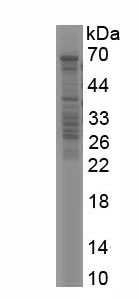 |
Greater than 95% as determined by reducing SDS-PAGE. |
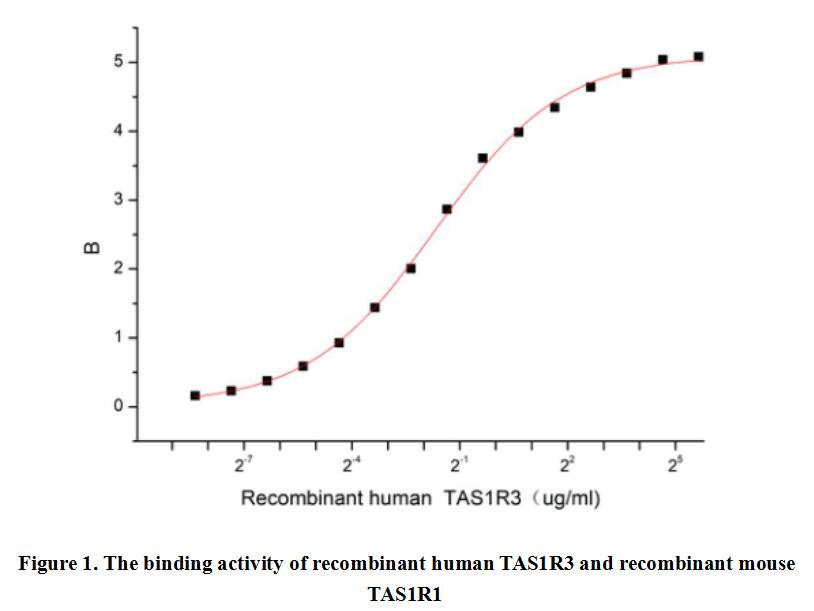 |
Taste receptor type 1 member 3 (TAS1R3), responsible for mediating taste perception, is a G protein-coupled receptor (GPCR) expressed in gustatory cells located within the taste buds on the tongue. It can form a heterodimeric receptor with TAS1R1 to elicit the umami taste response, or it can bind with TAS1R2 to form a receptor for the sweet taste response, thus a functional binding ELISA assay was conducted to detect the interaction of recombinant human TAS1R3 and recombinant mouse TAS1R1. Briefly, biotin-linked TAS1R3 were diluted serially in PBS, with 0.01% BSA (pH 7.4). Duplicate samples of 100 ul were then transferred to TAS1R1-coated microtiter wells and incubated for 1h at 37℃. Wells were washed with PBST 3 times and incubation with Streptavidin-HRP for 30min, then wells were aspirated and washed 5 times. With the addition of substrate solution, wells were incubated 15-25 minutes at 37℃. Finally, add 50 µl stop solution to the wells and read at 450 nm immediately. The binding activity of recombinant human TAS1R3 and recombinant mouse TAS1R1 was shown in Figure 1, the EC50 for this effect is 0.31 ug/mL. |
| 分子别名Alternative Names | T1R3Sweet taste receptor T1R3 |
|---|---|
| 背景介绍Background | Putative taste receptor. TAS1R1/TAS1R3 responds to the umami taste stimulus (the taste of monosodium glutamate). TAS1R2/TAS1R3 recognizes diverse natural and synthetic sweeteners. TAS1R3 is essential for the recognition and response to the disaccharide trehalose. Sequence differences within and between species can significantly influence the selectivity and specificity of taste responses. |
| 功能Function | Putative taste receptor. TAS1R1/TAS1R3 responds to the umami taste stimulus (the taste of monosodium glutamate). TAS1R2/TAS1R3 recognizes diverse natural and synthetic sweeteners. TAS1R3 is essential for the recognition and response to the disaccharide trehalose. Sequence differences within and between species can significantly influence the selectivity and specificity of taste responses. |
| 亚细胞定位Subcellular Location | Cell membrane; Multi-pass membrane protein. |
| 数据库链接Databases |
基因功能参考文献19 条
- Regarding "consumption of carbohydrates (% energy) and higher amount of sweet foods, respectively...no associations were found for the TAS1R3 alleles." PMID: 29110749 : 29110749
- TAS1R3 gene rs307355 polymorphism found independent risk factor for dental caries experience by logistic regression & increased risk of caries. Moderate caries (4-7 caries) found to be associated w/TAS1R3 rs307355 heterozygous genotype PMID: 25924601 : 25924601
- T1R3 gene expression in the tongue is suppressed by chemotherapy. PMID: 26422579 : 26422579
- The transcripts of TAS1R3 and UCN2 in peripheral blood cells may be considered potential biomarkers of consumption of sugary and fatty food, respectively, to complement data of food-intake questionnaires. PMID: 26168276 : 26168276
- Five amino acid residues in cysteine-rich domain of human T1R3 were involved in the response for sweet-tasting protein, thaumatin PMID: 23370115 : 23370115
- T1R3 is a receptor responsible for the detection of calcium by taste. PMID: 22773945 : 22773945
- Overexpressed the human N-terminal domain of T1R3 in E. coli and found that the refolded protein behaves as a dimer; showed that hT1R3-NTD is functional and capable of binding sucralose with an affinity in the millimolar range. PMID: 22450161 : 22450161
- amino acid substitutions (F749S and R757C), located in the transmembrane domain of T1R3, severely impair receptor functions in vitro PMID: 21422378 : 21422378
- The sweet taste receptors (alpha-gustducin and T1R3) are involved in glucose-stimulated secretion of GLP-1 and PYY. PMID: 21324568 : 21324568
- Allelic polymorphism within the TAS1R3 promoter is associated with human taste sensitivity to sucrose. PMID: 19559618 : 19559618
- The mechanism of interaction of the sweet protein monellin with T1R2-T1R3 receptor. PMID: 12706725 : 12706725
- cysteine-rich region of T1R3 has a role in determining responses to intensely sweet proteins PMID: 15299024 : 15299024
- An immunohistochemistry study to determine whether and where T1R3 may be localized in the liver and pancreas. PMID: 15585941 : 15585941
- transmembrane domains of human T1R3 bind with lactisole to inhibit sweet taste PMID: 15668251 : 15668251
- Although T1R2-T1R3 is known to have multiple potential ligand-binding sites to receive a wide variety of sweeteners, the present study is apparently the first to identify the ATD of hT1R3 as a new sweetener-binding region. PMID: 17499612 : 17499612
- These results show that T1R2 and T1R3 receptors, in addition to their role in taste perception, may also have a role in intrahepatic cholangiocytes. PMID: 17928076 : 17928076
- Expressed in the sweet/umami gustatory pathways in taste receptor cells and trigeminal neural pathways in transgenic mice. PMID: 18539481 : 18539481
- The heteromeric G-protein-coupled receptor T1R2:T1R3 responds to a vast array of chemically diverse natural and artificial sweeteners. PMID: 19083128 : 19083128
- Variations in perception of umami taste correlated with variations in the human TAS1R3 gene. PMID: 19587085 : 19587085
蛋白复溶体积计算器缓冲液体积 = 蛋白质量 ÷ 蛋白浓度
输入任意两项,第三项自动计算 |
蛋白浓度稀释计算器初浓度 × 初体积 = 终浓度 × 终体积
输入任意三项,第四项自动计算 |



