


| 纯度Purity | Greater than 90% as determined by reducing SDS-PAGE. |
|---|---|
| 内毒素Endotoxin | Please contact with the lab for this information |
| 蛋白构建Protein Construction |
【Ala18-His239】序列区间
|
| Accession | P11487 |
| 表达宿主Expression Host | E.coli |
| 种属Species | Homo sapiens (Human) |
| 预测分子量Predicted MW | 28.7 kDa |
| 制剂Formulation | Lyophilized from a 0.2 μm filtered solution of PBS, pH7.4, containing 0.01% SKL, 1mM DTT, 5% Trehalose and Proclin300. |
| 运输方式Shipping | The product is shipped with ice bag. Upon receipt, store it immediately at the temperature listed below. |
| 稳定性&储存Stability & Storage | 12 months at -20°C to -80°C in lyophilized state.6 months at -20°C to -80°C under sterile conditions after reconstitution.7-10 days at 2°C to 8°C under sterile conditions after reconstitution.Please minimize freeze-thaw cycles. |
| 复溶Reconstitution | Reconstitute in 20mM Tris, 150mM NaCl (pH8.0) to a concentration of 0.1-1.0 mg/mL. Do not vortex. |
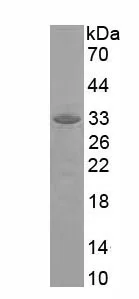 |
Greater than 90% as determined by reducing SDS-PAGE. |
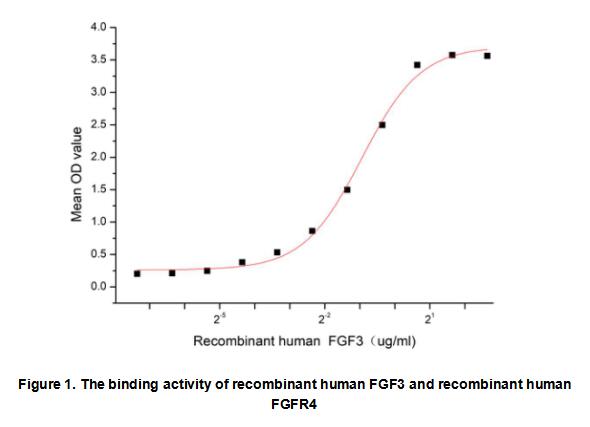 |
Fibroblast Growth Factor 3 (FGF3) also known as INT-2 proto-oncogene protein is a member of the fibroblast growth factor family. FGF family members possess broad mitogenic and cell survival activities and are involved in a variety of biological processes including embryonic development, cell growth, morphogenesis, tissue repair, tumor growth and invasion. Besides, Fibroblast Growth Factor Receptor 4 (FGFR4) has been identified as an interactor of FGF3, thus a binding ELISA assay was conducted to detect the interaction of recombinant human FGF3 and recombinant human FGFR4. Briefly, biotin-linked FGF3 were diluted serially in PBS, with 0.01% BSA (pH 7.4). Duplicate samples of 100 ul were then transferred to FGFR4-coated microtiter wells and incubated for 1h at 37℃. Wells were washed with PBST 3 times and incubation with Streptavidin-HRP for 30min, then wells were aspirated and washed 5 times. With the addition of substrate solution, wells were incubated 15-25 minutes at 37℃. Finally, add 50 µl stop solution to the wells and read at 450 nm immediately. The binding activity of recombinant human FGF3 and recombinant human FGFR4 was shown in Figure 1, the EC50 for this effect is 0.52 ug/mL. |
| 分子别名Alternative Names | HBGF3INT2Heparin-binding growth factor 3Murine Mammary Tumor Virus Integration Site(v-int-2)Oncogene HomologINT-2 Proto-Oncogene ProteinProto-oncogene Int-2 |
|---|---|
| 背景介绍Background | Plays an important role in the regulation of embryonic development, cell proliferation, and cell differentiation. Required for normal ear development. |
| 功能Function | Plays an important role in the regulation of embryonic development, cell proliferation, and cell differentiation. Required for normal ear development. |
| 亚细胞定位Subcellular Location | Secreted. |
| 数据库链接Databases |
基因功能参考文献21 条
- FGFR1 and/or FGF3 gene amplification correlated with a lower pathologic complete response in patients with HER2(+) early breast cancer treated with neoadjuvant anti-HER2 therapy PMID: 28381415 : 28381415
- fibroblast growth factor receptor 3 missense mutations were identified in 5 cases of thanatophoric dysplasia PMID: 28249712 : 28249712
- MCF7 cells over-expressing both WNT1 and FGF3 show a 3.5-fold increase in mammosphere formation; conditioned media from these cells also promotes stem cell activity in untransfected parental MCF7 and T47D cells, as WNT1 and FGF3 are secreted factors. PMID: 26421711 : 26421711
- analysis provided evidence for gene-gene interaction between FGF3 (rs4980700) and PAX9 (rs2073242), increasing risk for isolated oral clefts (p = 0.0003). FGF3 is associated with oral clefts and may interact with PAX9. PMID: 24697712 : 24697712
- haplotypes may contribute to the tendon disease process in elite volleyball athletes PMID: 24661680 : 24661680
- FGF3 gene expression is altered in a human breast cancer progression model. PMID: 25333703 : 25333703
- Higher FGF-23 concentration was associated with LVED mass and with incident atrial fibrillation and may, in part, explain the link between chronic kidney disease and AF. PMID: 24920722 : 24920722
- A de novo 290 kb interstitial duplication of chromosome 11q13.3 including the FGF3 and FGF4 genes. PMID: 24120895 : 24120895
- tooth agenesis had increased risk of a family history of cancer. tooth agenesis was associated with positive self-reported family history of cancer and variants in FGF3. PMID: 23169889 : 23169889
- This study is the first to show a significant association between coronary calcification and elevated serum FGF 23 in children. PMID: 21359960 : 21359960
- confirm the absence of otodental syndrome in heterozygous FGF3 carriers, but report unilateral microtia in one of them PMID: 21480479 : 21480479
- Manifestations of recessive FGF3 mutations range from fully penetrant LAMM syndrome to deafness with residual inner ear structures and, by extension, with minimal syndromic features. PMID: 21306635 : 21306635
- alterations in dosage of the Fgf3 gene cause dental morphological changes PMID: 20018768 : 20018768
- labyrinth aplasia, microtia, and microdontia (LAMM) syndrome, caused by mutations in FGF3 PMID: 19950373 : 19950373
- These findings suggest that the nuclear form of FGF3 inhibits cell proliferation by interfering with ribosomal biogenesis. PMID: 16263090 : 16263090
- Development of the inner ear is completely disturbed at a very early stage--or the otic vesicle is not induced at all--in all of the affected individuals who carried two mutant FGF3 alleles PMID: 17236138 : 17236138
- FGF3, FGF7, FGF10, FGF18, and FGFR1 may have roles in nonsyndromic cleft lip and palate PMID: 17360555 : 17360555
- Implication of FGF3 and FADD in human craniofacial disease. PMID: 17656375 : 17656375
- sequenced the FGF3 gene in 10 unrelated families in which probands had congenital deafness associated with various inner ear anomalies, including Michel aplasia, with or without tooth or external ear anomalies. PMID: 18435799 : 18435799
- study identified a homozygous missense mutation (c.196G-->T) in FGF3 in 21 affected individuals from a large extended family phenotypically characterized by autosomal recessive syndromic congenital sensorineural deafness, microtia and microdontia PMID: 18701883 : 18701883
- Loss of FGFR3 signaling provides evidence that extracellular signals regulate not simply the proliferation or survival of radial glial cells, but specifically their progression to intermediate progenitor cells during neurogenesis in vivo. PMID: 19923290 : 19923290
蛋白复溶体积计算器缓冲液体积 = 蛋白质量 ÷ 蛋白浓度
输入任意两项,第三项自动计算 |
蛋白浓度稀释计算器初浓度 × 初体积 = 终浓度 × 终体积
输入任意三项,第四项自动计算 |



