


| 纯度Purity | Greater than 95% as determined by reducing SDS-PAGE. |
|---|---|
| 内毒素Endotoxin | Please contact with the lab for this information |
| 蛋白构建Protein Construction |
【Met1-Glu93】序列区间
|
| Accession | P05109 |
| 表达宿主Expression Host | E.coli |
| 种属Species | Homo sapiens (Human) |
| 预测分子量Predicted MW | 12.1 kDa |
| 制剂Formulation | Lyophilized from a 0.2 μm filtered solution of 20mM Tris, 150mM NaCl, pH8.0, containing 1mM EDTA, 1mM DTT, 0.01% SKL, 5% Trehalose and Proclin300. |
| 运输方式Shipping | The product is shipped with ice bag. Upon receipt, store it immediately at the temperature listed below. |
| 稳定性&储存Stability & Storage | 12 months at -20°C to -80°C in lyophilized state.6 months at -20°C to -80°C under sterile conditions after reconstitution.7-10 days at 2°C to 8°C under sterile conditions after reconstitution.Please minimize freeze-thaw cycles. |
| 复溶Reconstitution | Reconstitute in 20mM Tris, 150mM NaCl (pH8.0) to a concentration of 0.1-1.0 mg/mL. Do not vortex. |
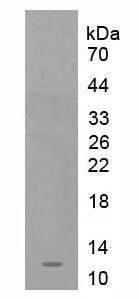 |
Greater than 95% as determined by reducing SDS-PAGE. |
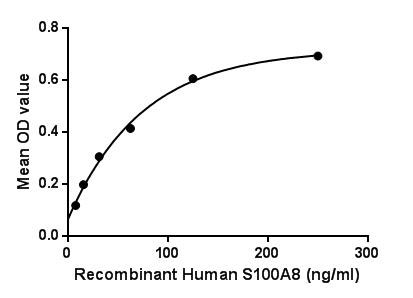 |
Figure. The binding activity of S100A8 with S100A9. S100 calcium-binding protein A8 (S100A8) also known as calgranulin A, is a member of the S100 family of proteins containing 2 EF-hand calcium-binding motifs. S100 proteins are localized in the cytoplasm and/or nucleus of a wide range of cells, and involved in the regulation of a number of cellular processes such as cell cycle progression and differentiation. Besides, S100 Calcium Binding Protein A9 (S100A9) has been identified as an interactor of S100A8, thus a binding ELISA assay was conducted to detect the interaction of recombinant human S100A8 and recombinant human S100A9. Briefly, S100A8 was diluted serially in PBS with 0.01% BSA (pH 7.4). Duplicate samples of 100μL were then transferred to S100A9-coated microtiter wells and incubated for 2h at 37℃. Wells were washed with PBST and incubated for 1h with anti-S100A8 pAb, then aspirated and washed 3 times. After incubation with HRP labelled secondary antibody, wells were aspirated and washed 3 times. With the addition of substrate solution, wells were incubated 15-25 minutes at 37℃. Finally, add 50µL stop solution to the wells and read at 450nm immediately. The binding activity of S100A8 and S100A9 was shown in Figure 1, and this effect was in a dose dependent manner. |
| 分子别名Alternative Names | MRP8MIF60B8AGCAGACFAGCGLACP-10L1AgNIFP8Calgranulin ACystic fibrosis antigenLeukocyte L1 complex light chainMigration inhibitory factor-related protein 8 |
|---|---|
| 背景介绍Background | S100A8 is a calcium- and zinc-binding protein which plays a prominent role in the regulation of inflammatory processes and immune response. It can induce neutrophil chemotaxis and adhesion. Predominantly found as calprotectin (S100A8/A9) which has a wide plethora of intra- and extracellular functions. The intracellular functions include: facilitating leukocyte arachidonic acid trafficking and metabolism, modulation of the tubulin-dependent cytoskeleton during migration of phagocytes and activation of the neutrophilic NADPH-oxidase. Activates NADPH-oxidase by facilitating the enzyme complex assembly at the cell membrane, transferring arachidonic acid, an essential cofactor, to the enzyme complex and S100A8 contributes to the enzyme assembly by directly binding to NCF2/P67PHOX. The extracellular functions involve proinflammatory, antimicrobial, oxidant-scavenging and apoptosis-inducing activities. Its proinflammatory activity includes recruitment of leukocytes, promotion of cytokine and chemokine production, and regulation of leukocyte adhesion and migration. Acts as an alarmin or a danger associated molecular pattern (DAMP) molecule and stimulates innate immune cells via binding to pattern recognition receptors such as Toll-like receptor 4 (TLR4) and receptor for advanced glycation endproducts (AGER). Binding to TLR4 and AGER activates the MAP-kinase and NF-kappa-B signaling pathways resulting in the amplification of the proinflammatory cascade. Has antimicrobial activity towards bacteria and fungi and exerts its antimicrobial activity probably via chelation of Zn(2+) which is essential for microbial growth. Can induce cell death via autophagy and apoptosis and this occurs through the cross-talk of mitochondria and lysosomes via reactive oxygen species (ROS) and the process involves BNIP3. Can regulate neutrophil number and apoptosis by an anti-apoptotic effect; regulates cell survival via ITGAM/ITGB and TLR4 and a signaling mechanism involving MEK-ERK. Its role as an oxidant scavenger has a protective role in preventing exaggerated tissue damage by scavenging oxidants. Can act as a potent amplifier of inflammation in autoimmunity as well as in cancer development and tumor spread. The iNOS-S100A8/A9 transnitrosylase complex directs selective inflammatory stimulus-dependent S-nitrosylation of GAPDH and probably multiple targets such as ANXA5, EZR, MSN and VIM by recognizing a [IL]-x-C-x-x-[DE] motif; S100A8 seems to contribute to S-nitrosylation site selectivity.; (Microbial infection) Upon infection by human coronavirus SARS-CoV-2, may induce expansion of aberrant immature neutrophils in a TLR4-dependent manner. |
| 功能Function | S100A8 is a calcium- and zinc-binding protein which plays a prominent role in the regulation of inflammatory processes and immune response. It can induce neutrophil chemotaxis and adhesion. Predominantly found as calprotectin (S100A8/A9) which has a wide plethora of intra- and extracellular functions. The intracellular functions include: facilitating leukocyte arachidonic acid trafficking and metabolism, modulation of the tubulin-dependent cytoskeleton during migration of phagocytes and activation of the neutrophilic NADPH-oxidase. Activates NADPH-oxidase by facilitating the enzyme complex assembly at the cell membrane, transferring arachidonic acid, an essential cofactor, to the enzyme complex and S100A8 contributes to the enzyme assembly by directly binding to NCF2/P67PHOX. The extracellular functions involve proinflammatory, antimicrobial, oxidant-scavenging and apoptosis-inducing activities. Its proinflammatory activity includes recruitment of leukocytes, promotion of cytokine and chemokine production, and regulation of leukocyte adhesion and migration. Acts as an alarmin or a danger associated molecular pattern (DAMP) molecule and stimulates innate immune cells via binding to pattern recognition receptors such as Toll-like receptor 4 (TLR4) and receptor for advanced glycation endproducts (AGER). Binding to TLR4 and AGER activates the MAP-kinase and NF-kappa-B signaling pathways resulting in the amplification of the proinflammatory cascade. Has antimicrobial activity towards bacteria and fungi and exerts its antimicrobial activity probably via chelation of Zn(2+) which is essential for microbial growth. Can induce cell death via autophagy and apoptosis and this occurs through the cross-talk of mitochondria and lysosomes via reactive oxygen species (ROS) and the process involves BNIP3. Can regulate neutrophil number and apoptosis by an anti-apoptotic effect; regulates cell survival via ITGAM/ITGB and TLR4 and a signaling mechanism involving MEK-ERK. Its role as an oxidant scavenger has a protective role in preventing exaggerated tissue damage by scavenging oxidants. Can act as a potent amplifier of inflammation in autoimmunity as well as in cancer development and tumor spread. The iNOS-S100A8/A9 transnitrosylase complex directs selective inflammatory stimulus-dependent S-nitrosylation of GAPDH and probably multiple targets such as ANXA5, EZR, MSN and VIM by recognizing a [IL]-x-C-x-x-[DE] motif; S100A8 seems to contribute to S-nitrosylation site selectivity.; (Microbial infection) Upon infection by human coronavirus SARS-CoV-2, may induce expansion of aberrant immature neutrophils in a TLR4-dependent manner. |
| 亚细胞定位Subcellular Location | Secreted. Cytoplasm. Cytoplasm, cytoskeleton. Cell membrane; Peripheral membrane protein. Note=Predominantly localized in the cytoplasm. Upon elevation of the intracellular calcium level, translocated from the cytoplasm to the cytoskeleton and the cell membrane. Upon neutrophil activation or endothelial adhesion of monocytes, is secreted via a microtubule-mediated, alternative pathway. |
| 数据库链接Databases |
基因功能参考文献50 条
- Study found that that the co-stimulation with both advanced glycation end-products and Porphyromonas gingivalis LPS increased S100A8 and S100A9 mRNA expression in gingival epithelial cells. These results demonstrated that the upregulation of calprotectin in gingival epithelial cells may primarily function intracellularly in this tissue and may contribute to the pathological process of periodontitis. PMID: 28771806 : 28771806
- Our results showed that S100A8/A9, absent or present at very low level in skin biopsies from healthy subjects, is dramatically upregulated in each epidermal layer from psoriatic patients. PMID: 29605872 : 29605872
- The results suggest that the calcium-binding proteins S100A8 and S100A9 in myeloid cells have an immune regulatory effect. PMID: 29933628 : 29933628
- Median MRP8/14 levels were higher in patients with Takayasu arteritis. PMID: 29196802 : 29196802
- S100A8 gene knockdown reduced cell proliferation in the HEC-1A cells compared with control cells, induced cell apoptosis, inhibited the phosphorylation of protein kinase B (Akt), and induced the expression of pro-apoptotic genes. PMID: 29595187 : 29595187
- Wide intra- and interindividual differences in calprotectin concentrations in the meconium may reflect intestinal inflammation associated with the fetal adaptation to life outside the uterus. PMID: 28463850 : 28463850
- Salivary calprotectin levels were significantly higher in RAS [Recurrent aphthous stomatitis] group (23.72 +/- 4.28 mg/L) compared to the HC [Healthy Controls] (21.59 +/- 4.27 mg/L) (P = 0.013). No significant relationship was found between calprotectin levels and age or gender in both groups (P >0.05). PMID: 29519972 : 29519972
- the levels of S100A8 and S100A9 in the sera, and calprotectin levels in the sera and urines of bladder cancer patients, were determined. PMID: 28609200 : 28609200
- MRP-8/14 concentration increases in coronary artery blood in association with thrombus formation in acute coronary syndrome. PMID: 28986057 : 28986057
- ANGPTL6, S100A8 and S100A9 are overexpressed in skin of psoriasis patients versus zero expression in controls. PMID: 27698489 : 27698489
- Elevated breast cancer cell and stromal S1008 protein expression are significant indicators of poorer outcomes in early stage breast cancer patients. Evaluation of S100A8 protein expression may provide additional prognostic information beyond traditional breast cancer prognostic biomarkers. PMID: 28717852 : 28717852
- S100A8 was required for laser-induced new collagen synthesis in skin cells. PMID: 29270708 : 29270708
- S100A8 methylation has a role in diagnosis and prognosis of hepatocellular carcinoma PMID: 27462864 : 27462864
- This study demonstrated that S100A8 was detected in the serums of Alzheimer disease patients PMID: 27911324 : 27911324
- Studies indicate S100A8 as the most overexpressed gene, and the cell cycle pathway as the most promising biomarker and therapeutic target for relapsed childhood B-acute lymphoblastic leukemia (B-ALL). PMID: 28183295 : 28183295
- Low S100A8 expression is associated with head and neck neoplasms. PMID: 26883112 : 26883112
- Report role of fecal calprotectin assay in the diagnosis and management of inflammatory bowel disease. PMID: 28735301 : 28735301
- S100A8 and S100A9 aggravate Coxsackievirus B3-induced myocarditis and might serve as therapeutic targets in inflammatory cardiomyopathies. PMID: 29158436 : 29158436
- Data suggest that fecal calprotectin may be a potential biomarker to identify patients with ankylosing spondylitis (AS) at risk of developing inflammatory bowel disease (IBD). PMID: 28148281 : 28148281
- Elevated S100A8 and S100A9 gene expression in SP-infected HMEECs and in the middle ear mucosa of OM, minor co-localized with neutrophil markers suggests that middle ear epithelial cell secretion of S100A8 and S100A9 may play a role in the pathogenesis of recurrent and chronic OM PMID: 28964306 : 28964306
- results of this study support an additional role of calprotectin in assessing inflammatory activity in patients with RA PMID: 28832684 : 28832684
- Data show that E3 ubiquitin ligase HRD1 (HRD1) decreased the protein level of S100A8 through ubiquitination. PMID: 28423597 : 28423597
- High S100A8 expression is associated with glioblastoma. PMID: 27006175 : 27006175
- This study implicates S100A8 and S100A9 as important mediators of tumor cell aggressiveness, and highlights the therapeutic potential of S100A8 and S100A9 for interference of metastasis. PMID: 27086923 : 27086923
- Data indicate a statistical correlation between fecal calprotectin (FC) and gastrointestinal graft-versus-host disease (GvHD). PMID: 28293713 : 28293713
- Perinatal alarmins S100A8 and S100A9 specifically altered MyD88-dependent proinflammatory gene programs. S100 programming prevented hyperinflammatory responses without impairing pathogen defense. TRIF-adaptor-dependent regulatory genes remained unaffected by perinatal S100 programming and responded strongly to lipopolysaccharide, but were barely expressed. PMID: 28459433 : 28459433
- Expression of S100A8, S100A9 and S100A12 is modulated by eicosapentaenoic acid and docosahexaenoic acid during Inflammation in adipose tissue and mononuclear cells. PMID: 28125622 : 28125622
- High S100A8 expression is associated with lung metastasis in malignant melanoma. PMID: 27151304 : 27151304
- Data show that the standardized nerve growth factor (NGF) concentration was negatively correlated with continuous pain, neuropathic pain and total score, and the standardized S100 proteins S100A8/A9 concentration was positively correlated with present pain intensity and continuous pain. PMID: 27936243 : 27936243
- S100A8 and S100A9 proteins in concentrations secreted by CD34(-)/CD31(+) circulating angiogenic cells (CACs) with impaired function reduce endothelial cell capillary-like network formation. These effects appear to be mediated by Toll-like receptor 4 and are absent with S100A8 and S100A9 in concentrations secreted by healthy CD34(-)/CD31(+) CACs. PMID: 27793853 : 27793853
- MRP8 elevated serum levels in patients with Behcet's disease indicate MRP8 role in the pathogenetic mechanisms of Behcet's disease. PMID: 25471894 : 25471894
- High baseline serum MRP8/14 levels are associated with lower survival in Chinese peritoneal dialysis patients. PMID: 22699162 : 22699162
- In acute coronary syndromes, MRP8 and MRP8/14 complex are specific ligands of TLR4, which induce the release of TNFalpha and probably other pro-inflammatory agents from monocytes PMID: 21782178 : 21782178
- study revealed a novel role of MRP8/14 in the autophagy-mediated elimination of intracellular BCG by promoting reactive oxygen species generation PMID: 25312864 : 25312864
- MRP8 has a crucial role in stimulating IL-6 expression by rheumatoid arthritis fibroblast-like synoviocytes. PMID: 23619188 : 23619188
- decreased pretreatment levels of myeloid-related protein-8/14 and C-reactive protein may have a role in poor adherence to treatment with tumor necrosis factor inhibitors in juvenile idiopathic arthritis PMID: 27562034 : 27562034
- MRP8/14 can activate cells by binding to TLR4, leading to the release of proinflammatory cytokines. These mediators can lead to increased disease activity in enthesitis-related arthritis. PMID: 24231443 : 24231443
- Fibronectin adhesive capacity and integrin expression of monocytes of type 1 and type 2 diabetic patients is related to the subjects' serum levels of MRP-8. PMID: 15277376 : 15277376
- Excessive release of cytotoxic MRP8/MRP14 by activated phagocytes might therefore present an important molecular pathomechanism contributing to endothelial damage during vasculitis and other inflammatory diseases PMID: 17095618 : 17095618
- MRP8 expression is related to the pathological stage of laryngeal squamous cell carcinoma. PMID: 22256739 : 22256739
- MRP8/14 in ankylosing spondylitis is associated with peripheral arthritis and active disease PMID: 27738838 : 27738838
- Circulating MRP-8/14 is associated with TX-dependent platelet activation in ACS, even during low-dose aspirin treatment, suggesting a contribution of residual TX to MRP-8/14 shedding, which may further amplify platelet activation. PMID: 25037196 : 25037196
- Phosphorylation inhibits tubulin polymerization in microtubules. PMID: 15331440 : 15331440
- Data suggest that tissue infiltrating macrophages secreting MRP8/14 may contribute to myositis, by driving the local production of cytokines directly from muscle. PMID: 24286299 : 24286299
- calprotectin induces IL-6 and MCP-1 production in Human Gingival Fibroblasts via TLR4 signaling that involves MAPK and NF-kappaB, resulting in the progression of periodontitis. PMID: 27925202 : 27925202
- Findings suggest that S100A8/A9 may be involved in the inflammatory response with induction of proinflammatory cytokines and may serve as a clinicopathological marker for disease activity in AOSD. PMID: 27537874 : 27537874
- Peripheral blood levels of S100A8 and TRAF6 in SAE patients were elevated and might be related to the severity of SAE and predict the outcome of SAE. PMID: 27411454 : 27411454
- Low S100A8/A9 levels may contribute to poor wound healing in colonized chronic wounds with striking difference between diabetic foot ulcers and venous leg ulcers. PMID: 27084691 : 27084691
- Suggest that, in individuals with lichen planus, S100A8 may exert distinct immunomodulatory and cytotoxicity functions. PMID: 26632637 : 26632637
- Serum calprotectin was significantly higher in rheumatoid arthritis patients than controls, and was correlated with disease activity. It was higher in seropositive than in seronegative patients. PMID: 26767827 : 26767827
蛋白复溶体积计算器缓冲液体积 = 蛋白质量 ÷ 蛋白浓度
输入任意两项,第三项自动计算 |
蛋白浓度稀释计算器初浓度 × 初体积 = 终浓度 × 终体积
输入任意三项,第四项自动计算 |



