


| 纯度Purity | Greater than 95% as determined by reducing SDS-PAGE. |
|---|---|
| 内毒素Endotoxin | Please contact with the lab for this information |
| 蛋白构建Protein Construction |
【Gln21-Phe180】序列区间
|
| Accession | Q9UHF5 |
| 表达宿主Expression Host | E.coli |
| 种属Species | Homo sapiens (Human) |
| 预测分子量Predicted MW | 22.1 kDa |
| 制剂Formulation | Lyophilized from a 0.2 μm filtered solution of PBS, pH7.4, containing 0.01% SKL, 1mM DTT, 5% Trehalose and Proclin300. |
| 运输方式Shipping | The product is shipped with ice bag. Upon receipt, store it immediately at the temperature listed below. |
| 稳定性&储存Stability & Storage | 12 months at -20°C to -80°C in lyophilized state.6 months at -20°C to -80°C under sterile conditions after reconstitution.7-10 days at 2°C to 8°C under sterile conditions after reconstitution.Please minimize freeze-thaw cycles. |
| 复溶Reconstitution | Reconstitute in 10mM PBS (pH7.4) to a concentration of 0.1-1.0 mg/mL. Do not vortex. |
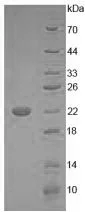 |
Greater than 95% as determined by reducing SDS-PAGE. |
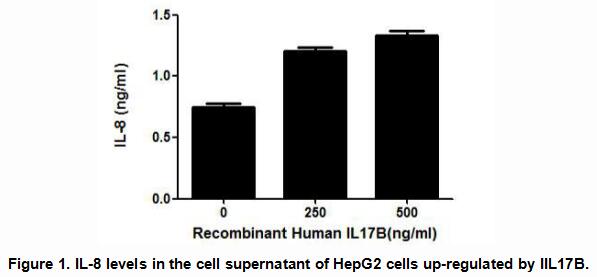 |
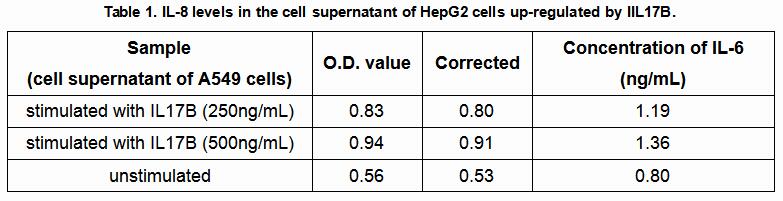
IL17B (Interleukin-17B) is is a T cell-derived cytokine that shares sequence similarity with IL17, which has been proven to mediate potent inflammatory immune response. Besides, increasing evidence suggests that IL17 may play a critical role in various kinds of liver diseases, including hepatocellualar carcinoma. Thus a stimulation assay has been conducted to detect the bioactivity of IL17B. HepG2 cells were seeded into 24-well plate at a density of 1x10⁵ cells/mL, and allowed to attach overnight before treated with or without certain concentrations (250ng/mL, 500ng/mL) of IL17B for 20h and IL-8 levels in the cell supernatant were determined by ELISA. |
 |
| 分子别名Alternative Names | IL-20Cytokine Zcyto7Neuronal interleukin-17-related factor |
|---|---|
| 背景介绍Background | Stimulates the release of tumor necrosis factor alpha and IL-1-beta from the monocytic cell line THP-1. |
| 功能Function | Stimulates the release of tumor necrosis factor alpha and IL-1-beta from the monocytic cell line THP-1. |
| 亚细胞定位Subcellular Location | Secreted. |
| 数据库链接Databases |
基因功能参考文献11 条
- The results indicate that the IL-17B/IL-17RB signaling can promote the growth and migration of tumor cells. PMID: 27146881 : 27146881
- Our data revealed a new mechanism that IL-17B enhanced the progression of gastric cancer by activating mesenchymal stem cells. PMID: 28145881 : 28145881
- Segregation analysis revealed that variants c.475T>G in SKP1, c.671G>A in PROB1, and c.527G>A in IL17B in the 5q31.1-q35.3 linkage region, and c.850G>A in HKDC1 in the 10q22 locus completely segregated with the phenotype in the studied Keratoconus family PMID: 27703147 : 27703147
- This comprehensive review details the recognition of activity, signaling, and the roles of IL17B-IL17RB in breast cancer have caused to determination of new therapeutic mechanisms--{REVIEW} PMID: 28160754 : 28160754
- Studies indicate that interleukin 17 (IL-17B)/interleukin 17 receptor B (IL-17RB) signaling is essential for pancreatic cancer malignancy. PMID: 26285835 : 26285835
- IL-17B-IL-17RB signaling promotes pancreatic cancer malignancy. PMID: 25732306 : 25732306
- Results show that amplified signaling of interleukin-17 receptor B (IL-17RB) and its ligand IL-17B promot tumorigenicity in breast cancer cells and impeded acinus formation in immortalized normal mammary epithelial cells. PMID: 23851503 : 23851503
- IL-17B can enhance the effects of TNF-alpha on the production of cytokines and chemokines that control immune cell trafficking and neutrophil homeostasis in the inflamed tissues. PMID: 24056520 : 24056520
- IL-17A, IL-17B, IL-17F and IL-23 in systemic lupus erythematosus patients were examined and the correlation between levels of the investigated cytokines and VEGF, PIGF, as well as number of endothelial cells, was investigated. PMID: 23661335 : 23661335
- expression and functional study of IL-17B PMID: 22394632 : 22394632
- IL-17 may play an important role in the occurrence of nasal polyps by overexpression. PMID: 16805377 : 16805377
蛋白复溶体积计算器缓冲液体积 = 蛋白质量 ÷ 蛋白浓度
输入任意两项,第三项自动计算 |
蛋白浓度稀释计算器初浓度 × 初体积 = 终浓度 × 终体积
输入任意三项,第四项自动计算 |



