


| 纯度Purity | Greater than 90% as determined by reducing SDS-PAGE. |
|---|---|
| 内毒素Endotoxin | Please contact with the lab for this information |
| 蛋白构建Protein Construction |
【Val128-Asn399】序列区间
|
| Accession | P35869 |
| 表达宿主Expression Host | E.coli |
| 种属Species | Homo sapiens (Human) |
| 预测分子量Predicted MW | 32.2 kDa |
| 制剂Formulation | Lyophilized from a 0.2 μm filtered solution of PBS, pH7.4, containing 0.01% SKL, 1mM DTT, 5% Trehalose and Proclin300. |
| 运输方式Shipping | The product is shipped with ice bag. Upon receipt, store it immediately at the temperature listed below. |
| 稳定性&储存Stability & Storage | 12 months at -20°C to -80°C in lyophilized state.6 months at -20°C to -80°C under sterile conditions after reconstitution.7-10 days at 2°C to 8°C under sterile conditions after reconstitution.Please minimize freeze-thaw cycles. |
| 复溶Reconstitution | Reconstitute in 10mM PBS (pH7.4) to a concentration of 0.1-1.0 mg/mL. Do not vortex. |
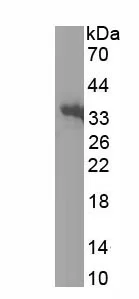 |
Greater than 90% as determined by reducing SDS-PAGE. |
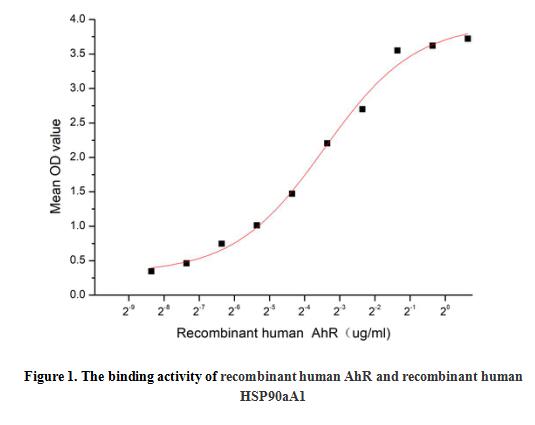 |
Aryl Hydrocarbon Receptor (AhR), also known as bHLHE76, is a 110 kDa member of the bHLH/PAS transcription factor family. It is widely expressed (breast, lung, liver), and serves many functions. It is a ligand-activated transcription factor best known for its role in sensing xenobiotics and regulating the expression of genes involved in xenobiotic metabolism, including drug transporters and drug metabolizing enzymes. Heat Shock Protein 90kDa Alpha A1 (HSP90aA1) has been identified as an interactor of AhR, thus a functional binding ELISA assay was conducted to detect the interaction of recombinant human AhR and recombinant human HSP90aA1. Briefly, AhR were diluted serially in PBS, with 0.01% BSA (pH 7.4). Duplicate samples of 100 µl were then transferred to HSP90aA1-coated microtiter wells and incubated for 1h at 37℃. Wells were washed with PBST and incubated for 1h with anti-AhR pAb, then aspirated and washed 3 times. After incubation with HRP labelled secondary antibody, wells were aspirated and washed 5 times. With the addition of substrate solution, wells were incubated 15-25 minutes at 37℃. Finally, add 50 µL stop solution to the wells and read at 450 nm immediately. The binding activity of AhR and HSP90aA1 was shown in Figure 1, and this effect was in a dose dependent manner, the EC50 for this effect is 0.09 ug/mL. |
| 分子别名Alternative Names | BHLHE76Class E basic helix-loop-helix protein 76 |
|---|---|
| 背景介绍Background | Ligand-activated transcription factor that enables cells to adapt to changing conditions by sensing compounds from the environment, diet, microbiome and cellular metabolism, and which plays important roles in development, immunity and cancer. Upon ligand binding, translocates into the nucleus, where it heterodimerizes with ARNT and induces transcription by binding to xenobiotic response elements (XRE). Regulates a variety of biological processes, including angiogenesis, hematopoiesis, drug and lipid metabolism, cell motility and immune modulation. Xenobiotics can act as ligands: upon xenobiotic-binding, activates the expression of multiple phase I and II xenobiotic chemical metabolizing enzyme genes (such as the CYP1A1 gene). Mediates biochemical and toxic effects of halogenated aromatic hydrocarbons. Next to xenobiotics, natural ligands derived from plants, microbiota, and endogenous metabolism are potent AHR agonists. Tryptophan (Trp) derivatives constitute an important class of endogenous AHR ligands. Acts as a negative regulator of anti-tumor immunity: indoles and kynurenic acid generated by Trp catabolism act as ligand and activate AHR, thereby promoting AHR-driven cancer cell motility and suppressing adaptive immunity. Regulates the circadian clock by inhibiting the basal and circadian expression of the core circadian component PER1. Inhibits PER1 by repressing the CLOCK-ARNTL/BMAL1 heterodimer mediated transcriptional activation of PER1. The heterodimer ARNT:AHR binds to core DNA sequence 5'-TGCGTG-3' within the dioxin response element (DRE) of target gene promoters and activates their transcription. |
| 功能Function | Ligand-activated transcription factor that enables cells to adapt to changing conditions by sensing compounds from the environment, diet, microbiome and cellular metabolism, and which plays important roles in development, immunity and cancer. Upon ligand binding, translocates into the nucleus, where it heterodimerizes with ARNT and induces transcription by binding to xenobiotic response elements (XRE). Regulates a variety of biological processes, including angiogenesis, hematopoiesis, drug and lipid metabolism, cell motility and immune modulation. Xenobiotics can act as ligands: upon xenobiotic-binding, activates the expression of multiple phase I and II xenobiotic chemical metabolizing enzyme genes (such as the CYP1A1 gene). Mediates biochemical and toxic effects of halogenated aromatic hydrocarbons. Next to xenobiotics, natural ligands derived from plants, microbiota, and endogenous metabolism are potent AHR agonists. Tryptophan (Trp) derivatives constitute an important class of endogenous AHR ligands. Acts as a negative regulator of anti-tumor immunity: indoles and kynurenic acid generated by Trp catabolism act as ligand and activate AHR, thereby promoting AHR-driven cancer cell motility and suppressing adaptive immunity. Regulates the circadian clock by inhibiting the basal and circadian expression of the core circadian component PER1. Inhibits PER1 by repressing the CLOCK-ARNTL/BMAL1 heterodimer mediated transcriptional activation of PER1. The heterodimer ARNT:AHR binds to core DNA sequence 5'-TGCGTG-3' within the dioxin response element (DRE) of target gene promoters and activates their transcription. |
| 亚细胞定位Subcellular Location | Cytoplasm. Nucleus. |
| 数据库链接Databases |
基因功能参考文献50 条
- Expression of microRNA potentially regulated by AhR and CAR in malignant tumors of the endometrium has been reported. PMID: 30225717 : 30225717
- The overexpression and activation of AHR are involved in the early development of skin squamous cell carcinomas. AHR expression correlates with EGFR expression and may influence cell proliferation. PMID: 30144817 : 30144817
- These studies identified SNPs that were cis-eQTLs for DEFB1 and AHR and, which were associated with variation in plasma KYN concentrations that were related to severity of major depressive disordersymptoms. PMID: 29317604 : 29317604
- rs2470893 SNP, which maps 196 bp from a CYP1A1 promoter XRE, is associated with variations in 3MC-dependent AHR binding and CYP1A1 expression. PMID: 29980579 : 29980579
- WASH-mediated AHR expression has a critical function in the maintenance of NKp46+ innate lymphoid cells PMID: 28589939 : 28589939
- the protective role of AhR in intestinal barrier function PMID: 29992488 : 29992488
- Elevated AhR expression may be involved in the progression of tissue remodeling in chronic rhinosinusitis without nasal polyp without allergic rhinitis similar to TGF-beta1 expression. Conversely, lower AhR expression may be involved in allergic reactions in chronic rhinosinusitis with nasal polyp with allergic rhinitis. PMID: 29183012 : 29183012
- These results suggest that D-Kyn increases lung cancer cells to metastasize by activating Ahr. PMID: 29442266 : 29442266
- The role of IDO1-IDO2-AHR pathway in the TLR4-induced tolerogenic phenotype in human dendritic cells has been reported. PMID: 28256612 : 28256612
- The association between AHR Arg55Lys polymorphism and male infertility risk was not confirmed (Meta-Analysis) PMID: 29427904 : 29427904
- A meta-analysis of five sets of data evaluated the association of aryl hydrocarbon receptor 1661G>A with male infertility. PMID: 28712079 : 28712079
- IDO decreased glycolysis and glutaminolysis by activating GCN2K, resulting in activation of AMPactivated protein kinase. PMID: 29693118 : 29693118
- AHR inhibition or knockdown/knockout consistently reduced human ER-/PR-/Her2- and inflammatory breast cancer cell invasion, migration, and metastasis. This was associated with a decrease in invasion-associated genes (e.g., Fibronectin, VCAM1, Thrombospondin, MMP1) and an increase in CDH1/E-cadherin, previously associated with decreased tumor aggression. PMID: 29735912 : 29735912
- This study demonstrated that the regulation of AHR expression by miR124 is critical to the development of inflammatory response in chronic rhinosinusitis with nasal polyps. PMID: 29605298 : 29605298
- In human keratinocytes, authors found that perillaldehyde (1) inhibited BaP-induced AHR activation and ROS production, (2) inhibited BaP/AHR-mediated release of the CCL2 chemokine, and (3) activated the NRF2/HO1 antioxidant pathway. PMID: 29643980 : 29643980
- Infants born to women with specific AHR and XRCC1 genotypes may have higher genetic risks for birth weight reduction PMID: 28893607 : 28893607
- ITE suppresses growth of human pulmonary artery endothelial cells independent of AhR PMID: 29140133 : 29140133
- High AHR expression is associated with nerve sheath tumorigenesis. PMID: 29351992 : 29351992
- IRES (ribosome entry site)activity is increased in the PTX-resistant ovarian cancer cells in which AHR protein expression was also enhanced. These results strongly suggest an important role for AHR ribosome entry site (IRES)-dependent translation mechanism in cancer cell response to paclitaxel treatment PMID: 29048649 : 29048649
- AhR activation by FICZ reduces FcepsilonRI and upregulates IDO expression in Langerhans cells. This AhR-mediated anti-inflammatory feedback mechanism may dampen the allergen-induced inflammation in atopic dermatitis. PMID: 28376268 : 28376268
- Report yeast estrogen screen for androgen- and estrogen-receptor mediated activities of 4-hydroxytestosterone, 4-hydroxyandrostenedione and their human metabolites. PMID: 29702199 : 29702199
- Report AhR-dependent transcriptional activity during acute exposure of lung cells to distinct types of environmental pollutants. PMID: 29704546 : 29704546
- The nuclear localization signal (NLS) is closed in the absence of a ligand, the structure of AhR will be changed in the presence of a ligand, which leads to NLS open, result in the nuclear translocation of AhR. PMID: 29092071 : 29092071
- Study provides evidence that AhR plays a critical role in polycyclic aromatic hydrocarbon-mediated DNA damage. PMID: 28886471 : 28886471
- in transcriptionally active heterodimer with ARNT, which recognizes the dioxin response element (DRE) in the promoter of downstream genes, right next to the DRE-docking sites is the extensive dimerization surface that is more hydrophobic than other surface areas, indicating that the dimerization interface of the AHR transcription complex is largely dictated by hydrophobic contacts PMID: 28396409 : 28396409
- AHR signaling is essential for activin A induced regulatory T cells that restrain asthmatic responses. PMID: 28320933 : 28320933
- Aryl hydrocarbon receptor activation induced by FICZ and Glyteer increased the expression of OVOL1 and Filaggrin in a dose- and time-dependent manner in normal human epidermal keratinocytes. PMID: 28703805 : 28703805
- Study shows the Q-rich/PST domain of the aryl hydrocarbon receptor regulates both ligand-induced nuclear transport and nucleocytoplasmic shuttling. PMID: 27535013 : 27535013
- Data suggest that response of bronchial epithelial cells to environmental carcinogen benzo[a]pyrene includes activation of AhR/Src/ERK signaling, CYP1A1 induction, and formation of stable DNA adducts. (AhR = aryl hydrocarbon receptor; Src = Src proto-oncogene kinase; ERK = extracellular signal-regulated kinases; CYP1A1 = cytochrome P450 family 1 subfamily A member 1) PMID: 29545172 : 29545172
- These data support a mechanistic pathway for the putative tumour suppressive role of AHR specifically in pituitary adenomas, possibly through its role as a cell cycle co-regulator, even in the absence of exogenous ligands. PMID: 28649092 : 28649092
- upregulation of mRNA and protein expression is associated with the pathogenesis of unexplained miscarriage PMID: 28503784 : 28503784
- The AhR physiological role in cancer [review] PMID: 28508231 : 28508231
- Our findings suggest that AhR-mediated IL-1beta regulation in cerebral endothelium could induce BBB breakdown and contribute to the pathogenesis of a variety of neurologic disorders. PMID: 28285151 : 28285151
- Ultraviolet B rays suppressed SIRT1 expression by activating AhR, and subsequently inhibited DNMT1 activity in CD4+ T cells from systemic lupus erythematosus patients. PMID: 28336124 : 28336124
- AHR regulated cell proliferation and tumorigenesis by directly targeting and activating HDAC8 expression in hepatocellular carcinoma cells. PMID: 27283490 : 27283490
- Human CCL1 gene is selectively targeted by AhR in M(IL-4) macrophage. IL-4-induced epigenetic modification potentiates AhR-mediated CCL1 expression. PMID: 27888289 : 27888289
- Moreover, time course and promoter activity assays suggest that TIPARP and TIPARP-AS1 work in concert to regulate AHR signaling. Collectively, these data show an added level of complexity in the AHR signaling cascade which involves lncRNAs, whose functions remain poorly understood. PMID: 29274782 : 29274782
- Utilising a three-dimensional lymph endothelial cell (LEC) monolayer & MDA-MB231 breast cancer cell spheroid co-culture model in combination with knock-down approach allowed elucidation of the molecular/biochemical basis of AHR/CYP1A1-induced tumour breaching through the LEC barrier. PMID: 28171546 : 28171546
- breast cancer ER status likely influences AhR activity involved in these signaling pathways. The mechanisms involved in AhR activation and target gene expression in breast cancers are also discussed PMID: 29320557 : 29320557
- AhR modulates hyperoxic lung injury by regulating the genes that are necessary for cell proliferation and inflammation. PMID: 27103661 : 27103661
- This study of human fibroblasts bearing endogenous heterozygous AIP mutations and transfected pituitary GH3 cells shows that AIP mutations affect the AIP protein level and alter AhR transcriptional activity in a gene- and tissue-dependent manner. PMID: 27080473 : 27080473
- We demonstrated that infants whose mothers smoked during pregnancy with the combination of AHR, CYP1A1, and XRCC1 polymorphisms had lower birth size. PMID: 27592400 : 27592400
- A low AHR-expression level in human lung cancer tissues is significantly associated with its malignancy.Cytoplasmic, resting AHR protein acts as an epithelial-mesenchymal transition suppressor via a non-genomic pathway. PMID: 27752740 : 27752740
- Aryl hydrocarbon receptor signaling modifies Toll-like receptor-regulated responses in human dendritic cells. PMID: 27783115 : 27783115
- These findings identify a role for pattern recognition receptor (PRR) signaling in regulating the AHR response through selective down-regulation of Cyp1 expression in human monocytes and macrophages. PMID: 29018148 : 29018148
- The results of the present study suggest that AhR stimulates estrogen-dependent progression of breast carcinoma by inducing aromatase expression under some conditions. These results provide new insights on the possible roles of environmental toxins in breast cancer development. PMID: 27900579 : 27900579
- AHR, CYP1A1, CYP1A2, or CYP1B1 variants associated with head-and-neck squamous cell carcinoma risk in smokers. PMID: 27894333 : 27894333
- Low AHR expression is associated with Prostate Cancer. PMID: 28972393 : 28972393
- activation of the aryl hydrocarbon receptor using the non-toxic agonist 2-(1'H-indole-3'-carbonyl)-thiazole-4-carboxylic acid methyl ester (ITE) induces human regulatory t cells. PMID: 27783946 : 27783946
- this study demonstrates a role for the AHR in regulating human B cell development, and it suggests that transcriptional alterations of EBF1 by the AHR are involved in the underlying mechanism PMID: 28978690 : 28978690
蛋白复溶体积计算器缓冲液体积 = 蛋白质量 ÷ 蛋白浓度
输入任意两项,第三项自动计算 |
蛋白浓度稀释计算器初浓度 × 初体积 = 终浓度 × 终体积
输入任意三项,第四项自动计算 |



