


| 纯度Purity | Greater than 95% as determined by reducing SDS-PAGE. |
|---|---|
| 内毒素Endotoxin | Please contact with the lab for this information |
| 蛋白构建Protein Construction |
【Gly33-Asp168】序列区间
|
| Accession | P21246 |
| 表达宿主Expression Host | E.coli |
| 种属Species | Homo sapiens (Human) |
| 预测分子量Predicted MW | 16.4 kDa |
| 制剂Formulation | Lyophilized from a 0.2 μm filtered solution of PBS, pH7.4, containing 0.01% SKL, 1mM DTT, 5% Trehalose and Proclin300. |
| 运输方式Shipping | The product is shipped with ice bag. Upon receipt, store it immediately at the temperature listed below. |
| 稳定性&储存Stability & Storage | 12 months at -20°C to -80°C in lyophilized state.6 months at -20°C to -80°C under sterile conditions after reconstitution.7-10 days at 2°C to 8°C under sterile conditions after reconstitution.Please minimize freeze-thaw cycles. |
| 复溶Reconstitution | Reconstitute in 10mM PBS (pH7.4) to a concentration of 0.1-1.0 mg/mL. Do not vortex. |
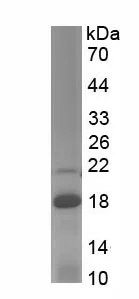 |
Greater than 95% as determined by reducing SDS-PAGE. |
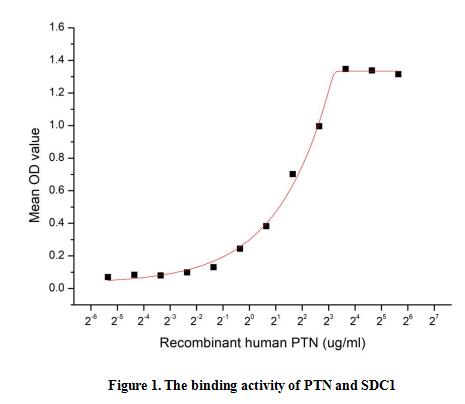 |
Pleiotrophin (PTN) is a 136 amino acid secreted heparin-binding cytokine that signals diverse functions, including lineage-specific differentiation of glial progenitor cells, neurite outgrowth, and angiogenesis. A considerable amount of research has been carried out to understand the mechanisms by which PTN regulates these events. PTN has now been shown to bind a diverse collection of receptors including Syndecan 1 (SDC1). A functional binding ELISA assay was conducted to detect the interaction of recombinant human PTN and recombinant human SDC1. Briefly, PTN were diluted serially in PBS, with 0.01% BSA (pH 7.4). Duplicate samples of 100 µl were then transferred to SDC1-coated (2 ug/ml, 100 ul/well) microtiter wells and incubated for 1h at 37℃. Wells were washed with PBST and incubated for 1h with PTN pAb, then aspirated and washed 3 times. After incubation with HRP labelled secondary antibody, wells were aspirated and washed 5 times. With the addition of substrate solution, wells were incubated 15-25 minutes at 37℃. Finally, add 50µL stop solution to the wells and read at 450nm immediately. The binding activity of recombinant human PTN and recombinant human SDC1 was shown in Figure 1, the EC50 was 3.47 ug/ml. |
| 分子别名Alternative Names | HARPHBGF8HBNFNEGF1Heparin Binding Growth Factor 8Neurite Growth-Promoting Factor 1Heparin Affin Regulatory PeptideHeparin Binding Growth Associated Molecule |
|---|---|
| 背景介绍Background | Secreted growth factor that mediates its signal through cell-surface proteoglycan and non-proteoglycan receptors. Binds cell-surface proteoglycan receptor via their chondroitin sulfate (CS) groups. Thereby regulates many processes like cell proliferation, cell survival, cell growth, cell differentiation and cell migration in several tissues namely neuron and bone. Also plays a role in synaptic plasticity and learning-related behavior by inhibiting long-term synaptic potentiation. Binds PTPRZ1, leading to neutralization of the negative charges of the CS chains of PTPRZ1, inducing PTPRZ1 clustering, thereby causing the dimerization and inactivation of its phosphatase activity leading to increased tyrosine phosphorylation of each of the PTPRZ1 substrates like ALK, CTNNB1 or AFAP1L2 in order to activate the PI3K-AKT pathway. Through PTPRZ1 binding controls oligodendrocyte precursor cell differentiation by enhancing the phosphorylation of AFAP1L2 in order to activate the PI3K-AKT pathway. Forms a complex with PTPRZ1 and integrin alpha-V/beta-3 (ITGAV:ITGB3) that stimulates endothelial cell migration through SRC dephosphorylation and activation that consequently leads to ITGB3 'Tyr-773' phosphorylation. In adult hippocampus promotes dendritic arborization, spine development, and functional integration and connectivity of newborn granule neurons through ALK by activating AKT signaling pathway. Binds GPC2 and chondroitin sulfate proteoglycans (CSPGs) at the neuron surface, leading to abrogation of binding between PTPRS and CSPGs and neurite outgrowth promotion. Binds SDC3 and mediates bone formation by recruiting and attaching osteoblasts/osteoblast precursors to the sites for new bone deposition. Binds ALK and promotes cell survival and cell proliferation through MAPK pathway activation. Inhibits proliferation and enhances differentiation of neural stem cells by inhibiting FGF2-induced fibroblast growth factor receptor signaling pathway. Mediates regulatory mechanisms in normal hemostasis and in hematopoietic regeneration and in maintaining the balance of myeloid and lymphoid regeneration. In addition may play a role in the female reproductive system, auditory response and the progesterone-induced decidualization pathway. |
| 功能Function | Secreted growth factor that mediates its signal through cell-surface proteoglycan and non-proteoglycan receptors. Binds cell-surface proteoglycan receptor via their chondroitin sulfate (CS) groups. Thereby regulates many processes like cell proliferation, cell survival, cell growth, cell differentiation and cell migration in several tissues namely neuron and bone. Also plays a role in synaptic plasticity and learning-related behavior by inhibiting long-term synaptic potentiation. Binds PTPRZ1, leading to neutralization of the negative charges of the CS chains of PTPRZ1, inducing PTPRZ1 clustering, thereby causing the dimerization and inactivation of its phosphatase activity leading to increased tyrosine phosphorylation of each of the PTPRZ1 substrates like ALK, CTNNB1 or AFAP1L2 in order to activate the PI3K-AKT pathway. Through PTPRZ1 binding controls oligodendrocyte precursor cell differentiation by enhancing the phosphorylation of AFAP1L2 in order to activate the PI3K-AKT pathway. Forms a complex with PTPRZ1 and integrin alpha-V/beta-3 (ITGAV:ITGB3) that stimulates endothelial cell migration through SRC dephosphorylation and activation that consequently leads to ITGB3 'Tyr-773' phosphorylation. In adult hippocampus promotes dendritic arborization, spine development, and functional integration and connectivity of newborn granule neurons through ALK by activating AKT signaling pathway. Binds GPC2 and chondroitin sulfate proteoglycans (CSPGs) at the neuron surface, leading to abrogation of binding between PTPRS and CSPGs and neurite outgrowth promotion. Binds SDC3 and mediates bone formation by recruiting and attaching osteoblasts/osteoblast precursors to the sites for new bone deposition. Binds ALK and promotes cell survival and cell proliferation through MAPK pathway activation. Inhibits proliferation and enhances differentiation of neural stem cells by inhibiting FGF2-induced fibroblast growth factor receptor signaling pathway. Mediates regulatory mechanisms in normal hemostasis and in hematopoietic regeneration and in maintaining the balance of myeloid and lymphoid regeneration. In addition may play a role in the female reproductive system, auditory response and the progesterone-induced decidualization pathway. |
| 亚细胞定位Subcellular Location | Secreted. |
| 数据库链接Databases |
基因功能参考文献50 条
- Molecular crosstalk between tumour-associated macrophages and glioma stem cells through PTN-PTPRZ1 paracrine signalling supports glioblastoma malignant growth. PMID: 28569747 : 28569747
- Expression of Mac-1 on the surface of human embryonic kidney (HEK) 293 cells induced their adhesion and migration to PTN. Accordingly, PTN promoted Mac-1-dependent cell spreading and initiated intracellular signaling manifested in phosphorylation of Erk1/2. PMID: 28939773 : 28939773
- This study showed that increased serum pleiotrophin levels are associated with better developed coronary collateral circulation in patients with chronic total occlusion in at least one major coronary artery. PMID: 28885394 : 28885394
- Pleiotrophin, a target of miR-384, promotes proliferation, metastasis and lipogenesis in hepatitis B virus-related hepatocellular carcinoma. PMID: 28557334 : 28557334
- Elevated plasma midkine and pleiotrophin levels in systemic lupus erythematosus (SLE) patients suggest their involvement in this disease. PMID: 27903979 : 27903979
- High PTN and N-syndecan expression was closely associated with metastasis and poor prognosis, suggesting that they may promote tumor progression and perineural invasion in the orthotopic mouse model of pancreatic cancer. PMID: 28638231 : 28638231
- PTN expression in glioma cells is associated with chromosome 7 gain. PTN enhances PDGFB-induced gliomagenesis by stimulating proliferation of neural progenitor cells. PMID: 27806344 : 27806344
- an early extracellular space disruption of PTN composition induces short- and long-term defaults in the establishment of proper functional cerebellar circuit. PMID: 26399645 : 26399645
- NK cells promote fetal development through the secretion of growth-promoting factors, pleiotrophin and osteoglycin. PMID: 29262349 : 29262349
- PTN knockdown attenuated the progression of experimental PVR in vivo. These findings provide new insights into the pathogenesis of PVR. PMID: 28083679 : 28083679
- Annealing helicase HARP closes RPA-stabilized DNA bubbles non-processively. PMID: 28334870 : 28334870
- Neural precursor cell (NPC):glioma cell communication underpins the propensity of glioma to colonize the lateral ventricle subventricular zone (SVZ) through secretion of chemoattractant signals toward which glioma cells home; analyses of SVZ NPC-secreted factors revealed the neurite outgrowth-promoting factor pleiotrophin, with required SPARC/SPARCL1 and HSP90B as mediators of this chemoattractant effect. PMID: 28823557 : 28823557
- these data indicate that PTN-PTPRZ-A signaling controls the timing of oligodendrocyte precursor cell differentiation in vivo, in which the CS moiety of PTPRZ receptors maintains them in a monomeric active state until its ligand binding. PMID: 27445335 : 27445335
- PTN could be considered as a potential biomarker for the presence of breast cancer. PMID: 28041942 : 28041942
- this study shows that the expression of PTN is significantly downregulated in keloid fibroblasts compared to normal human fibroblasts PMID: 27465069 : 27465069
- findings link pleiotrophin abundance in gliomas with survival in humans and mice, and show that pleiotrophin promotes glioma progression through increased VEGF deposition and vascular abnormalization. PMID: 26645582 : 26645582
- PTN levels in amniotic fluid were found to be lower in pregnancies complicated by chorioamnionitis than in healthy pregnancies. PMID: 27089523 : 27089523
- Increased Pleiotrophin Concentrations in Papillary Thyroid Cancer PMID: 26914549 : 26914549
- Data show that binding of pleiotrophin (PTN) to neuropilin-1 (NRP-1) stimulated the internalization and recycling of NRP-1 at the cell surface. PMID: 26408254 : 26408254
- PTN and its signaling components may be of significance in the pathogenesis of epithelial ovarian cancer. PMID: 25418856 : 25418856
- High serum pleiotrophin levels are associated with non-small cell lung cancer. PMID: 25743809 : 25743809
- PTN expression in glioma was higher than in paratumor tissues. Overexpression was associated with the WHO grade, low Karnofsky score, time to recurrence, and poor survival. Co-expression of midkine and PTN had a worse prognosis than either alone. PMID: 25001988 : 25001988
- PTN was found to express abnormally high in lung cancer, especially small cell lung cancer tissue. PMID: 25864755 : 25864755
- antagonizes the cell-cycle-stimulating activity associated with Brd2, thus enhancing induced neuronal differentiation PMID: 24695857 : 24695857
- Over expression of PTN is significantly correlated with poor prognosis in gastric cancer patients. PMID: 25436328 : 25436328
- Suppression of PTN activity with an anti-PTN antibody promoted apoptosis of cells. PMID: 24698102 : 24698102
- pleiotrophin is transactivated directly by SOX2, a transcription factor essential for the maintenance of both neural stem cells and glioblastoma stem cells. PMID: 23686309 : 23686309
- Ligand independent activation of anaplastic lymphoma kinase (ALK) results when the cytokine pleiotrophin (PTN) interacts with its receptor, the receptor protein tyrosine phosphatase beta-zeta (RPTPbeta-zeta). Review) PMID: 23777859 : 23777859
- PTN is able to induce ex vivo angiogenesis during aging. PMID: 23481101 : 23481101
- elevated expression of PTN is likely to be involved in the pathogenesis of hypertrophic scar (HS). PMID: 23054143 : 23054143
- NDC80, NUF2 and PTN were significantly aberrantly overexpressed in serous adenocarcinomas. PMID: 23056589 : 23056589
- Soluble rhMDK, rmMDK and rhPTN were expressed at a high-level and the protein was purified by a one-step purification using heparin affinity chromatography. Activity of purified rhMDK and rhPTN was confirmed by a cell proliferation assay. PMID: 22871361 : 22871361
- pleiotrophin (PTN) was significantly overexpressed across all our macrodactyly samples. The mitogenic functions of PTN correlate closely with the clinical characteristics of macrodactyly. PMID: 22848377 : 22848377
- Data suggest a physiological role for HARP in modulating (i.e., antagonizing) endogenous anticoagulant activity of heparin-like material in the vasculature. PMID: 22672269 : 22672269
- Our data suggest that PTN is implicated in human prostate cancer growth in vivo PMID: 22783964 : 22783964
- this study shows that PTN expression is upregulated in a mouse model of peritoneal fibrosis and is present in human peritoneal tissues and in peritoneal dialysate effluent. PMID: 21881556 : 21881556
- in postmenopausal women, the PTN gene promoter polymorphism -1227C>T and CT haplotype could contribute to the genetic background of osteoporosis. PMID: 21353611 : 21353611
- in the prostate pleiotrophin (Ptn) functions as a regulator of both mesenchymal and epithelial proliferation, and that androgens regulate Ptn levels. PMID: 20812209 : 20812209
- results demonstrate that P(122-131) inhibits biological activities that are related to the induction of a transformed phenotype in PCa cells, by interacing with RPTPbeta-zeta and interfering with other pleiotrophin receptors PMID: 20738847 : 20738847
- The role of PTN and its involvement in tumor growth and angiogenesis, is summarized. PMID: 20167557 : 20167557
- molecular mechanism of the interactions between the oligosaccharides and pleiotrophin PMID: 20584902 : 20584902
- Overexpression of pleiotrophin is associated with glioblastoma. PMID: 20013808 : 20013808
- Midkine and pleiotrophin have bactericidal properties: preserved antibacterial activity in a family of heparin-binding growth factors during evolution. PMID: 20308059 : 20308059
- The data suggest that PTN expression in the human plaques may be in part regulated by IFN-gamma and that PTN is involved in the adaptive immunity. PMID: 19917672 : 19917672
- Using in vitro infection of peripheral blood mononuclear cells or using peripheral blood mononuclear cells from AIDS patients, the authors showed that PTN was sufficient to induce human immunodeficiency virus type 1 (HIV-1) replication. PMID: 20032204 : 20032204
- combination of SDF-1, PTN, IGF2, and EFNB1 mimics the DA phenotype-inducing property of SDIA and was sufficient to promote differentiation of hESC to functional midbrain DA neurons PMID: 19672298 : 19672298
- Pleiotrophin signaling through anaplastic lymphoma kinase is rate-limiting for glioblastoma growth. PMID: 11809760 : 11809760
- overexpression of Pleiotrophin is associated with inflammation and pancreatic cancer PMID: 11895915 : 11895915
- induced the stimulation of tritiated thymidine incorporation in quiescent human peripheral blood mononuclear cells in a dose-dependant manner PMID: 11936877 : 11936877
- PTN induces weak chemotactic and strong haptotactic migration of glioblastoma and cerebral microvascular endothelial cells. PMID: 14692702 : 14692702
蛋白复溶体积计算器缓冲液体积 = 蛋白质量 ÷ 蛋白浓度
输入任意两项,第三项自动计算 |
蛋白浓度稀释计算器初浓度 × 初体积 = 终浓度 × 终体积
输入任意三项,第四项自动计算 |



