


| 纯度Purity | Greater than 90% as determined by reducing SDS-PAGE. |
|---|---|
| 内毒素Endotoxin | Please contact with the lab for this information |
| 蛋白构建Protein Construction |
【Met1-His158】序列区间
|
| Accession | P24666 |
| 表达宿主Expression Host | E.coli |
| 种属Species | Homo sapiens (Human) |
| 预测分子量Predicted MW | 19.2 kDa |
| 制剂Formulation | Lyophilized from a 0.2 μm filtered solution of PBS, pH7.4, containing 0.01% SKL, 1mM DTT, 5% Trehalose and Proclin300. |
| 运输方式Shipping | The product is shipped with ice bag. Upon receipt, store it immediately at the temperature listed below. |
| 稳定性&储存Stability & Storage | 12 months at -20°C to -80°C in lyophilized state.6 months at -20°C to -80°C under sterile conditions after reconstitution.7-10 days at 2°C to 8°C under sterile conditions after reconstitution.Please minimize freeze-thaw cycles. |
| 复溶Reconstitution | Reconstitute in 10mM PBS (pH7.4) to a concentration of 0.1-1.0 mg/mL. Do not vortex. |
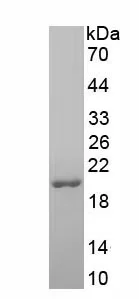 |
Greater than 90% as determined by reducing SDS-PAGE. |
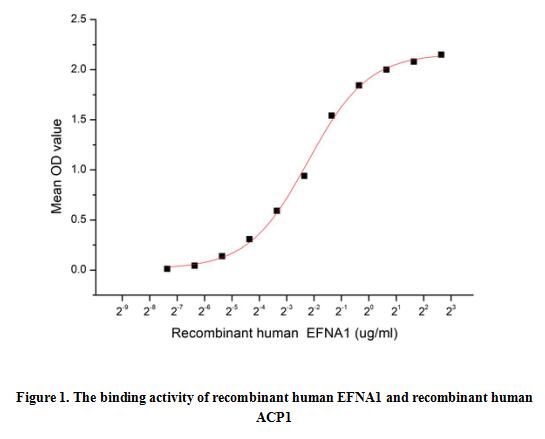 |
Acid phosphatase locus 1 (ACP1) is a low molecular weight protein tyrosine phosphatase that has been shown to be an important regulator of insulin receptor signaling. EFNA1 is a kind of receptor tyrosine kinase which can Interact with ACP1. Thus a functional binding ELISA assay was conducted to detect the interaction of recombinant human EFNA1 and recombinant human ACP1. Briefly, EFNA1 was diluted serially in PBS with 0.01% BSA (pH 7.4). Duplicate samples of 100 μl were then transferred to ACP1-coated microtiter wells and incubated for 1h at 37℃. Wells were washed with PBST and incubated for 1h with anti-EFNA1 pAb, then aspirated and washed 3 times. After incubation with HRP labelled secondary antibody for 1h at 37℃, wells were aspirated and washed 5 times. With the addition of substrate solution, wells were incubated 15-25 minutes at 37℃. Finally, add 50 µL stop solution to the wells and read at 450/630 nm immediately. When recombinant human ACP1 is immobilized at 2 ug/ml (100 ul/well), the concentration of EFNA1 that produces 50% optimal binding response is found to be approximately 0.21 ug/ml. |
| 分子别名Alternative Names | HAAPLow Molecular Weight Phosphotyrosine Protein PhosphataseAdipocyte acid phosphataseRed cell acid phosphatase 1LMW-PTPase |
|---|---|
| 背景介绍Background | Acts on tyrosine phosphorylated proteins, low-MW aryl phosphates and natural and synthetic acyl phosphates. Isoform 3 does not possess phosphatase activity. |
| 功能Function | Acts on tyrosine phosphorylated proteins, low-MW aryl phosphates and natural and synthetic acyl phosphates. Isoform 3 does not possess phosphatase activity. |
| 亚细胞定位Subcellular Location | Cytoplasm. |
| 数据库链接Databases |
基因功能参考文献50 条
- ACP1 may have an important role in regulation of the multiple systems associated with suicide. PMID: 28668716 : 28668716
- Conditioned medium from MDA-MB-231 breast cancer cells with total knockdown of LMW-PTP, but not of slow isoform LMW-PTP, significantly reduced osteoclast differentiation of RAW 264.7 cells. PMID: 29187443 : 29187443
- results confirm the role of TPH1, TPH2, 5HT2A, CRHR1 and ACP1 variants in the risk of suicidal behavior. PMID: 27479537 : 27479537
- These data support that PTPN22 1858C/T, PTPRJ 2965C/G and 1176 A/C polymorphisms and ACP1 A, B and C alleles are not associated with a higher risk of immune thrombocytopenia P in adults. PMID: 27309885 : 27309885
- The LMW-PTP slow isoform can be an important protein in bone metastatic disease, with a fundamental role in the interplay between tumor cells and osteoclasts, through the regulation of Src activity and IL-8 secretion. PMID: 27127127 : 27127127
- Overexpression of LMWPTP in prostate cancer confers a malignant phenotype with worse clinical outcome. PMID: 26159288 : 26159288
- ADA6, PTPN22 and ACP1 are involved in immune reactions: since endometriosis has an autoimmune component. PMID: 26216523 : 26216523
- LMPTP expression increases in end-stage heart failure in humans PMID: 26213100 : 26213100
- Suggest that hypermethylation of ACP1, BMP4, and TSPYL5 are common events in HCC and could be used as potentially detectable biomarkers in HCC tissues. PMID: 26386860 : 26386860
- the present study found that the ACP1*C allele, previously associated with an increased vulnerability to infectious/parasitic diseases may also be able to shape behavioral immune defenses by interaction with the level of E. PMID: 24933463 : 24933463
- Association of an increased risk of coronary artery disease, especially in females, with ACP1 polymorphisms. PMID: 25846885 : 25846885
- ACP1 knockdown attenuates effects of osmotic stress in HaCaT cells, mainly in the status of Src kinase, Rac and STAT5 phosphorylation and activity. PMID: 25781955 : 25781955
- The rs3828329 of ACP1 gene is also a risk factor of CAD in Han Chinese females aged 65 years and older. PMID: 25123136 : 25123136
- ACP1 polymorphism is associated with type 1 diabetes mellitus. PMID: 25125338 : 25125338
- In ACP1 *B/*C genotype, which shows the highest enzymatic activity, spermatic concentration is significantly lower and atypical spermatozoa are significantly more frequent as compared to other ACP1 genotypes. PMID: 23278455 : 23278455
- In Class 3 people the combination of high ACP f-isozyme concentration and the ADA*2 allele, lowers the rate of glycolysis that may reduce the amount of metabolic calories and activates Sirtuin genes that protect cells against age-related diseases. PMID: 23959645 : 23959645
- certain genotypes of ACP1 associated with high phosphatase activity may increase the T-cell response to PF4-heparin complexes, with higher levels of circulating antibodies PMID: 23621699 : 23621699
- A significant increase of PTPN22 *T allele in endometriosis is observed in women carrying ACP1*C allele, in women carrying p53 codon 72 *Pro allele PMID: 23453606 : 23453606
- clarification of the importance of ACP1 in carcinogenesis through the analysis of LMW-PTP interaction with different substrates [review] PMID: 23584899 : 23584899
- The data suggest an interaction between p53 codon 72 and ACP wherein a positive effect of the p53 *Pro allele on susceptibility to coronary artery disease occurs. PMID: 23197232 : 23197232
- mRNA expression of the slow isoform was increased in breast cancer and that of the fast isoform was reduced in breast cancer. PMID: 23645747 : 23645747
- balanced redox-state is required for VEGF to facilitate reversible S-glutathionylation of LMW-PTP, FAK activation and endothelial cell migration PMID: 22854047 : 22854047
- lack of association with inflammatory bowel disease in Spanish patients PMID: 22428720 : 22428720
- There is a significant association between acid phosphatase locus 1 (ACP(1) and cancer grade, mainly due to ACP(1) genotypes carrying the *C allele that are much less represented in patients with low grade when compared with those with high grade. PMID: 22692348 : 22692348
- the ACP1 protein is a tyrosine phosphatase that influences Wnt signaling, a pathway regulated by lithium, making ACP1 a functional candidate for involvement in the phenotype. PMID: 21423239 : 21423239
- Data indicate that ACP1 rs11553742*T with increased susceptibility in systemic lupus erythematosus (SLE) patients. PMID: 22064183 : 22064183
- Gain of the telomeric region 2p25.3 harboring the ACP1 gene is common in CLL (25%, 44 of 178 cases). PMID: 22035742 : 22035742
- the ACP1*C allele influences the risk of cardiovascular disease events in patients with rheumatoid arthritis. PMID: 21767392 : 21767392
- Although both variants dephosphorylate the EPHA2 receptor, the rate and specificity of dephosphorylation for specific tyrosines are different for ACP1 and human cytoplasmic protein tyrosine phosphatase-B. PMID: 21538645 : 21538645
- investigated hypothesis that favism is caused by toxic Vicia faba substances, which in some ACP1 phenotypes cause increased phosphorylation and thus increased glycolysis, with strong reduction in reduced glutathione production, resulting in hemolysis PMID: 21644204 : 21644204
- In overweight women (BMI > 25), the proportion of low activity ACP1 phenotypes is much lower in type 1 diabetes than in gestational diabetes and in healthy females. PMID: 19855922 : 19855922
- the correlation between blood glucose and glycated Hb in relation to AK1 and ACP1 polymorphism was studied. PMID: 20152999 : 20152999
- Type 1 diabetes subjects show a highly significant increase of ACP1*A/ADA1*2 gametic type compared with healthy subjects from the same population (P = 0.003). PMID: 20805743 : 20805743
- association with coronary artery disease evident only in diabetic subjects and dependent on female gender PMID: 20581655 : 20581655
- A significant interaction between ACP1 and ADA1 concerning susceptibility to type 1 diabetes, was revealed. PMID: 19789510 : 19789510
- ACP1 is associated with allergy PMID: 12100313 : 12100313
- Association of the ACP1 genotype with metabolic parameters upon initial diagnosis of type 1 diabetes. PMID: 12640337 : 12640337
- LMW-PTP has a role in immunological synapse establishment and stabilization through the negative control of FAK activity and of cell surface receptor redistribution PMID: 12815062 : 12815062
- The analysis involved the data on nine polymorphic codominant loci: HP, GC, TF, PI, PGM1, GLO1, C3, ACP1, and ESD. The loci were selected by significance of differences in genotype frequencies between tuberculosis patients and healthy controls PMID: 12942785 : 12942785
- We show that the association of STAT5 and LMW-PTP does not exclusively involve the phosphatase active site and phosphotyrosine residue of STAT5. PMID: 14637146 : 14637146
- acid phosphatase 1 contributes to the clinical manifestations of type 2 diabetes and probably also have a marginal influence on susceptibility to the disease PMID: 15281007 : 15281007
- complex interaction among maternal age, sex of infant and ACP1 concerning age at diagnosis of diabetes PMID: 15586390 : 15586390
- Finds ACP1*C is a recessively deleterious allele that reduces viability during early life stages and is not maintained by overdominant selection in European populations. PMID: 15974295 : 15974295
- Significant correlations between LMW-PTP overexpression and the most common clinical-pathological features of cancers exist. In colon cancer and neuroblastoma increased total LMW-PTP mRNA expression correlates with unfavourable outcome. PMID: 16036221 : 16036221
- Crystal structure of the second human low molecular weight PTPase isoenzyme provides the opportunity to examine the structural basis of different substrate and inhibitor/activator responses. PMID: 16253994 : 16253994
- mother/newborn pairs: ACP1 (acid phosphatase 1)distribution has fewer pairs with maternal low ACP1 S isoform and infant high S isoform concentration;Recurrent spontaneous abortion couples show wife low S isoform and husband high S isoform concentration PMID: 16762482 : 16762482
- GRX plays an important role in PDGF-BB-dependent cell proliferation by regulating the redox state of LMW-PTP PMID: 16893901 : 16893901
- Among newborns carrying the ACP1C allele there is an increase of Sex Ratio among the offspring of smoking mothers relative to non-smoking mothers. PMID: 16973312 : 16973312
- Human recombinant LMWPTP-A displayed an RN5Pase activity that was higher than its tyrosine phosphatase activity, indicating that this phosphatase may participate in protein deglycation, a new form of protein repair. PMID: 17472574 : 17472574
- results suggest a cooperative effect of ADA and ACP1 genetic polymorphism on the susceptibility to repeated spontaneous abortion and to some of its clinical characteristics PMID: 17565542 : 17565542
蛋白复溶体积计算器缓冲液体积 = 蛋白质量 ÷ 蛋白浓度
输入任意两项,第三项自动计算 |
蛋白浓度稀释计算器初浓度 × 初体积 = 终浓度 × 终体积
输入任意三项,第四项自动计算 |



