


| 纯度Purity | Greater than 95% as determined by reducing SDS-PAGE. |
|---|---|
| 内毒素Endotoxin | Please contact with the lab for this information |
| 蛋白构建Protein Construction |
【Tyr25-Ser360】序列区间
|
| Accession | P28482 |
| 表达宿主Expression Host | E.coli |
| 种属Species | Homo sapiens (Human) |
| 预测分子量Predicted MW | 42.8 kDa |
| 制剂Formulation | Lyophilized from a 0.2 μm filtered solution of PBS, pH7.4, containing 0.01% SKL, 1mM DTT, 5% Trehalose and Proclin300. |
| 运输方式Shipping | The product is shipped with ice bag. Upon receipt, store it immediately at the temperature listed below. |
| 稳定性&储存Stability & Storage | 12 months at -20°C to -80°C in lyophilized state.6 months at -20°C to -80°C under sterile conditions after reconstitution.7-10 days at 2°C to 8°C under sterile conditions after reconstitution.Please minimize freeze-thaw cycles. |
| 复溶Reconstitution | Reconstitute in 10mM PBS (pH7.4) to a concentration of 0.1-1.0 mg/mL. Do not vortex. |
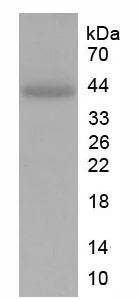 |
Greater than 95% as determined by reducing SDS-PAGE. |
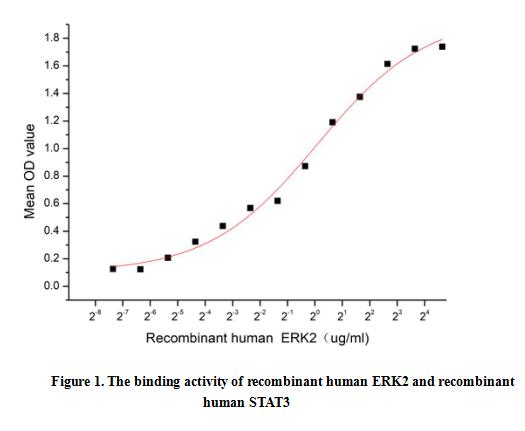 |
Extracellular Signal Regulated Kinase 2 (ERK2) is a 42-kDa protein serine/threonine kinase that is a member of the MAP kinase family. ERK2 is ubiquitously distributed in tissues with the highest expression in heart, brain, and spinal cord. Depending on the cellular context, the MAPK/ERK cascade mediates diverse biological functions such as cell growth, adhesion, survival and differentiation through the regulation of transcription, translation, cytoskeletal rearrangements. The MAPK/ERK cascade also plays a role in initiation and regulation of meiosis, mitosis, and postmitotic functions in differentiated cells by phosphorylating a number of transcription factors. It is reported that ERK2 can interact with STAT3 and treatment of cells with a MEK-ERK inhibitor blocks STAT3 S727 phosphorylation in response to IL-2. Thus a functional ELISA assay was conducted to detect the interaction of recombinant human ERK2 and recombinant human STAT3. Briefly, ERK2 was diluted serially in PBS with 0.01% BSA (pH 7.4). Duplicate samples of 100 μl were then transferred to STAT3-coated microtiter wells and incubated for 1h at 37℃. Wells were washed with PBST and incubated for 1h with anti-ERK2 pAb, then aspirated and washed 3 times. After incubation with HRP labelled secondary antibody for 1h at 37℃, wells were aspirated and washed 5 times. With the addition of substrate solution, wells were incubated 15-25 minutes at 37℃. Finally, add 50 µL stop solution to the wells and read at 450/630nm immediately. The binding activity of recombinant human ERK2 and recombinant human STAT3 was shown in Figure 1, the EC50 for this effect is 1.06 ug/mL. |
| 分子别名Alternative Names | MAPK1P38P40ERK2ERT1MAPK2P42MAPKP42-MAPKPRKM1PRKM2P41P41mapkP41-mapkMitogen-Activated Protein Kinase 1Mitogen-activated protein kinase 2 |
|---|---|
| 背景介绍Background | Serine/threonine kinase which acts as an essential component of the MAP kinase signal transduction pathway. MAPK1/ERK2 and MAPK3/ERK1 are the 2 MAPKs which play an important role in the MAPK/ERK cascade. They participate also in a signaling cascade initiated by activated KIT and KITLG/SCF. Depending on the cellular context, the MAPK/ERK cascade mediates diverse biological functions such as cell growth, adhesion, survival and differentiation through the regulation of transcription, translation, cytoskeletal rearrangements. The MAPK/ERK cascade plays also a role in initiation and regulation of meiosis, mitosis, and postmitotic functions in differentiated cells by phosphorylating a number of transcription factors. About 160 substrates have already been discovered for ERKs. Many of these substrates are localized in the nucleus, and seem to participate in the regulation of transcription upon stimulation. However, other substrates are found in the cytosol as well as in other cellular organelles, and those are responsible for processes such as translation, mitosis and apoptosis. Moreover, the MAPK/ERK cascade is also involved in the regulation of the endosomal dynamics, including lysosome processing and endosome cycling through the perinuclear recycling compartment (PNRC); as well as in the fragmentation of the Golgi apparatus during mitosis. The substrates include transcription factors (such as ATF2, BCL6, ELK1, ERF, FOS, HSF4 or SPZ1), cytoskeletal elements (such as CANX, CTTN, GJA1, MAP2, MAPT, PXN, SORBS3 or STMN1), regulators of apoptosis (such as BAD, BTG2, CASP9, DAPK1, IER3, MCL1 or PPARG), regulators of translation (such as EIF4EBP1) and a variety of other signaling-related molecules (like ARHGEF2, DCC, FRS2 or GRB10). Protein kinases (such as RAF1, RPS6KA1/RSK1, RPS6KA3/RSK2, RPS6KA2/RSK3, RPS6KA6/RSK4, SYK, MKNK1/MNK1, MKNK2/MNK2, RPS6KA5/MSK1, RPS6KA4/MSK2, MAPKAPK3 or MAPKAPK5) and phosphatases (such as DUSP1, DUSP4, DUSP6 or DUSP16) are other substrates which enable the propagation the MAPK/ERK signal to additional cytosolic and nuclear targets, thereby extending the specificity of the cascade. Mediates phosphorylation of TPR in response to EGF stimulation. May play a role in the spindle assembly checkpoint. Phosphorylates PML and promotes its interaction with PIN1, leading to PML degradation. Phosphorylates CDK2AP2.; Acts as a transcriptional repressor. Binds to a [GC]AAA[GC] consensus sequence. Repress the expression of interferon gamma-induced genes. Seems to bind to the promoter of CCL5, DMP1, IFIH1, IFITM1, IRF7, IRF9, LAMP3, OAS1, OAS2, OAS3 and STAT1. Transcriptional activity is independent of kinase activity. |
| 功能Function | Serine/threonine kinase which acts as an essential component of the MAP kinase signal transduction pathway. MAPK1/ERK2 and MAPK3/ERK1 are the 2 MAPKs which play an important role in the MAPK/ERK cascade. They participate also in a signaling cascade initiated by activated KIT and KITLG/SCF. Depending on the cellular context, the MAPK/ERK cascade mediates diverse biological functions such as cell growth, adhesion, survival and differentiation through the regulation of transcription, translation, cytoskeletal rearrangements. The MAPK/ERK cascade plays also a role in initiation and regulation of meiosis, mitosis, and postmitotic functions in differentiated cells by phosphorylating a number of transcription factors. About 160 substrates have already been discovered for ERKs. Many of these substrates are localized in the nucleus, and seem to participate in the regulation of transcription upon stimulation. However, other substrates are found in the cytosol as well as in other cellular organelles, and those are responsible for processes such as translation, mitosis and apoptosis. Moreover, the MAPK/ERK cascade is also involved in the regulation of the endosomal dynamics, including lysosome processing and endosome cycling through the perinuclear recycling compartment (PNRC); as well as in the fragmentation of the Golgi apparatus during mitosis. The substrates include transcription factors (such as ATF2, BCL6, ELK1, ERF, FOS, HSF4 or SPZ1), cytoskeletal elements (such as CANX, CTTN, GJA1, MAP2, MAPT, PXN, SORBS3 or STMN1), regulators of apoptosis (such as BAD, BTG2, CASP9, DAPK1, IER3, MCL1 or PPARG), regulators of translation (such as EIF4EBP1) and a variety of other signaling-related molecules (like ARHGEF2, DCC, FRS2 or GRB10). Protein kinases (such as RAF1, RPS6KA1/RSK1, RPS6KA3/RSK2, RPS6KA2/RSK3, RPS6KA6/RSK4, SYK, MKNK1/MNK1, MKNK2/MNK2, RPS6KA5/MSK1, RPS6KA4/MSK2, MAPKAPK3 or MAPKAPK5) and phosphatases (such as DUSP1, DUSP4, DUSP6 or DUSP16) are other substrates which enable the propagation the MAPK/ERK signal to additional cytosolic and nuclear targets, thereby extending the specificity of the cascade. Mediates phosphorylation of TPR in response to EGF stimulation. May play a role in the spindle assembly checkpoint. Phosphorylates PML and promotes its interaction with PIN1, leading to PML degradation. Phosphorylates CDK2AP2.; Acts as a transcriptional repressor. Binds to a [GC]AAA[GC] consensus sequence. Repress the expression of interferon gamma-induced genes. Seems to bind to the promoter of CCL5, DMP1, IFIH1, IFITM1, IRF7, IRF9, LAMP3, OAS1, OAS2, OAS3 and STAT1. Transcriptional activity is independent of kinase activity. |
| 亚细胞定位Subcellular Location | Cytoplasm, cytoskeleton, spindle. Nucleus. Cytoplasm, cytoskeleton, microtubule organizing center, centrosome. Cytoplasm. Membrane, caveola. Cell junction, focal adhesion. |
| 数据库链接Databases |
基因功能参考文献50 条
- TRIM65 silencing inhibited cell proliferation, promoted cell apoptosis and arrested cell cycle, highly like through blocking ERK1/2 pathway. PMID: 30039885 : 30039885
- Nuclear accumulation of symplekin promotes cellular proliferation and dedifferentiation in an ERK1/2-dependent manner. PMID: 28630428 : 28630428
- Hydrogen bond analyses also prove that Mg(2+) binding increases occupancies of hydrogen bonds formed between ATP and residues K52, Q103, D104, and M106. We expect that this study can provide a significant theoretical hint for designs of anticancer drugs targeting ERK2 PMID: 28030988 : 28030988
- AKR1C3 is a novel epithelial-mesenchymal transition driver in prostate cancer metastasis through activating ERK signaling PMID: 30139661 : 30139661
- Its activation may play a role in therapeutic resistance and disease relapse in head and neck squamous cell carcinoma by maintenance of the cancer stem cell phenotype. PMID: 29575240 : 29575240
- that eukaryotic elongation factor 2 kinase might inhibit TGF-beta1-induced normal lung fibroblast (NHLF) proliferation and differentiation and activate NHLF cell apoptosis and autophagy through p38 MAPK signaling PMID: 29355493 : 29355493
- The activation of p38 in response to low doses of ultraviolet radiation was postulated to be protective for p53-inactive cells. Therefore, MCPIP1 may favor the survival of p53-defective HaCaT cells by sustaining the activation of p38. PMID: 29103983 : 29103983
- the present study demonstrated that scopoletin inhibited MMP1 and proinflammatory cytokine expression by inhibiting p38 MAPK phosphorylation. PMID: 30015831 : 30015831
- High MAPK1 expression is associated with Prostate Cancer. PMID: 29321092 : 29321092
- Role for ERK1/2-dependent activation of FCHSD2 in cancer cell-selective regulation of clathrin-mediated endocytosis. PMID: 30249660 : 30249660
- MiR-451, which is down-regulated in human gastric cancer samples, potently modulated multiple metastatic phenotypes including cell migration, invasion, proliferation, and epithelial-mesenchymal transition. These effects were achieved via down-regulation of the miR-451 target gene, ERK2. PMID: 27780852 : 27780852
- Autophagy protects bone marrow mesenchymal stem cells from palmitate-induced apoptosis through the reactive oxygen speciesJNK/p38 MAPK signaling pathways. PMID: 29901107 : 29901107
- The present study demonstrated that the downregulation of filaggrin in the epidermis by toluene is mediated by ERK1/2 and STAT3-dependent pathways. PMID: 27498358 : 27498358
- The results of the present study suggested that the therapeutic effect of TGP on psoriasis may be mediated by modulation of the p38 MAPK/NFkappaB p65 signaling pathway. The results of the present study contribute to the understanding of the role of TGP in the treatment of psoriasis. The present study provides insights suggesting that p38 MAPK may be a novel regulatory signaling pathway for the treatment of psoriasis. PMID: 29916542 : 29916542
- L5-LDL, a naturally occurring mild oxidized LDL, induced G-CSF and GM-CSF production in human macrophages through LOX-1, ERK2, and NF-kappaB dependent pathways PMID: 29078142 : 29078142
- the MAPKspecific inhibitor SB203580 attenuated the inhibitory effects of 4HPR on the migration of HepG2 cells. Moreover, we also observed that 4HPR inhibited the activation and expression of myosin light chain kinase (MLCK) in HepG2 cells. PMID: 29767236 : 29767236
- Summarizing the obtained results we can postulate p38 implication in H2O2-induced senescence of hMESCs, and suggest p38 inhibition as a promising approach in prevention of premature senescence. PMID: 30192113 : 30192113
- TGFB1-mediated PI3K/Akt and p38 MAP kinase dependent alternative splicing of fibronectin extra domain A in human podocyte culture has been reported. PMID: 29729706 : 29729706
- These data suggest ebselen may inhibit ROS production triggered by H. pylori LPS treatment via GPX2/4 instead of TLR4 signaling and reduce phosphorylation of p38 MAPK, resulting in altered production of IL8. Ebselen may, therefore, be a potential therapeutic agent to mediate H. pylori LPS-induced cell damage. PMID: 29488609 : 29488609
- SHP-2 may augment the ERK1/2 activity and cell proliferation activity in IL-21 signaling. PMID: 29503347 : 29503347
- intact keratin filaments are regulators for PKB/Akt and p44/42 activity, basal and in response to stretch. PMID: 29198699 : 29198699
- High MAPK1 expression is associated with gastric cancer. PMID: 29286172 : 29286172
- Immune profiling of human prostate epithelial cells in health and pathology determined by expression of p38/TRAF-6/ERK MAP kinases pathways has been reported. PMID: 29475459 : 29475459
- activation-loop phosphorylation does not change the average conformation of p38; rather it quenches the loop ps-ns dynamics. PMID: 29666261 : 29666261
- ntermediate Molecular Mass Hyaluronan and CD44 interactions on PMNs potently elicit F-actin cytoskeleton polymerization and p38- and ERK1/2-MAPK phosphorylation to enhance PMN function. PMID: 28730511 : 28730511
- Our results revealed that SChLAP1 may competitively bind miR-198 and modulate the expression of MAPK1 indirectly in prostate cancer cells. PMID: 28492138 : 28492138
- our data indicated that HOTAIR may competitively bind miR-23b and modulate the expression of MAPK1 indirectly in cervical cancer cells PMID: 29335299 : 29335299
- Integrated ERK1/ERK2 response to B-cell receptor stimulation and SF3B1 gene mutations refine prognosis in chronic lymphocytic leukemia. PMID: 27927769 : 27927769
- These findings identified the relationship between ERK1/2 Snitrosylation and phosphorylation. PMID: 29286066 : 29286066
- Our data suggest that TGF-beta1-induced chemokinesis in PDAC cells is mediated through a RAC1/NOX4/ROS/p38 MAPK cascade. PMID: 29039574 : 29039574
- MAPK1 expression was markedly upregulated in epithelial ovarian cancer tissues and inversely correlated with miR320 expression. PMID: 28990044 : 28990044
- CRP bound to surface CD32 (also known as FcgammaRII) on myeloma cells, which activated a pathway mediated by the kinase p38 MAPK and the transcription factor Twist that enhanced the cells' secretion of osteolytic cytokines. PMID: 29233917 : 29233917
- Cold stress-induced ferroptosis involves the ASK1-p38 pathway. PMID: 28887319 : 28887319
- our results revealed that Livin induced EMT through the activation of the p38/GSK3beta pathway, which in turn promoted the progression and metastasis of breast cancer, especially for triple-negative breast cancer (TNBC) PMID: 29039608 : 29039608
- A cellular threshold for active ERK1/2 levels determines Raf/MEK/ERK-mediated growth arrest versus death responses. PMID: 28986121 : 28986121
- ERK1/2/p53/PUMA signaling axis is related to cisplatin-induced cell death in ovarian cancer cells. PMID: 28287251 : 28287251
- DANCR was found to mediate the proliferation and osteogenic differentiation of HBMSCs via p38 MAPK inactivation, but not via extracellular signal-regulated protein kinase (ERK)1/2 or c-Jun N-terminal kinase (JNK) MAPKs, but. PMID: 29115577 : 29115577
- SU-005 inhibited both p38g and p38delta auto-phosphorylation in HeLa and HEK293T cells. PMID: 27431267 : 27431267
- total flavone of Desmodium styracifolium inhibited HK-2 cell apoptosis and autophagy by regulating KIM-1 via p38/MAPK pathway. PMID: 29071538 : 29071538
- VPS4B might facilitate chondrocyte apoptosis in Osteoarthritis via p38 MAPK signaling pathway. PMID: 28744712 : 28744712
- results demonstrated that OEA exerts anti-inflammatory effects by enhancing PPARalpha signaling, inhibiting the TLR4-mediated NF-kappaB signaling pathway, and interfering with the ERK1/2-dependent signaling cascade (TLR4/ERK1/2/AP-1/STAT3), which suggests that OEA may be a therapeutic agent for inflammatory diseases. PMID: 27721381 : 27721381
- findings demonstrate that post-transcriptional regulation via p38 MAPK plays a central role in the rapid synthesis of pro-IL-1beta in response to MSU crystals, which is an essential step for IL-1beta production in human monocytes. PMID: 27694988 : 27694988
- In rheumatoid arthritis (RA), the expression of TREM-2 was reduced at first and then up-regulated after stimulation by TNF-alpha. TREM-2 also inhibited the activation of TNF-alpha induced of inflammation in RA-fibroblast-like synovial cells (FLSs) by the p38 pathway. PMID: 28869414 : 28869414
- ITGA6 might be involved in a mechanism that underlies radiation resistance and that ITGA6 could be a potential target for therapies aimed at overcoming radiation resistance in breast cancer. PMID: 27624978 : 27624978
- the physiological role of the negative crosstalk between the cAMP/PKA/AKAP4 and the PKC/ERK1/2 pathways is to regulate capacitation and acrosome reaction. PMID: 27901058 : 27901058
- EGF-mediated lysosome trafficking, protease secretion, and invasion is regulated by the activity of p38 mitogen activated protein kinase (MAPK) and sodium hydrogen exchangers (NHEs). Interestingly, EGF stimulates anterograde lysosome trafficking through a different mechanism than previously reported for HGF, suggesting that there are redundant signaling pathways that control lysosome positioning PMID: 28978320 : 28978320
- co-treatment with curcumin and cisplatin synergistically induces apoptosis through ROS-mediated activation of ERK1/2 in bladder cancer PMID: 27564099 : 27564099
- epinephrine inhibits the Na+/K+-ATPase by the sequential activation of alpha2 adrenergic receptors, Src, p38MAPK, and ERK leading to PGE2 release. PMID: 29466417 : 29466417
- This study thus characterizes ERK-mediated suppression of TXNIP as a presently unreported mechanism by which ap junctions regulate cell behaviors. PMID: 28694028 : 28694028
- Advanced glycation end products decrease collagen I levels in fibroblasts from the vaginal wall of patients with pelvic organ prolapse via the RAGE, MAPK and NF-kappaB pathways. PMID: 28849117 : 28849117
蛋白复溶体积计算器缓冲液体积 = 蛋白质量 ÷ 蛋白浓度
输入任意两项,第三项自动计算 |
蛋白浓度稀释计算器初浓度 × 初体积 = 终浓度 × 终体积
输入任意三项,第四项自动计算 |



