


| 纯度Purity | Greater than 97% as determined by reducing SDS-PAGE. |
|---|---|
| 内毒素Endotoxin | Please contact with the lab for this information |
| 蛋白构建Protein Construction |
【Thr47-Ser219】序列区间
|
| Accession | Q5ZPR3 |
| 表达宿主Expression Host | E.coli |
| 种属Species | Homo sapiens (Human) |
| 预测分子量Predicted MW | 22.4 kDa |
| 制剂Formulation | Lyophilized from a 0.2 μm filtered solution of 20mM Tris, 150mM NaCl, pH8.0, containing 1mM EDTA, 1mM DTT, 0.01% SKL, 5% Trehalose and Proclin300. |
| 运输方式Shipping | The product is shipped with ice bag. Upon receipt, store it immediately at the temperature listed below. |
| 稳定性&储存Stability & Storage | 12 months at -20°C to -80°C in lyophilized state.6 months at -20°C to -80°C under sterile conditions after reconstitution.7-10 days at 2°C to 8°C under sterile conditions after reconstitution.Please minimize freeze-thaw cycles. |
| 复溶Reconstitution | Reconstitute in 20mM Tris, 150mM NaCl (pH8.0) to a concentration of 0.1-1.0 mg/mL. Do not vortex. |
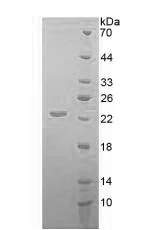 |
Greater than 97% as determined by reducing SDS-PAGE. |
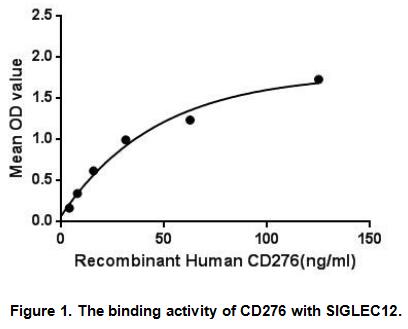 |
Cluster Of Differentiation 276 (CD276) also known as B7-H3 in human, is a member of the B7/CD28 superfamily of costimulatory molecules serving as an accessory modulator of T-cell response. B7 proteins are immunoglobulin (Ig) superfamily members with extracellular Ig-V-like and Ig-C-like domains and short cytoplasmic domains. Among the family members, they share about 20-40% amino acid (aa) sequence identity. CD276 may play a protective role in tumor cells by inhibiting natural-killer mediated cell lysis as well as a role of marker for detection of neuroblastoma cells. It has also been found to enhance the induction of primary cytotoxic T lymphocytes and stimulate IFN-gamma production. Besides, Sialic acid-binding Ig-like lectin 12 (SIGLEC12) has been identified as an interactor of CD276, thus a binding ELISA assay was conducted to detect the interaction of recombinant human CD276 and recombinant human SIGLEC12. Briefly, CD276 were diluted serially in PBS, with 0.01% BSA (pH 7.4). Duplicate samples of 100uL were then transferred to SIGLEC12-coated microtiter wells and incubated for 2h at 37℃. Wells were washed with PBST and incubated for 1h with anti-CD276 pAb, then aspirated and washed 3 times. After incubation with HRP labelled secondary antibody, wells were aspirated and washed 3 times. With the addition of substrate solution, wells were incubated 15-25 minutes at 37℃. Finally, add 50µL stop solution to the wells and read at 450nm immediately. The binding activity of CD276 and SIGLEC12 was shown in Figure 1, and this effect was in a dose dependent manner. |
| 分子别名Alternative Names | B7-H3B7H3CD276 MoleculeB7 homolog 3Costimulatory molecule |
|---|---|
| 背景介绍Background | Earlier studies found that B7H3 (also known as B7H3) promotes the activation of T cells. Chapoval et al. confirmed that in the presence of anti-CD3 antibodies, B7H3 can promote the proliferation of CD4 and CD8+ T cells and selectively promote the secretion of IFN-γ. And B7H3 transfection into tumor cells can enhance the killing ability of CTL. Further research found that only TLT-2 transgenic cells could bind to mouse B7H3 with high affinity, and TLT-2 was determined to be the receptor molecule of B7H3. Moreover, Hashiguchi et al. confirmed that the B7H3-TLT-2 pathway enhanced T cell activation. However, Leitner et al. did not find the specific binding of B7H3 to TLT-2 by flow cytometry, therefore, the exact receptor molecule of B7H3 is still unclear.On the other hand, studies have found that B7H3 can also suppress T-cell immune responses. Some studies have shown that B7H3 can inhibit human and mouse T cells by activating or inhibiting NFTA (nuclear factor for activated T cells), NF-KB (nuclear factor kB) and AP-1 (activator protein-1) pathways. activation. In addition, results have demonstrated that B7H3 may inhibit T cell immune responses by inhibiting the activity of Thl. The study of Leiner et al. also found that B7H3 can down-regulate the secretion of IL-2 in T cells to inhibit the activity of T cells. |
| 功能Function | Earlier studies found that B7H3 (also known as B7H3) promotes the activation of T cells. Chapoval et al. confirmed that in the presence of anti-CD3 antibodies, B7H3 can promote the proliferation of CD4 and CD8+ T cells and selectively promote the secretion of IFN-γ. And B7H3 transfection into tumor cells can enhance the killing ability of CTL. Further research found that only TLT-2 transgenic cells could bind to mouse B7H3 with high affinity, and TLT-2 was determined to be the receptor molecule of B7H3. Moreover, Hashiguchi et al. confirmed that the B7H3-TLT-2 pathway enhanced T cell activation. However, Leitner et al. did not find the specific binding of B7H3 to TLT-2 by flow cytometry, therefore, the exact receptor molecule of B7H3 is still unclear.On the other hand, studies have found that B7H3 can also suppress T-cell immune responses. Some studies have shown that B7H3 can inhibit human and mouse T cells by activating or inhibiting NFTA (nuclear factor for activated T cells), NF-KB (nuclear factor kB) and AP-1 (activator protein-1) pathways. activation. In addition, results have demonstrated that B7H3 may inhibit T cell immune responses by inhibiting the activity of Thl. The study of Leiner et al. also found that B7H3 can down-regulate the secretion of IL-2 in T cells to inhibit the activity of T cells. |
| 亚细胞定位Subcellular Location | Membrane; Single-pass type I membrane protein. |
| 数据库链接Databases |
基因功能参考文献50 条
- High B7-H3 expression is associated with phyllodes tumors. PMID: 30486739 : 30486739
- characterization of the expression pattern and biological function of B7-H3 in brain gliomas; B7-H3 expression is regulated by multiple mechanisms and is potentially involved in the T-cell receptor signaling pathway; higher B7-H3 expression indicates a worse prognosis for glioma patients PMID: 30027617 : 30027617
- High expression level of B7H3 in muscleinvasive bladder cancer (MIBC) tissues is associated with a poor clinico-pathological status and poor prognosis, and promotes the development of MIBC in vitro and in vivo. PMID: 30132557 : 30132557
- Tumor B7-H3 expression was significantly higher in immunocompetent vs. immunosuppressed patients, largely driven by very low expression in HIV+ patients. PMID: 29484464 : 29484464
- Colorectal cancer (CRC) patients expressing both high B7-H3 and high B3GALT4 contributed to a significant decrease in overall survival. The expression of B3GALT4 in CRC is positively correlated with B7-H3 expression in vitro. B7-H3/B3GLAT4 may be used as dual prognostic biomarkers for CRC. PMID: 30131660 : 30131660
- this study shows reduced sB7-H3 expression in the peripheral blood of systemic lupus erythematosus patients PMID: 29423417 : 29423417
- High B7-H3 expression is associated with cervical cancer invasiveness. PMID: 28627681 : 28627681
- IDH1 and B7H3 cannot be used as independent prognostic factors, co-expression of IDH1 and B7H3 significantly correlated with the prognosis of CRC patients and may serve as a combined predictive marker. Thus, the correlation between IDH1 and B7H3 has been proven in vivo and in vitro. PMID: 29871819 : 29871819
- Our findings revealed that B7-H3 affect ovarian cancer progression through the Jak2/Stat3 pathway, indicating that B7-H3 has the potential to be a useful prognostic marker. PMID: 28765941 : 28765941
- metastatic melanoma cells with knockdown expression of B7-H3 showed modest decrease in proliferation and glycolytic capacity. PMID: 28513992 : 28513992
- results suggest that B7-H3 may be a valuable biomarker in determining tumor progression and prognosis of intrahepatic cholangiocarcinoma PMID: 29696716 : 29696716
- these results demonstrate that sB7-H3 promotes invasion and metastasis through the TLR4/NF-kappaB pathway in pancreatic carcinoma PMID: 27273624 : 27273624
- Inhibition of the B7-H3 immune checkpoint limits tumor growth by enhancing cytotoxic lymphocyte function PMID: 28685773 : 28685773
- Higher B7-H3 expression correlates with Gleason grade, prostate cancer stage and poor oncologic outcomes in prostatectomy cohorts. B7-H3 expression appears to be related to androgen signaling as well as the immune reactome. PMID: 27801901 : 27801901
- Review/Meta-analysis: High B7-H3 expression was a significant indicator of lymph node metastasis and advanced TNM stage in non-small cell lung cancer. PMID: 27835582 : 27835582
- B7-H3 promotes epithelial mesenchymal transformation in colorectal cancer cells by activating the PI3K-Akt pathway and upregulating the expression of Smad1. PMID: 27145365 : 27145365
- Plasma B7-H3 levels were decreased significantly in children subjected to pediatric general and cardiac surgery, which is closely associated with the severity of surgical stress. The negative correlation of plasma B7-H3 levels at day 1 and day 3 after surgery with surgical stress scoring implicates that the plasma B7-H3 level might be a useful biomarker for monitoring stress intensity during pediatric surgery. PMID: 27459969 : 27459969
- B7-H3 promotes the oxaliplatin resistance in colorectal cancer cells upregulating the expression of XRCC1 via PI3K-AKT pathway. PMID: 28676400 : 28676400
- Children with Mycoplasma pneumoniae pneumonia had significantly higher levels of sB7-H3 and IL-36 compared to control subjects. PMID: 27188891 : 27188891
- CD276 is broadly expressed by tumor cells and tumor vasculature but Is dispensable for tumor growth. PMID: 28399408 : 28399408
- B7-H3 hijacks SREBP-1/FASN signaling mediating abnormal lipid metabolism in lung cancer PMID: 27939887 : 27939887
- We found that B7-H3 promoted the Warburg effect, evidenced by increased glucose uptake and lactate production in B7-H3-expressing cells. B7-H3 also increased the protein levels of HIF1alpha and its downstream targets, LDHA and PDK1, key enzymes in the glycolytic pathway PMID: 27197253 : 27197253
- Upregulated sB7-H3 expression in MPEs is correlated with TNM stage of NSCLC and may serve as a potential biomarker for NSCLC-derived MPEs PMID: 27071700 : 27071700
- High expression of B7-H3 is associated with Colorectal cancer. PMID: 26787540 : 26787540
- Elevated B7-H3 expression is significantly associated with poor survival in cancer patients. (Meta-analysis) PMID: 27626927 : 27626927
- The results provide novel insights into the function of B7-H3 in cancer, and suggest that targeting of B7-H3 may be a novel alternative to improve current anticancer therapies. PMID: 26771843 : 26771843
- Suggesting that B7-H3 and Tregs may act cooperatively in tumor immune evasion, leading to poor outcomes for NSCLC patients. PMID: 26823710 : 26823710
- B7-H3 is one of the most strongly expressed B7-family molecules in AML and merits further investigation. PMID: 26376842 : 26376842
- findings demonstrate that activation-induced B7-H3 expression on synovial monocytes has the potential to inhibit Th1-mediated immune responses and immunomodulatory roles affecting RA pathogenesis. PMID: 26702052 : 26702052
- B7H3 promotes cell migration and invasion through the Jak2/Stat3/MMP9 signaling pathway in colorectal cancer PMID: 26151358 : 26151358
- B7-H1 and B7-H3 are independent predictors of poorer survival in patients with non-small cell lung cancer. PMID: 25609202 : 25609202
- B7-H3 may play an important role in asthma exacerbation and was a useful clinical biomarker to evaluate asthma exacerbation. PMID: 26108069 : 26108069
- found that the N-glycans of B7-H3 from Ca9-22 oral cancer cells contain the terminal alpha-galactose and are more diverse with higher fucosylation and better interaction with DC-SIGN and Langerin on immune cells than that from normal cells PMID: 26438868 : 26438868
- Study shows that B7-H3 promotes mantle cell lymphoma progression and its knockdown significantly enhances the chemosensitivity. PMID: 25872657 : 25872657
- These results demonstrated that B7-H3 expression in acute leukemia predicts an unfavorable outcome. PMID: 25130683 : 25130683
- Our results indicate that B7-H3 expression in cervical invasive squamous cell carcinoma may play an important role in overcoming CD8(+) T-cell immunoregulation to acquire aggressive growth. PMID: 25675190 : 25675190
- Data shows that B7-H3 is aberrantly expressed in gastric cancer. In addition to modulating tumor immunity, B7-H3 may have a novel role in regulating SGC-7901 cell metastasis. PMID: 25120098 : 25120098
- Overexpression of B7-H3 in CD14+ monocytes is associated with renal cell carcinoma progression.B7-H3 might play an important role in angiogenesis of renal cell carcinoma mediated by CD14(+) monocytes. PMID: 25416051 : 25416051
- Data show that immunoglobulin-like transcript 4 (ILT4) increases the expression of the co-inhibitory molecule B7-H3 through PI3K/AKT/mTOR signalling. PMID: 26149216 : 26149216
- IL-2/IL-2R and B7-H3 pathways may be involved in the progression of clear cell renal cell carcinoma PMID: 25089268 : 25089268
- The overexpression of B7-H3 induces resistance to apoptosis in colorectal cancer cell lines by upregulating the Jak2-STAT3 signaling pathway. PMID: 25684945 : 25684945
- B7-H3 was significantly up-regulated on monocytes in rheumatoid arthritis patients, while soluble B7-H3 in serum was decreased. A polymorphism variant, B7-H3-T-A-C-T, was shown to be associated with the incidence of RA and the decreased release of sB7-H3. PMID: 25931383 : 25931383
- B7-H3-mediated STAT3 signaling pathway is an important mechanism for inducing M2-type polarization of tumor associated macrophages. PMID: 25370943 : 25370943
- The study confirms the overexpression of B7-H3 in colorectal cancer and shows the main localization of the protein in cytoplasm and cell membrane. PMID: 25139714 : 25139714
- High level of serum B7-H3 in patients with Hepatocellular Carcinoma is caused by the increased expression of a newly discovered spliced soluble B7-H3 isoform in carcinoma and peritumor tissues. PMID: 24194851 : 24194851
- Data indicate that six sites of co-stimulatory molecule B7-H3 gene have single nucleotide polymorphisms variations and five sites are related to the pathogenesis of rheumatoid arthritis (RA). PMID: 25200161 : 25200161
- Study shows that CD276 can be used to discriminate ECs from malignant tissue from ECs from normal tissue. In addition, CD276(+) CEC do occur in higher frequencies in patients with advanced cancer. PMID: 24892449 : 24892449
- Data indicate that the expression of membrane B7-H3 (mB7-H3) in peri-tumor normal tissues was higher than that in tumor tissues, and it can serve as an assistant diagnostic marker for hepatitis B virus-associated hepatocellular carcinoma (HBV-HCC). PMID: 25001942 : 25001942
- B7H3 and ATP1B3 are overexpressed in tumor endothelial cells, favoring an angiogenic phenotype. PMID: 24236063 : 24236063
- Thus, B7-H3 may have a critical role in primary hepatocellular carcinoma and it may enhance tumor escape from the immune surveillance of CD8(+) T cells. PMID: 24787022 : 24787022
蛋白复溶体积计算器缓冲液体积 = 蛋白质量 ÷ 蛋白浓度
输入任意两项,第三项自动计算 |
蛋白浓度稀释计算器初浓度 × 初体积 = 终浓度 × 终体积
输入任意三项,第四项自动计算 |



