


| 纯度Purity | Greater than 90% as determined by reducing SDS-PAGE. |
|---|---|
| 内毒素Endotoxin | Please contact with the lab for this information |
| 蛋白构建Protein Construction |
【Pro47-Gly245】序列区间
|
| Accession | O60603 |
| 表达宿主Expression Host | E.coli |
| 种属Species | Homo sapiens (Human) |
| 预测分子量Predicted MW | 36.0 kDa |
| 制剂Formulation | Lyophilized from a 0.2 μm filtered solution of PBS, pH7.4, containing 0.01% SKL, 1mM DTT, 5% Trehalose and Proclin300. |
| 运输方式Shipping | The product is shipped with ice bag. Upon receipt, store it immediately at the temperature listed below. |
| 稳定性&储存Stability & Storage | 12 months at -20°C to -80°C in lyophilized state.6 months at -20°C to -80°C under sterile conditions after reconstitution.7-10 days at 2°C to 8°C under sterile conditions after reconstitution.Please minimize freeze-thaw cycles. |
| 复溶Reconstitution | Reconstitute in 10mM PBS (pH7.4) to a concentration of 0.1-1.0 mg/mL. Do not vortex. |
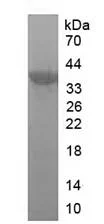 |
Greater than 90% as determined by reducing SDS-PAGE. |
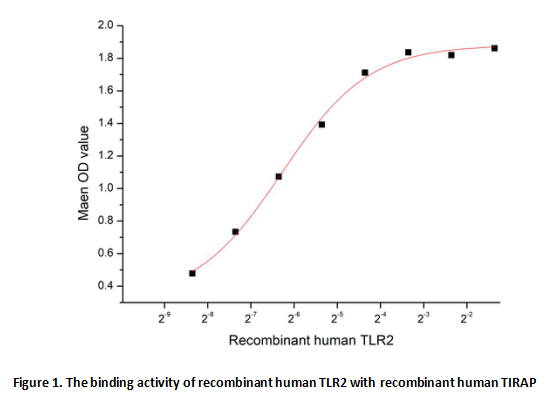 |
TLR2 is a member of TLR family which is type I transmembrane proteins with a large number of extracellular leucine-rich repeats (LRRs) and a cytoplasmic Toll/IL-1 receptor (TIR) domain. Human TLR2 is synthesized as a 784 amino acid precursor that contains a signal sequence (aa 1-18), an extracellular domain (aa 19-588) with approximately 20 LRRs, a transmembrane segment (aa 589-609), and a cytoplasmic TIR domain (aa 610-784). The receptor is expressed on a number of cell types including monocytes, dendritic cells, neutrophils, B cells, endothelial cells and hepatocytes. TLR2 stimulation induces mTORC1 activation through TIRAP, which is essential for TLR2-mediated IFN-γ production. Thus a functional binding ELISA assay was conducted to detect the interaction of recombinant human TLR2 and recombinant human TIRAP. Briefly, TLR2 were diluted serially in PBS, with 0.01% BSA (pH7.4). Duplicate samples of 100 ul were then transferred to TIRAP-coated microtiter wells and incubated for 1h at 37℃. Wells were washed with PBST and incubated for 1h with anti-TLR2 pAb, then aspirated and washed 3 times. After incubation with HRP labelled secondary antibody, wells were aspirated and washed 5 times. With the addition of substrate solution, wells were incubated 15-25 minutes at 37℃. Finally, add 50 µL stop solution to the wells and read at 450 nm immediately. The binding activity of TLR2 and TIRAP was shown in Figure 1, and this effect was in a dose dependent manner, the EC50 was 0.013 ug/ml. |
| 分子别名Alternative Names | CD282TIL4Toll/interleukin-1 receptor-like protein 4 |
|---|---|
| 背景介绍Background | Cooperates with LY96 to mediate the innate immune response to bacterial lipoproteins and other microbial cell wall components. Cooperates with TLR1 or TLR6 to mediate the innate immune response to bacterial lipoproteins or lipopeptides. Acts via MYD88 and TRAF6, leading to NF-kappa-B activation, cytokine secretion and the inflammatory response. May also activate immune cells and promote apoptosis in response to the lipid moiety of lipoproteins. Recognizes mycoplasmal macrophage-activating lipopeptide-2kD (MALP-2), soluble tuberculosis factor (STF), phenol-soluble modulin (PSM) and B.burgdorferi outer surface protein A lipoprotein (OspA-L) cooperatively with TLR6. Stimulation of monocytes in vitro with M.tuberculosis PstS1 induces p38 MAPK and ERK1/2 activation primarily via this receptor, but also partially via TLR4. MAPK activation in response to bacterial peptidoglycan also occurs via this receptor. Acts as a receptor for M.tuberculosis lipoproteins LprA, LprG, LpqH and PstS1, some lipoproteins are dependent on other coreceptors (TLR1, CD14 and/or CD36); the lipoproteins act as agonists to modulate antigen presenting cell functions in response to the pathogen. M.tuberculosis HSP70 (dnaK) but not HSP65 (groEL-2) acts via this protein to stimulate NF-kappa-B expression. Recognizes M.tuberculosis major T-antigen EsxA (ESAT-6) which inhibits downstream MYD88-dependent signaling (shown in mouse). Forms activation clusters composed of several receptors depending on the ligand, these clusters trigger signaling from the cell surface and subsequently are targeted to the Golgi in a lipid-raft dependent pathway. Forms the cluster TLR2:TLR6:CD14:CD36 in response to diacylated lipopeptides and TLR2:TLR1:CD14 in response to triacylated lipopeptides. Required for normal uptake of M.tuberculosis, a process that is inhibited by M.tuberculosis LppM. |
| 功能Function | Cooperates with LY96 to mediate the innate immune response to bacterial lipoproteins and other microbial cell wall components. Cooperates with TLR1 or TLR6 to mediate the innate immune response to bacterial lipoproteins or lipopeptides. Acts via MYD88 and TRAF6, leading to NF-kappa-B activation, cytokine secretion and the inflammatory response. May also activate immune cells and promote apoptosis in response to the lipid moiety of lipoproteins. Recognizes mycoplasmal macrophage-activating lipopeptide-2kD (MALP-2), soluble tuberculosis factor (STF), phenol-soluble modulin (PSM) and B.burgdorferi outer surface protein A lipoprotein (OspA-L) cooperatively with TLR6. Stimulation of monocytes in vitro with M.tuberculosis PstS1 induces p38 MAPK and ERK1/2 activation primarily via this receptor, but also partially via TLR4. MAPK activation in response to bacterial peptidoglycan also occurs via this receptor. Acts as a receptor for M.tuberculosis lipoproteins LprA, LprG, LpqH and PstS1, some lipoproteins are dependent on other coreceptors (TLR1, CD14 and/or CD36); the lipoproteins act as agonists to modulate antigen presenting cell functions in response to the pathogen. M.tuberculosis HSP70 (dnaK) but not HSP65 (groEL-2) acts via this protein to stimulate NF-kappa-B expression. Recognizes M.tuberculosis major T-antigen EsxA (ESAT-6) which inhibits downstream MYD88-dependent signaling (shown in mouse). Forms activation clusters composed of several receptors depending on the ligand, these clusters trigger signaling from the cell surface and subsequently are targeted to the Golgi in a lipid-raft dependent pathway. Forms the cluster TLR2:TLR6:CD14:CD36 in response to diacylated lipopeptides and TLR2:TLR1:CD14 in response to triacylated lipopeptides. Required for normal uptake of M.tuberculosis, a process that is inhibited by M.tuberculosis LppM. |
| 亚细胞定位Subcellular Location | Membrane; Single-pass type I membrane protein. Cytoplasmic vesicle, phagosome membrane; Single-pass type I membrane protein. Membrane raft. |
| 数据库链接Databases |
基因功能参考文献50 条
- TLR2 protein has a role in introduction of IL-6, IL-8, and TNF-alpha cytokines into human amniotic epithelial cells by Ureaplasma urealyticum-derived lipid-associated membrane proteins PMID: 30070088 : 30070088
- No significant association between TLR2 + 2477G/A polymorphism and bacterial meningitis risk were found under allele contrast, recessive genetic model. PMID: 29457581 : 29457581
- The detection of higher frequencies of the TLR2, TLR4 and/or TLR9 polymorphisms in colorectal cancer (CRC) patients compared with the control groups highlight the role of these polymorphism in CRC development and cancer progression PMID: 29883450 : 29883450
- These findings further validated the involvement of P. acnes in the pathology of intervertebral disc degeneration (IVDD) and provided evidence that P. acnes-induced apoptosis of NPCs via the TLR2/JNK pathway is likely responsible for the pathology of IVDD. PMID: 29323102 : 29323102
- Live Faecalibacterium prausnitzii, an abundant obligate anaerobe of the colonic microbiota, induced higher TLR2 and TLR2/6 activation than the dead bacterium. PMID: 29112296 : 29112296
- the results of the present study showed significantly higher mRNA expression levels for TLR2 180days post-transplantation in the graft dysfunction group compared to well functioning graft group PMID: 29452169 : 29452169
- Finding suggest that genetic variation in TLR2 (rs3804099) is associated with severity and prognosis of bacterial meningitis in Chinese children. PMID: 28202935 : 28202935
- The findings show that the expression of TLR2, TLR4 and TLR9, and hypoxia markers HIF-1alpha and CAIX is abnormal in pancreatic intraepithelial neoplasia suggesting that both the innate immunity activation and hypoxia response are involved in early pancreatic carcinogenesis. PMID: 30357962 : 30357962
- Results provide evidence regarding the association of the rs3804099 in the TLR2 gene with H. pylori infection and Peptic Ulcer. The rs3804099 may affect vulnerability to H. pylori infection, particularly to CagA+ strains of bacteria. PMID: 29755012 : 29755012
- Studied association of vitamin D receptor (VDR) single nucleotide polymorphisms (SNPs) and promoter region deletions of toll like receptor 2 (TLR2) with genetic predisposition for pulmonary tuberculosis (PTB) in India communities. Results show that the BsmI and FokI polymorphisms of the VDR gene are significantly associated with an increased risk of PTB. PMID: 29727015 : 29727015
- OLP changed the expression profile of miR-155 and miR-19a, which in turn directly affected the production of eNOS and TLR2, respectively. In addition, by synergistically inducing an imbalance between Th1 and Th2, the simultaneous deregulation of miR-155/eNOS and miR-19a/TLR2 was responsible for an elevated risk of OLP. PMID: 29813046 : 29813046
- Results suggested that TRL2 contributes to the development of atherosclerosis by regulating lipid accumulation, plaque formation and serum inflammatory cytokines level. PMID: 28815701 : 28815701
- Data suggest that serum levels of soluble TLR2 are down-regulated in subjects with type 2 diabetes as compared to control subjects; levels of soluble TLR4 are similar in both groups of subjects. PMID: 29160122 : 29160122
- our current findings demonstrate that TLR2 expression is upregulated in human colorectal cancer (CRC) tumor tissue and indicates poor prognosis. We show that TLR2 can promote CRC cellular proliferation concomitant with the upregulation of anti-apoptotic genes BCL2A1, WISP1 and BIRC3 subsequent to the activation of the PI3K/Akt and NF-kappaB signaling pathways. PMID: 29689497 : 29689497
- Genotyping was performed to detect -196 to -174 del polymorphism and G2258A SNP (Arg753Gln, rs5743708) in TLR2 gene in patients with pulmonary tuberculosis and healthy controls. We could not find a significant difference in allelic or genotypic frequencies of two TLR2 polymorphisms between cases and controls. PMID: 29675696 : 29675696
- Low TLR2 expression is associated with pancreatic ductal adenocarcinoma. PMID: 30246618 : 30246618
- Our results suggest that the R753Q polymorphism of the TLR-2 gene may be involved in the pathogenesis of mastocytosis. PMID: 29909409 : 29909409
- TLR2 SNPs were not associated with acute graft rejection in kidney transplant recipients. PMID: 28411360 : 28411360
- Heterozygote Arg753Gln TLR2 gene polymorphism was found in 9 of 86 pulmonary tuberculosis subjects (10.5%) but none in the latent TB group. Arg753Gln polymorphism of TLR2 gene is a risk factor for active pulmonary tuberculosis while Arg677Trp polymorphism is not. PMID: 29686176 : 29686176
- TLR2 Arg677Trp polymorphism and H. pylori infection may play crucial roles in peptic ulcer development respectively in north of Iran. PMID: 28844484 : 28844484
- CD44 regulated TLR2 responses in human macrophages, whereby a reduction in CD44 levels or engagement of CD44 by its ligand (HA) or a CD44-specific Ab reduced NF-kappaB translocation and downstream proinflammatory cytokine production. PMID: 29196459 : 29196459
- TLR2 up-regulation and TLR3 down-regulation occur in doxorubicin-treated patients who develop heart dysfunction. This may suggest a predictive role of TLR2-TLR3 imbalance in doxorubicin-induced heart failure. PMID: 29959987 : 29959987
- a crucial role of TLR2 depends on agonist release by bacterial surfactants, is reported. PMID: 27470911 : 27470911
- host gene variants in TLR2 signaling pathways were modestly associated with cervical A. vaginae in women with clinical pelvic inflammatory disease PMID: 29286178 : 29286178
- TLR2 may affect inflammatory reaction in coronary artery endothelial cells by introducing pro-inflammatory molecules like MyD88, pIRAK-1, and pNF-kappaB. PMID: 28986953 : 28986953
- A moderately truncated lipooligosaccharides (LOS) structure did not interfere with M. marinum invasion. However, a deeper shortening of the LOS structure was associated with increased entry of M. marinum into host cells and increased elimination of the bacilli by the macrophages. These effects were dependent on Toll-like receptor 2. PMID: 29183333 : 29183333
- Our results evidenced the deleterious effect of the Hap7 haplotype ([Del]-T-[M or L]) in the incidence rate in severe bacterial infections in pediatric SCA. This haplotype presents both the -196 to -174 22-bp deletion, localized in the TLR2 first untranslated exon, and the SNP rs4696480 T allele, in the TLR2 promoter, that have previously been associated with susceptibility to infections of various etiologies. PMID: 28667380 : 28667380
- A positive association between TLR2 polymorphisms and hepatitis B infection in a Han Chinese population. PMID: 29320990 : 29320990
- important factor in placental anti-parasite defenses, involved in the local secretion of cytokines but also in regulating, at least partially, the trophoblast turnover PMID: 29208238 : 29208238
- Mycobacterium tuberculosis protein MymA is a TLR2 agonist that upregulates signaling via MyD88 and NF-kappaB in macrophages to stimulate the release of proinflammatory cytokines PMID: 28802400 : 28802400
- Data showed strong interactions of toll-like receptors TLR2 and 4 associated with Leishmania(V.) braziliensis, while toll-like receptor TLR9, in contrast, a strong interaction with Leishmania (L.) amazonensis. PMID: 29543867 : 29543867
- Lsa21 is a potent TLR2 and TLR4 agonist that induces strong innate response and may play important role in Leptospira pathogenesis PMID: 27996041 : 27996041
- No significant association between polymorphisms of TLR2 and TLR4 with pulmonary tuberculosis or latent tuberculosis infection was detected. PMID: 29924447 : 29924447
- ionizing radiation increased the cell surface expressions of TLR2 and TLR4 through reactive oxygen species-mediated JNK activation. PMID: 28369600 : 28369600
- the TLR2-196 to -174 Ins/Del polymorphism is a risk factor for HIV-1 transmission in HIV-1 infected North Indian individuals. PMID: 28730622 : 28730622
- TLR-2 transcript is significantly up-regulated in the tissue of intracranial aneurysm. PMID: 29066233 : 29066233
- TLR2 signaling is important to control the fungal burden in the vaginal tract. These finding provide new evidence about the role of this innate receptor during vulvovaginal candidiasis. PMID: 28911197 : 28911197
- Variant A of the SNP TLR2-rs4696480 polymorphism significantly increased the risk of OSCC (p = 0.03) and OLL (p = 0.02). PMID: 28624699 : 28624699
- Expression of TLR2 and TLR4 may be affected by the type of bacteria that are present in the gut. PMID: 29085211 : 29085211
- Identification of TLR2/TLR6 signalling lactic acid bacteria for supporting immune regulation. PMID: 27708357 : 27708357
- Studied associations of 12 single nucleotide polymorphisms (SNPs) within toll like receptor genes (TLR2, TLR3, TLR4, and TLR9) and genetic predisposition to neonatal severe hepatitis. Found certain SNPS were associated with prognosis of neonatal severe hepatitis. PMID: 28703296 : 28703296
- High Expressions of TLR2 is associated with degenerative knee osteoarthritis. PMID: 28418842 : 28418842
- The TLR2 (R753Q and A-16934T) single nucleotide polymorphisms are not associated with atopic dermatitis in a group of Turkish patients PMID: 28443596 : 28443596
- results implicate neuronal TLR2 expression in human Parkinson's disease pathogenesis PMID: 27888296 : 27888296
- this study signifies that TLR2 adaptor molecules are necessary for the proper production of cytokines, chemokines and pro-labour mediators after TLR ligation PMID: 28844021 : 28844021
- results indicate that although live B. anthracis and S. aureus express abundant TLR2 ligands, highly-purified PGN from either bacterial source is not recognized by TLR2. PMID: 29474374 : 29474374
- TLR2 and BGN contribute to sterile inflammation and infertility in man. PMID: 27849015 : 27849015
- Data show that infecting unencapsulated E. faecalis cps2 is a stronger stimulator for toll like receptor 2 (TLR2) and interleukin-1beta (IL-1beta) mRNAs, but not for inducible nitric oxide synthase (iNOS) mRNA. PMID: 28800779 : 28800779
- In the majority of cosmonauts increases in endogenous ligands were followed by growth in the number of both monocytes and granulocytes that express TLR2 and TLR4. PMID: 29553590 : 29553590
- These data suggest that TLR2 activation is involved in the induction of IL-15 production by primary Sjogren's syndrome salivary gland epithelial cells and promotes inflammation through NF-kappaB activation. PMID: 27260411 : 27260411
蛋白复溶体积计算器缓冲液体积 = 蛋白质量 ÷ 蛋白浓度
输入任意两项,第三项自动计算 |
蛋白浓度稀释计算器初浓度 × 初体积 = 终浓度 × 终体积
输入任意三项,第四项自动计算 |



