


| 纯度Purity | Greater than 95% as determined by reducing SDS-PAGE. |
|---|---|
| 内毒素Endotoxin | Please contact with the lab for this information |
| 蛋白构建Protein Construction |
【Ala2-Phe222】序列区间
|
| Accession | P08263 |
| 表达宿主Expression Host | E.coli |
| 种属Species | Homo sapiens (Human) |
| 预测分子量Predicted MW | 26.7 kDa |
| 制剂Formulation | Lyophilized from a 0.2 μm filtered solution of PBS, pH7.4, containing 0.01% SKL, 1mM DTT, 5% Trehalose and Proclin300. |
| 运输方式Shipping | The product is shipped with ice bag. Upon receipt, store it immediately at the temperature listed below. |
| 稳定性&储存Stability & Storage | 12 months at -20°C to -80°C in lyophilized state.6 months at -20°C to -80°C under sterile conditions after reconstitution.7-10 days at 2°C to 8°C under sterile conditions after reconstitution.Please minimize freeze-thaw cycles. |
| 复溶Reconstitution | Reconstitute in 10mM PBS (pH7.4) to a concentration of 0.1-1.0 mg/mL. Do not vortex. |
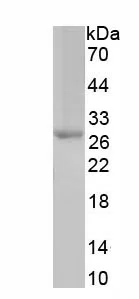 |
Greater than 95% as determined by reducing SDS-PAGE. |
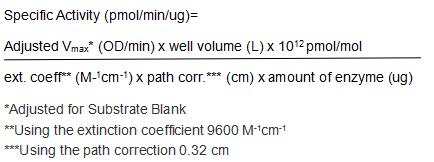 |
GSTa1 (Glutathione S-transferase a1) is an enzyme that plays an important role in detoxification by catalyzing the conjugation of many hydrophobic and electrophilic compounds with reduced glutathione. This subfamily of enzymes has a particular role in protecting cells from Reactive Oxygen Species and the products of peroxidation. Polymorphisms in this gene influence the ability of individuals to metabolize different drugs. GSTa1 catalyze the endogenous glutathione conjugation 1-Chloro-2,4-dinitrobenzene (CDNB), which can increase in the absorbance at 340 nm. The reaction was performed in adding 10 μl 200 mM glutathione (reduced) and 10 μl 100 mM CDNB in 980 μl 100 mM NaH2PO4 (pH7.0), rapidly mixed. Then add 50 μl mixed substrates to 50 μl different concentrations of recombinant human GSTa1, mix gentliy. Incubated at 37℃ for 5min, then read at a wavelength of 340 nm. The specific activity of recombinant human GSTa1 is >17000 pmol/min/µg. |
| 分子别名Alternative Names | GSTA1GST2GSTA1-1GTH1GST class-alpha member 1GST HA subunit 1GST-epsilonGlutathione S-transferase A1, N-terminally processed |
|---|---|
| 背景介绍Background | Glutathione S-transferase that catalyzes the nucleophilic attack of the sulfur atom of glutathione on the electrophilic groups of a wide range of exogenous and endogenous compounds (Probable). Involved in the formation of glutathione conjugates of both prostaglandin A2 (PGA2) and prostaglandin J2 (PGJ2). It also catalyzes the isomerization of D5-androstene-3,17-dione (AD) into D4-androstene-3,17-dione and may therefore play an important role in hormone biosynthesis. Through its glutathione-dependent peroxidase activity toward the fatty acid hydroperoxide (13S)-hydroperoxy-(9Z,11E)-octadecadienoate/13-HPODE it is also involved in the metabolism of oxidized linoleic acid. |
| 功能Function | Glutathione S-transferase that catalyzes the nucleophilic attack of the sulfur atom of glutathione on the electrophilic groups of a wide range of exogenous and endogenous compounds (Probable). Involved in the formation of glutathione conjugates of both prostaglandin A2 (PGA2) and prostaglandin J2 (PGJ2). It also catalyzes the isomerization of D5-androstene-3,17-dione (AD) into D4-androstene-3,17-dione and may therefore play an important role in hormone biosynthesis. Through its glutathione-dependent peroxidase activity toward the fatty acid hydroperoxide (13S)-hydroperoxy-(9Z,11E)-octadecadienoate/13-HPODE it is also involved in the metabolism of oxidized linoleic acid. |
| 亚细胞定位Subcellular Location | Cytoplasm. |
| 数据库链接Databases |
基因功能参考文献50 条
- GSTA1 Expression Is Correlated With Aldosterone Level in KCNJ5-Mutated Adrenal Aldosterone-Producing Adenoma. PMID: 29165597 : 29165597
- Data (including data from studies using single-molecule fluorescence imaging) suggest that, for GSTA1, there are at least two conformations of the protein, consistent with model that ligand binding promotes closure of carboxy-terminal helix over active site; study involved binding of glutathione analogs and enzyme inhibitors. PMID: 28677395 : 28677395
- Combined GSTM1, GSTT1, GSTA1 and GSTP1 polymorphisms might be associated to the risk of clear cell renal cell carcinoma. PMID: 27500405 : 27500405
- Data show that the glutathione S-transferase alpha 1(GSTA1) TT genotype was more frequent in hepatocellular carcinoma (HCC) than in non-HCC patients, suggesting that individuals carrying this genotype could be associated with 2-fold higher risk of developing HCCs. PMID: 27936036 : 27936036
- Nrf-2 and Gst-a were more abundant in bone morrow of chronic myeloid leukemia(CML) patients compared with that of healthy donors. In addition, Nrf-2 and Gst-a were further up-regulated in samples of patients with weak response to IM. In conclusion, our study shows that rapid clearance of 4-HNE by Nrf-2/GST may represents a novel molecular basis of IM resistance in CML. PMID: 28267438 : 28267438
- Study found an association, although not statistically significant between GSTA1 gene variants and perioperative serum alpha-GST level, an indicator for liver hepatotoxicity. PMID: 27179909 : 27179909
- common polymorphisms in GSTA1, GSTM1 and GSTT1 are associated with susceptibility to bladder cancer in individuals from Balkan endemic nephropathy areas of Serbia. PMID: 27568660 : 27568660
- Data show that a higher concentration of fluoride in the saliva was detected in children with a higher glutathione S-transferase (GST) activity. PMID: 27449362 : 27449362
- polymorphisms not associated with bladder cancer susceptibility [meta-analysis] PMID: 27631264 : 27631264
- Influence of glutathione S-transferase gene polymorphisms on busulfan pharmacokinetics and outcome of hematopoietic stem-cell transplantation in thalassemia pediatric patients. PMID: 26691424 : 26691424
- The frequency of GSTA1, GSTM1 and GSTP1 genotypes was not significantly different between progressive myoclonus epilepsy patients and controls PMID: 26552558 : 26552558
- GSTA1 polymorphism is associated with different pregnancy-related conditions PMID: 26321410 : 26321410
- this is the first population pharmacokinetic study to suggest that GSTA1 polymorphisms in adults are associated with busulfan pharmacokinetics PMID: 26419450 : 26419450
- GST genotyping before hematopoietic stem cell transplantation may allow better prediction of busulfan pharmacokinetics and drug toxicity, and thereby improve outcome after busulfan and cyclophosphamide conditioning PMID: 25565670 : 25565670
- the differences of PK in BU among different ethnic groups existed because of the different distribution frequencies of GST gene polymorphism in Chinese patients and Caucasian patients. PMID: 25730183 : 25730183
- Data show that the distribution of the glutathione S-transferases alleles GSTA1*A/*B and GSTP1*A, *B, and *C in the Polish population correspond to the results of studies in Caucasians. PMID: 25867434 : 25867434
- Patients with a GSTA1*A heterozygous variant had a lower exposure to 4-hydroxycyclophosphamide (4OHCTX) during cyclophosphamide treatment of lupus nephritis compared to wild-type patients. PMID: 26222310 : 26222310
- Our data indicated that GSTA1 expression may be a target molecule in early diagnosis and treatment of lung cancer PMID: 25374180 : 25374180
- Data suggest that cytochrome P450 3A4- and glutathione S-transferase A1-transfected -hepatoma cell line C3A may become a cell material in the biochemical artificial liver system. PMID: 24782212 : 24782212
- The study found that GSTA1 polymorphism was associated with increased risk of Balkan endemic nephropathy. PMID: 25111321 : 25111321
- Review/Meta-analysis: suggest that GSTA1 BB genotype was a risk factor for colorectal cancer, especially in Caucasian populations. PMID: 25778330 : 25778330
- The distribution of genotype frequencies of the polymorphism GSTA1 was statistically different between cases and controls, and the presence of genotypes A / B and B / B suggests a protective role against the risk of PCa compared to genotype A / A. PMID: 25251951 : 25251951
- The role of the glutathione S-transferase A1, M1, P1 and T1 gene polymorphisms and potential effect modification by occupational exposure to different chemicals in Serbian bladder cancer male patients, was investigated. PMID: 24914957 : 24914957
- Increased GSTA1 levels are associated with delayed graft function. PMID: 24612768 : 24612768
- The GSTA1*-69T and GSTO2*D142 variants are both associated with a significantly increased risk of asthma. PMID: 24471578 : 24471578
- High expression of GSTA1 is associated with chronic obstructive pulmonary disease. PMID: 24344877 : 24344877
- The polymorphism of GSTA1 (rs3957357) may not be associated with the risk of recurrent spontaneous abortion in Chinese Han population. PMID: 24390679 : 24390679
- Combined GSTM1*0/GSTA1*A genotypes might be considered as genetic markers for cardiovascular death risk in ESRD patients, which may permit targeting of preventive and early intervention. PMID: 24423050 : 24423050
- GSTA1 and CYP39A1 were found to be associated with busulfan clearance. When combined, the two haplotypes explained 17% of the variability in busulfan clearance. PMID: 24192117 : 24192117
- Polymorphisms in GSTA1 gene is associated with secondary mixed phenotype acute leukemia. PMID: 24276031 : 24276031
- Data indicate that genotypes of the GSTA1, GSTM1, GSTT1, and GSTP1 did not contribute independently towards the risk of bladder cancer, but in association with smoking, both GSTA1 and GSTM1 increase individual susceptibility to bladder cancer. PMID: 24075358 : 24075358
- Data indicate that GSTA1 genotype may be predictive for doxorubicin efficacy but warrants further study. PMID: 24215845 : 24215845
- GSTA1*A2 haplotype was associated with lower drug levels and higher drug clearance (P PMID: 23292236 : 23292236:
- Report increased GSTA1 in airways of asthmatics. PMID: 23647087 : 23647087
- GSTA1 low or intermediate genoytpe was associated with a non-significant protective effect for esophageal adenocarcinoma and esophageal squamous cell carcinoma. PMID: 23731957 : 23731957
- GST-a levels significantly correlated with exposure from mercury-containing dental amalgams in a dose-dependent fashion. PMID: 22893351 : 22893351
- Ceramide may increase resistance to chemotherapeutics in Caco-2 cells by up-regulating the expression of GSTA1. PMID: 22993865 : 22993865
- Data indicate that the GSTA1-1 catalytic promiscuity correlates strongly with characteristics of the thermodynamic partition function. PMID: 23649628 : 23649628
- The interaction of the chemotherapeutic drug chlorambucil (CBL) with human GSTA1-1 (hGSTA1-1) using kinetic analysis, protein crystallography and molecular dynamics, is reprted. PMID: 23460799 : 23460799
- GSTM1 and GSTA1 polymorphisms significantly impact the malignant potential of transitional cell carcinoma of the urinary bladder. PMID: 23394311 : 23394311
- The GST genetic variants examined were not associated with susceptibility to coronary artery disease in our Taiwanese cohort. PMID: 23570881 : 23570881
- GSTA1 levels may play a role in modulating enterocyte proliferation but do not influence differentiation or apoptosis. PMID: 23251616 : 23251616
- Variability in GST genes (GSTA1, GSTT1, GSTP1, GSTA1) is not a major determinant of colorectal cancer susceptibility in the Central European population. PMID: 22697302 : 22697302
- Results confirmed that patients with schizophrenia who were carriers of the GSTA1 *B risk allele had an increased MD in bilateral thalami and increased severity of auditory and global hallucinations in comparison with non-B carriers. PMID: 22959778 : 22959778
- Polymorphisms in genes encoding interleukin-10 and drug metabolizing enzymes GSTP1, GSTT1, GSTA1 and UGT1A1 influence risk and outcome in Hodgkin lymphoma. PMID: 22475179 : 22475179
- The data suggest that menadione-induced JNK activation involves the production of reactive oxygen species, likely superoxide anion, and intracellular GSH levels play an important role in preventing GSTA1-JNK complex dissociation. PMID: 22906494 : 22906494
- Tyr-9-induced localisation of a C-terminal helix (alpha9)of glutathione transferase A1-1 was ligand dependent, suggesting that the phenolic hydroxyl group of the active site tyrosine influences alpha9 dynamics by mediating the orientation of the bound ligand. PMID: 21530062 : 21530062
- A significant association is found between the GSTA1 gene and an increased risk of recurrent miscarriage. PMID: 22633257 : 22633257
- GSTA1 and the GSTO2 are asthma susceptible genes involved in increasing the risk of asthma development in the Italian population PMID: 22040239 : 22040239
- After adjustment of confounding factors, GSTP1 Ile105Val, GSTA1 C-69T, and TGFbeta1 T869C polymorphisms were found to be significantly associated with the risk of Grade 2-3 radiation-induced fibrosis. PMID: 22079734 : 22079734
蛋白复溶体积计算器缓冲液体积 = 蛋白质量 ÷ 蛋白浓度
输入任意两项,第三项自动计算 |
蛋白浓度稀释计算器初浓度 × 初体积 = 终浓度 × 终体积
输入任意三项,第四项自动计算 |



