


| 纯度Purity | Greater than 95% as determined by reducing SDS-PAGE. |
|---|---|
| 内毒素Endotoxin | Please contact with the lab for this information |
| 蛋白构建Protein Construction |
【Val114-Gly281】序列区间
|
| Accession | P50591 |
| 表达宿主Expression Host | E.coli |
| 种属Species | Homo sapiens (Human) |
| 预测分子量Predicted MW | 19.6 kDa |
| 制剂Formulation | 20mM Tris, 150mM NaCl, pH8.0, containing 1mM EDTA, 1mM DTT, 0.01% SKL, 5% Trehalose and Proclin300. |
| 运输方式Shipping | The product is shipped with ice bag. Upon receipt, store it immediately at the temperature listed below. |
| 稳定性&储存Stability & Storage | 12 months at -20°C to -80°C in lyophilized state.6 months at -20°C to -80°C under sterile conditions after reconstitution.7-10 days at 2°C to 8°C under sterile conditions after reconstitution.Please minimize freeze-thaw cycles. |
| 复溶Reconstitution | Reconstitute in 20mM Tris, 150mM NaCl (pH8.0) to a concentration of 0.1-1.0 mg/mL. Do not vortex. |
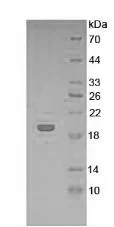 |
Greater than 95% as determined by reducing SDS-PAGE. |
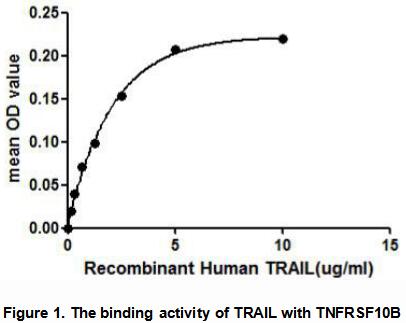 |
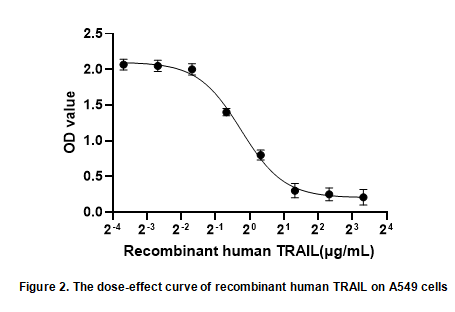
Protein TRAIL (TNF-Related Apoptosis-Inducing Ligand) is a cytokine that belongs to the tumor necrosis factor (TNF) ligand family. TRAIL induces apoptosis in transformed and tumor cells. This protein binds to several members of TNF receptor superfamily including TNFRSF10B/TRAILR2. Thus a binding ELISA assay was conducted to detect the interaction of TRAIL and TNFRSF10B. Briefly, recombinant human TRAIL were diluted serially in PBS, with 0.01%BSA (pH 7.4). Duplicate samples of 100uL were then transferred to TNFRSF10B-coated microtiter wells and incubated for 2h at 37°C. Wells were washed with PBST and incubated for 1h with anti-TRAIL pAb, then aspirated and washed 3 times. After incubation with HRP labelled secondary antibody, wells were aspirated and washed 3 times. With the addition of substrate solution, wells were incubated 15-25 minutes at 37°C. Finally, add 50µL stop solution to the wells and read at 450nm immediately. The binding activity of TRAIL and TNFRSF10B was shown in Figure 1, and this effect was in a dose dependent manner. Tumor Necrosis Factor Related Apoptosis Inducing Ligand (TRAIL) is a recently identified member of the TNF gene superfamily. TRAIL is widely expressed in a variety of human tissues, most predominantly in lung, spleen and prostat. As its name suggests, TRAIL was primarily of particular interest for its ability to selectively induce apoptosis in tumour cells in vitro and in vivo, while apparently exhibiting minimal off-target effects. In order to test the effect of human recombinant TRAIL protein on cell apoptosis, 2x10⁴ A549 cells were seeded into quintuplicate wells of 96-well plates and allowed to attach, replaced with various concentrations of recombinant human TRAIL. After incubated for 72 hours, the 96-well plates were read at OD450 nm. The result was shown in Figure1. It was obvious that rmTRAIL significantly decreased cell viability of A549 cells. The ED50 of recombinant human TRAIL is 0.84 μg/mL. |
 |
| 分子别名Alternative Names | CD253TNFSF10APO2LApo2-LTL2TRAILTumor Necrosis Factor Ligand Superfamily Member 10Apo-2 Ligand |
|---|---|
| 背景介绍Background | Cytokine that binds to TNFRSF10A/TRAILR1, TNFRSF10B/TRAILR2, TNFRSF10C/TRAILR3, TNFRSF10D/TRAILR4 and possibly also to TNFRSF11B/OPG. Induces apoptosis. Its activity may be modulated by binding to the decoy receptors TNFRSF10C/TRAILR3, TNFRSF10D/TRAILR4 and TNFRSF11B/OPG that cannot induce apoptosis. |
| 功能Function | Cytokine that binds to TNFRSF10A/TRAILR1, TNFRSF10B/TRAILR2, TNFRSF10C/TRAILR3, TNFRSF10D/TRAILR4 and possibly also to TNFRSF11B/OPG. Induces apoptosis. Its activity may be modulated by binding to the decoy receptors TNFRSF10C/TRAILR3, TNFRSF10D/TRAILR4 and TNFRSF11B/OPG that cannot induce apoptosis. |
| 亚细胞定位Subcellular Location | Cell membrane; Single-pass type II membrane protein. Secreted. |
| 数据库链接Databases |
基因功能参考文献50 条
- TRAIL protects against insulin resistance, NAFLD and vascular inflammation. Increasing TRAIL levels may be an attractive therapeutic strategy, to reduce features of diabetes, as well as liver and vascular injury, so commonly observed in individuals with NAFLD. PMID: 28507343 : 28507343
- data strongly suggest that XIAP-mediated inhibition of final caspase-3 processing is the last and major hurdle in TRAIL-induced apoptosis in NCI-H460 cells, which can be overcome by Smac in a Bcl-2 level dependent manner. PMID: 29927992 : 29927992
- Patients harboring the homozygous AA genotype of TRAIL SNPs rs1131568 and rs1131579 and the TT genotype of the TRAIL SNP rs1131580 had lower overall survival and higher rates of extrahepatic recurrence (EHR) than patients harboring the wild type or heterozygous genotypes. PMID: 30051596 : 30051596
- TRAIL synergistically sensitized irradiation-induced apoptosis in glioblastoma stem-like cells by increasing DR5 expression and decreasing cFLIP expression. PMID: 29777390 : 29777390
- Serum TRAIL concentrations are significantly reduced in patients with early preeclampsia. PMID: 29674187 : 29674187
- The combination treatment with ILz:rhTRAIL and bortezomib was able to induce cell death in both TRAIL-susceptible and TRAIL-resistant cancer cells through the intracellular TRAIL signaling pathway. The efficiency of cell death was dependent on the properties of TRAIL under the environment provided by bortezomib. The combination treatment-induced cell death was not regulated by bortezomib-induced ER stress response or by a PMID: 29661248 : 29661248
- A significant relationship was found between TRAIL polymorphisms and the susceptibility and severity of intervertebral disc degeneration in Han Chinese. PMID: 29284457 : 29284457
- High expression level of Galectin-3 and low expression level of TRAIL were found to be positively correlated with the shorter median survival time and overall survival time. PMID: 28925481 : 28925481
- Genes related to the extrinsic pathway of apoptosis including a receptor for TRAIL. PMID: 30061204 : 30061204
- Nelfinavir induces ER stress in renal cancer cells and sensitizes them to TRAIL. PMID: 30061216 : 30061216
- DR5-Cbl-b/c-Cbl-TRAF2 complex inhibited TRAIL-induced apoptosis by promoting TRAF2-mediated polyubiquitination of caspase-8 in gastric cancer cells. PMID: 28972304 : 28972304
- We found that the combination of alpha-mangostin with TRAIL induced apoptosis of SAS cells through the mitochondrial pathway via activation of caspase-9 and -3/7, following release of cytochrome c. This apoptosis was induced by S/G2/M-phase arrest. Immunopositivity for c-Myc was observed in the cytoplasm of tumor cells in 16 (40%) of the 40 cases of human oral squamous cell carcinoma (HOSCC). PMID: 29039600 : 29039600
- this study characterized in juvenile systemic lupus erythematosus a distinct profile from adult SLE that comprises increased sFas, sTRAIL, and reduced sFasL, notably in patients with active disease and with nephritis. PMID: 28378099 : 28378099
- Notch1 activation also suppressed A549 cell apoptosis by inhibiting the PI3K/pAkt pathway and activating the caspase-3 pathway in cooperation with TRAIL. Combining Notch1 signal with TRAIL inhibited PI3K, phosphorylated Akt and phosphorylated STAT3 expressions. PMID: 28718726 : 28718726
- we show that executioner caspase activation of the apoptotic nuclease CAD/DFF40 is essential for TRAIL-induced mutations in surviving cells. As exposure to chemotherapy drugs also activates apoptotic caspases and presumably CAD, we hypothesized that these pathways may also contribute to the mutagenesis induced by conventional chemotherapy drugs, perhaps augmenting the mutations that arise from direct DNA damage PMID: 28981092 : 28981092
- Cultured HCN-2 neurons were incubated at different times with GITRL and/or TRAIL, and thereafter nucleic acid and protein expression were measured. HCN-2 cells do not express GITRL mRNA, but the latter is induced after treatment with TRAIL. Cells did not express the GITRL receptor GITR mRNA, neither in control cultures, nor after treatment with TRAIL. TRAIL, when associated to GITRL, exerted additive toxic effects. PMID: 28524007 : 28524007
- DR5 has a dual role in death and survival signaling, which results in TRAIL resistance in cancer cells. PMID: 29048428 : 29048428
- Dynamin isoforms differentially regulate the endocytosis and apoptotic signaling downstream of TRAIL-death receptor (TRAIL-DR) complexes in cancer cells. TRAIL stimulation activates ryanodine receptor-mediated calcium release from endoplasmic reticulum stores, leading to calcineurin-mediated dephosphorylation and activation of Dyn1, TRAIL-DR endocytosis, and increased resistance to TRAIL-induced apoptosis. PMID: 28049841 : 28049841
- These results suggest that the FasL -844T>C single nucleotide polymorphism is implicated in the susceptibility to hepatitis C virus in Egyptian patients and firstly report the involvement of TRAIL gene polymorphism in the risk of the disease. PMID: 28587866 : 28587866
- ONC201 has potent antiproliferative and proapoptotic effects in a broad range of breast cancer subtypes, through TRAIL-dependent and TRAIL-independent mechanisms.The small-molecule ONC201 induces expression of TRAIL and its receptor DR5. ONC201 has entered clinical trials in advanced cancers. Here, we show that ONC201 is efficacious against both triple-negative breast cancers (TNBC) and non-TNBC cells PMID: 28424227 : 28424227
- our data suggest that nanoparticle-engineered TRAIL-expressing human adipose-derived stem cells exhibit the therapeutically relevant behavior of "seek-and-destroy" tumortropic migration and could be a promising therapeutic approach to improve the treatment outcomes of patients with malignant brain tumors. PMID: 27849590 : 27849590
- CaP@LDL-mediated STAT3-decoy ODN delivery might be a promising new strategy for reversing TRAIL resistance in hepatocellular carcinoma therapy. PMID: 29158840 : 29158840
- RA/poly(I:C) combination synergizes to induce a bioactive autocrine/paracrine loop of type-I Interferons (IFNs) which is ultimately responsible for TRAIL and TRAIL-R1/2 expression upregulation, while inhibition of TRAIL-R3/4 expression is type-I IFN-independent. PMID: 28409399 : 28409399
- our results demonstrated that nanovectorization of TRAIL with BNNTs enhanced its binding to both DR4 and DR5 receptors at 37 degrees C. Our novel nanovector could potentially be used for delivering TRAIL to cells for cancer treatment PMID: 28120533 : 28120533
- In primary hyperparathyroidism, hyperplasias demonstrated the highest expression of TRAIL and Fas, whereas in adenomas it was increased compared to normal tissue, but lower than in hyperplasias. PMID: 27763797 : 27763797
- Long-term toxicity test in cynomolgus monkeys did not cause rAAV2-sTRAIL95-281-related toxic and side effects, except that anti-AAV and anti-sTRAIL antibodies were generated. In conclusion, these data demonstrated that administration of rAAV2-sTRAIL95-281 in mice and in cynomolgus monkeys is safe without obvious toxic and side effects to the animals, and throw light on pharmacokinetics and safety in human clinical trials PMID: 28429751 : 28429751
- we found that plumbagin could enhance TRAIL-induced apoptosis in Kasumi-1 cells, and the mechanisms include ROS-mediated upregulation of DR5 expression, caspase-8 activation and inhibition of cFLIP expression PMID: 28498435 : 28498435
- None of these crude extracts exhibited cytotoxic effect on normal mouse embryonic fibroblasts (MEF), with the exception of EGY34. Analysis of the signaling pathways underlying the sensitization of MDA-MB-231 cells to TRAIL-induced apoptosis, by western blotting, revealed that all crude extracts facilitated initiator caspase8/-10 activation upon TRAIL stimulation PMID: 28440502 : 28440502
- Report a novel mechanism for the TRAIL-induced apoptosis of TrkAIII expressing NB cells that depends upon SHP/Src-mediated crosstalk between the TRAIL-receptor signaling pathway and TrkAIII. PMID: 27821809 : 27821809
- our findings identify a key role for c-Myc in TRAIL deregulation and as a biomarker of the anticancer action of HDACi in acute myeloid leukemia . PMID: 27358484 : 27358484
- Apoptosis induced by TRAIL is preferentially induced by TRAIL-R1 pathway in breast/lung tumor cells. PMID: 28039489 : 28039489
- These effects of metformin were accompanied by robust reductions in the protein levels of XIAP, a negative regulator of TRAIL-induced apoptosis. Silencing XIAP in TNBC cells mimicked the TRAIL-sensitizing effects of metformin. Metformin also enhanced the antitumor effects of TRAIL in a metastatic murine TNBC model PMID: 28324269 : 28324269
- siRNA silencing of CHOP significantly reduced cyproterone acetate-induced DR5 up-regulation and TRAIL sensitivity in prostate cancer cells. Our study shows a novel effect of cyproterone acetate on apoptosis pathways in prostate cancer cells and raises the possibility that a combination of TRAIL with cyproterone acetate could be a promising strategy for treating castration-resistant prostate cancer. PMID: 28270124 : 28270124
- TRAIL-armed exosomes can induce apoptosis in cancer cells. PMID: 26944067 : 26944067
- TRAIL expression in CTLs was negatively correlated with the expression of perforin and granzyme B, and negatively correlated with CTLs apoptosis in severe aplastic anemia patients. PMID: 28631177 : 28631177
- results provide convincing evidence that employing TRAIL combined with cisplatin/LA-12 could contribute to more effective killing of prostate cancer cells compared to the individual action of the drugs, and offer new mechanistic insights into their cooperative anticancer action PMID: 29182622 : 29182622
- UMI-77 enhances TRAIL-induced apoptosis by unsequestering Bim and Bak, which provides a novel therapeutic strategy for the treatment of gliomas. PMID: 28337703 : 28337703
- These results reveal KDM4A as a key epigenetic silencer of TRAIL and DR5 in tumors. PMID: 27612013 : 27612013
- Low Trail expression is associated with esophageal cancer. PMID: 29055676 : 29055676
- Results show that TNF-Related Apoptosis Inducing Ligand (TRAIL/TNFSF10) mRNA level correlates with T4 effector-memory lymphocytes (T4EM) lymphocytes radiosensitivity. PMID: 26982083 : 26982083
- Imbalance of the apoptosis pathway, with dysregulation of p73 and TRAIL, seems to play a role in the oncogenesis of odontogenic tumors PMID: 28025428 : 28025428
- hepatitis B virus (HBV) X protein (HBx) restricts TNFSF10 receptor signaling via macroautophagy/autophagy-mediated degradation of TNFRSF10B/DR5, a TNFSF10 death receptor. PMID: 27740879 : 27740879
- Findings suggest that loss of function of the human TRAIL promoter due to the SNP mutation leads to reduced expression and impaired inducibility of TRAIL, with the consequence of enhanced growth and migration of tumor cells, ultimately resulting in the progression of the hepatocellular carcinoma. PMID: 27580702 : 27580702
- these data show increased TRAIL mRNA expression in the airways and parenchyma in chronic obstructive pulmonary disease PMID: 26555706 : 26555706
- TRAIL expression is associated with thyroid hormone levels in vivo and TRAIL expression in peripheral blood mononuclear cells is stimulated by thyroid hormones in vitro. PMID: 28551332 : 28551332
- Antagonistic antibodies against the death receptors demonstrated that Apo2L/TRAIL mediated its apoptotic signals through activation of the TRAIL-R2 in PTHrP expressing breast cancer cells PMID: 23822995 : 23822995
- Co-treatment of carboplatin and autophagy inhibitor chloroquine increased lung tissue infiltration by CD4(+), FoxP3(+) lymphocytes and antigen-specific immune activation. Subsequent ex vivo experiments showed the activation of carboplatin related TRAIL-dependent apoptosis through caspase 8 and a synergistic role of miR-155 in lung tissue infiltration by CD4(+), and FoxP3(+) lymphocytes. PMID: 27692344 : 27692344
- Caspase-8 can serve in two distinct roles in response to TRAIL receptor engagement, as a scaffold for assembly of a Caspase-8-FADD-RIPK1 "FADDosome" complex, leading to NFkappaB-dependent inflammation, or as a protease that promotes apoptosis. PMID: 28212752 : 28212752
- Endogenous TRAIL/TRAIL-R-mediated CCL2 secretion promotes accumulation of tumor-supportive immune cells in the cancer microenvironment. PMID: 28212753 : 28212753
- BAY61-3606 sensitizes colon cancer cells to TRAIL-induced apoptosis by up-regulating DR4 expression in p53-dependent manner and inhibiting NF-kappaB activity. PMID: 27721019 : 27721019
蛋白复溶体积计算器缓冲液体积 = 蛋白质量 ÷ 蛋白浓度
输入任意两项,第三项自动计算 |
蛋白浓度稀释计算器初浓度 × 初体积 = 终浓度 × 终体积
输入任意三项,第四项自动计算 |



