


| 纯度Purity | Greater than 90% as determined by reducing SDS-PAGE. |
|---|---|
| 内毒素Endotoxin | Please contact with the lab for this information |
| 蛋白构建Protein Construction |
【Gln25-Pro332】序列区间
|
| Accession | P78423 |
| 表达宿主Expression Host | E.coli |
| 种属Species | Homo sapiens (Human) |
| 预测分子量Predicted MW | 36.3 kDa |
| 制剂Formulation | Lyophilized from a 0.2 μm filtered solution of 20mM Tris, 150mM NaCl, pH8.0, containing 1mM EDTA, 1mM DTT, 0.01% SKL, 5% Trehalose and Proclin300. |
| 运输方式Shipping | The product is shipped with ice bag. Upon receipt, store it immediately at the temperature listed below. |
| 稳定性&储存Stability & Storage | 12 months at -20°C to -80°C in lyophilized state.6 months at -20°C to -80°C under sterile conditions after reconstitution.7-10 days at 2°C to 8°C under sterile conditions after reconstitution.Please minimize freeze-thaw cycles. |
| 复溶Reconstitution | Reconstitute in 20mM Tris, 150mM NaCl (pH8.0) to a concentration of 0.1-1.0 mg/mL. Do not vortex. |
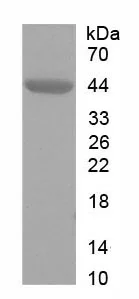 |
Greater than 90% as determined by reducing SDS-PAGE. |
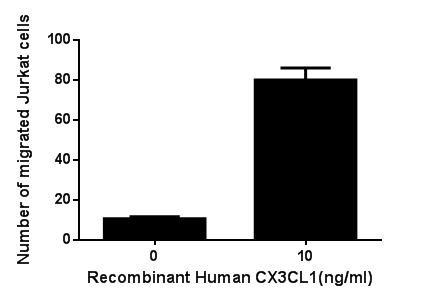 |
Figure. The chemotactic effect of CX3CL1 on THP-1 cells. Chemokine C-X3-C-Motif Ligand 1 (CX3CL1) also known as fractalkine is a large cytokine protein of 373 amino acids, it contains multiple domains and is the only known member of the CX3C chemokine family. Soluble CX3CL1 potently chemoattracts T cells and monocytes, while the cell-bound chemokine promotes strong adhesion of leukocytes to activated endothelial cells, where it is primarily expressed. Thus, chemotaxis assay used 24-well microchemotaxis system was undertaken to detect the chemotactic effect of CX3CL1 on the human monocytic cell line THP-1. Briefly, THP-1 cells were seeded into the upper chambers (150uL cell suspension, 106 cells/mL in RPMI 1640 with FBS free) and SLC (1ng/mL, 10ng/mL, 100ng/mL and 1000ng/mL diluted separately in serum free RPMI 1640 ) was added in lower chamber with a polycarbonate filter (8um pore size) used to separate the two compartments. After incubation at 37℃ with 5% CO2 for 1h, the filter was removed, then cells in low chamber were observed by inverted microscope at low magnification (×100) and the number of migrated cells were counted at high magnification (×400) randomly (five fields for each filter). Result shows CX3CL1 is able to induce migration of THP-1 cells. The migrated Jurkat cells in low chamber at low magnification (×100) were shown in Figure 1. Five fields of each chamber were randomly chosen, and the migrated cells were counted at high magnification (×400). Statistical results were shown in Figure 2. The optimum chemotaxis of CX3CL1 occurs at 1-1000ng/mL. (A) THP-1 cells were seeded into the upper chambers and serum free RPMI 1640 with 10ng/mL CX3CL1 was added in lower chamber, then cells in lower chamber were observed at low magnification (×100) after incubation for 1h; (B) THP-1 cells were seeded into the upper chambers and serum free RPMI 1640 without CX3CL1 was added in lower chamber, then cells in lower chamber were observed at low magnification (×100) after incubation for 1h. Figure. The chemotactic effect of CX3CL1 on THP-1 cells. |
| 分子别名Alternative Names | NTNABCD3C3XkineCXC3CXC3CNTTSCYD1ABCD3FKNNeurotactinFractalkineSmall Inducible Cytokine Subfamily D(Cys-X3-Cys)Member 1 |
|---|---|
| 背景介绍Background | Chemokine that acts as a ligand for both CX3CR1 and integrins ITGAV:ITGB3 and ITGA4:ITGB1. The CX3CR1-CX3CL1 signaling exerts distinct functions in different tissue compartments, such as immune response, inflammation, cell adhesion and chemotaxis. Regulates leukocyte adhesion and migration processes at the endothelium. Can activate integrins in both a CX3CR1-dependent and CX3CR1-independent manner. In the presence of CX3CR1, activates integrins by binding to the classical ligand-binding site (site 1) in integrins. In the absence of CX3CR1, binds to a second site (site 2) in integrins which is distinct from site 1 and enhances the binding of other integrin ligands to site 1.; The soluble form is chemotactic for T-cells and monocytes, but not for neutrophils.; The membrane-bound form promotes adhesion of those leukocytes to endothelial cells. |
| 功能Function | Chemokine that acts as a ligand for both CX3CR1 and integrins ITGAV:ITGB3 and ITGA4:ITGB1. The CX3CR1-CX3CL1 signaling exerts distinct functions in different tissue compartments, such as immune response, inflammation, cell adhesion and chemotaxis. Regulates leukocyte adhesion and migration processes at the endothelium. Can activate integrins in both a CX3CR1-dependent and CX3CR1-independent manner. In the presence of CX3CR1, activates integrins by binding to the classical ligand-binding site (site 1) in integrins. In the absence of CX3CR1, binds to a second site (site 2) in integrins which is distinct from site 1 and enhances the binding of other integrin ligands to site 1.; The soluble form is chemotactic for T-cells and monocytes, but not for neutrophils.; The membrane-bound form promotes adhesion of those leukocytes to endothelial cells. |
| 亚细胞定位Subcellular Location | Cell membrane; Single-pass type I membrane protein.; [Processed fractalkine]: Secreted. |
| 数据库链接Databases |
基因功能参考文献50 条
- this study shows that allergenic proteases cleave the chemokine CX3CL1 directly from the surface of airway epithelium and augment the effect of rhinovirus PMID: 28677664 : 28677664
- Study demonstrated that CX3CL1/CX3CR1 was overexpressed in prostate cancer tissues with spinal metastasis compared with primary tumors. Overexpression of CX3CR1 increased cell proliferation, migration and invasion. Also, study observed that EGFR/Src/FAK pathway was activated by CX3CL1/CX3CR1. PMID: 30066854 : 30066854
- The chemokine CX3CL1 was established as a central NF-kappaB target gene mediating therapy resistance. While no direct impact of CX3CL1 expression on cancer cell apoptosis was identified in co-culture assays it became apparent that CX3CL1 is acting in a paracrine fashion, leading to an increased recruitment of inflammatory cells. PMID: 29867042 : 29867042
- TRAF1, CTGF, and CX3CL1 genes are hypomethylated in osteoarthritis PMID: 28470428 : 28470428
- Low shear stress ( approximately 4.58 dyne/cm) for more than 1 h promoted Fractalkine expression and activated the extracellular signal-regulated kinase (ERK)1/2, p38, and Jun N-terminal kinase (JNK) mitogen-activated protein kinases signaling pathways by their phosphorylation. PMID: 29406386 : 29406386
- The results strongly suggest that glutaminyl cyclase-catalysed N-terminal pyroglutamate formation of CX3CL1 is important for the stability or the interaction with its receptor and opens new insights into the function of glutaminyl cyclase in inflammation. PMID: 28739588 : 28739588
- Serum fractalkine levels were significantly higher in the impaired glucose tolerance and type 2 diabetes groups compared to the normal glucose tolerance group. PMID: 29455547 : 29455547
- Reduced fractalkine levels were found in follicular fluid and granulosa cells, accompanied by decreased progesterone production and reduced steroidogenic acute regulatory protein (StAR) expression in the granulosa cells of patients with polycystic ovary syndrome. Administration of fractalkine reversed the inhibition of progesterone and StAR expression. PMID: 27386819 : 27386819
- The US28 gene product has maintained the function of the ancestral gene and has the ability to bind and signal in response to human CX3CL1, the natural ligand for CX3CR1. PMID: 28315475 : 28315475
- we conclude that fractalkine may be involved in vulnerability of human carotid plaque PMID: 28677375 : 28677375
- FKN concentrations are attenuated in girls with anorexia nervosa compared with healthy adolescents and are positively related to nutritional status. PMID: 27658415 : 27658415
- CX3CL1/CX3CR1 axis plays a key role in the development of ischemia-induced oligodendrocyte injury via p38MAPK signaling pathway. PMID: 26189830 : 26189830
- miR-223 controls the expression of CX3CL1 by targeting HDAC2 in chronic obstructive pulmonary disease patients and mouse models of the disease. PMID: 26864305 : 26864305
- high levels of fractalkine in ectopic endometrium taken from patients with endometriosis promoted proliferation and invasion of endometrial stromal cells through activating AKT and p38 signal pathways PMID: 27553970 : 27553970
- Amendment of the cytokine profile in macrophages subsequent to their interaction with smooth muscle cells: Differential modulation by fractalkine and resistin. PMID: 27180200 : 27180200
- Soluble FKN that was efficiently shed from the surface of LPS-activated ECs in response to binding of CD16(+) monocytes to ECs, diminished monocyte adhesion in down-regulating CX3CR1 expression on the surface of CD16(+) monocytes resulting in decreased TNF-secretion. PMID: 27031442 : 27031442
- Data indicate that patients with systemic sclerosis (SSc) displayed higher serum levels of VEGF, endothelin-1 and s-Fractalkine, and that the s-Fractalkine levels positively correlated with CD34(+)CD45(-) endothelial progenitor cells (EPC) numbers. PMID: 28320472 : 28320472
- FKN and CX3CR1 expression was significantly increased in pancreatic ductal adenocarcinoma (PDAC) tissues, especially in the metastatic samples, and was highly-correlated with severity of PDAC. Ectopic expression of FKN promoted the proliferation and migration of PDAC, while knockdown of CX3CR1 reversed the function of FKN. PMID: 28986258 : 28986258
- Fractalkine may be involved in both immunopathological and anti-viral immune responses to rhinovirus infection in asthma. PMID: 28859129 : 28859129
- High CX3CL1 expression is associated with spinal metastases. PMID: 28122354 : 28122354
- High expression of CX3CR1 correlates with significantly shorter survival, specifically in post-menopausal patients with advanced and terminal stages of the disease. Taken together, this support a key regulatory role for the fractalkine axis in advanced and relapsed peritoneal metastasis in epithelial ovarian carcinoma. PMID: 27941884 : 27941884
- changes in GSK-3beta activity and/or levels regulate the production and subsequent secretion of fractalkine, a chemokine involved in the immune response that has been linked to AD and to other different neurological disorders. PMID: 27832289 : 27832289
- In conclusion, leukoplakia-associated fibroblasts produced and secreted less CX3CL1 by inhibiting the ERK signaling pathway, thereby contributing to impaired cell resistance to Candida albicans. PMID: 27891323 : 27891323
- Fractalkine-CX3CR1 signaling has been shown to protect neurons. PMID: 27814376 : 27814376
- CX3CL1 exerts numerous effects on pathophysiological conditions that have both negative and positive consequences on pathogenesis and outcome [review] PMID: 27098399 : 27098399
- XCL2 and CX3CL1 expression in lung cancers and adjacent non-cancerous tissues was detected by quantitative PCR and ELISA. The expression of XCL2 and CX3CL1 increases with increasing degree of malignancy, indicating that both chemokines might be important targets in gene therapy for lung cancer. PMID: 27156946 : 27156946
- Recent works show that, in allergic diseases, there is an increased expression of fractalkine/CX3CL1 and its unique receptor CX3CR1 and that this chemokine does not act as chemoattractant. In allergic asthma, CX3CR1 expression regulates Th2 and Th1 cell survival in the inflammatory lung, while, in atopic dermatitis, it regulate Th2 and Th1 cell retention into the inflammatory site. [review] PMID: 27011244 : 27011244
- Serum FKN may serve as a novel biomarker for assessing disease progression and a new potential therapeutic target for anti-resorptive treatment in osteoporosis patients. PMID: 27476376 : 27476376
- FKN may serve as a reliable biomarker for evaluating disease severity in atopic dermatitis patients. PMID: 27098623 : 27098623
- Post-transcriptional suppression of KSRP destabilizes CX3CL1 mRNA in liver epithelial cells. PMID: 26631623 : 26631623
- CX3CL1 increased the migration and invasiveness of DU145 and PC-3, causing epithelial-to-mesenchymal transition. TACE/TGF-alpha/EGFR pathway activation and Slug upregulation were responsible for this. PMID: 26718770 : 26718770
- Cell proliferation enhancing and anti-apoptosis activity requires the intracellular domain and apparently the dimerization of the transmembrane chemokine ligand. PMID: 26796342 : 26796342
- CX3CL1 was expressed only by the normal and cancer adjacent normal fallopian tube epithelium; its expression was largely lost in the malignant fallopian epithelium. PMID: 26633537 : 26633537
- Skin and serum CX3CL1 elevated expression was associated with psoriasis severity. PMID: 26586708 : 26586708
- FKN enhances cell proliferation by promoting cell cycle progression in hypoxic prostate cancer cells. PMID: 26496926 : 26496926
- CX3CL1(+) apo-MPs released by apoptotic cells mediate the chemotactic transmigration of alveolar macrophages. PMID: 24603149 : 24603149
- Suggest that CX3CL1 participates in cross-talk mechanisms between endothelium and other muscle tissue cells and may promote a shift in the microenvironment toward a more regenerative milieu after exercise. PMID: 26632602 : 26632602
- Report increased circulating fractalkine in STEMI patients, which was rapidly decreased after PCI. PMID: 26049921 : 26049921
- This study found that CX3CL1 and TREM2, two genes related to neuroinflammation, were expressed at higher levels in brain regions with pronounced vulnerability to Alzheimer disease-related changes. PMID: 25596843 : 25596843
- The interactions of CX3CL1, LEPR and IL-6 genes might increase the risk of coronary artery disease in Chinese Han population. PMID: 26191329 : 26191329
- Fractalkine in synovial fluid and serum is reflective of symptomatic severity in knee osteoarthritis. PMID: 25692263 : 25692263
- CX3CL1 and CX3CR1 may contribute to the formation of coronary atherosclerotic plaque in coronary artery disease PMID: 25845619 : 25845619
- Forskolin-induced differentiation and syncytialization of the trophoblast cell line BeWo was accompanied with a substantial upregulation in fractalkine expression and led to increased adhesion of the monocyte cell line THP-1, which bound to syncytia. PMID: 25566740 : 25566740
- Fractalkine signaling regulates macrophage recruitment into the cochlea and promotes survival of spiral ganglion neurons. PMID: 26558776 : 26558776
- the results from the present study support the concept of the CX3CL1-mediated activation of the progression of the multiple myeloma via CX3CR1. PMID: 25962684 : 25962684
- we suggest that increased maternal TNF-alpha may up-regulate the expression and release of placental fractalkine, which, in turn, may contribute to an exaggerated systemic inflammatory response in preeclampsia PMID: 25769431 : 25769431
- Data show that US28 receptor binds with high selectivity and improved binding for the CX3C chemokine, CX3CL1. PMID: 26080445 : 26080445
- data suggest that fractalkine contributes to lymphocyte shifts, which may influence development of MVO through the action of effector T cells. PMID: 26168217 : 26168217
- In a CKD cohort, CX3CL1 levels were associated positively with several CVD risk factors and metabolic traits, lower estimated glomerular filtration rate, and higher levels of inflammatory cytokines, as well as prevalent CVD and diabetes. PMID: 25795074 : 25795074
- Fractalkine levels are elevated the first 12 h after percutaneous coronary intervention in patients with acute myocardial infarction, however, not correlated to infarct size. PMID: 24930044 : 24930044
蛋白复溶体积计算器缓冲液体积 = 蛋白质量 ÷ 蛋白浓度
输入任意两项,第三项自动计算 |
蛋白浓度稀释计算器初浓度 × 初体积 = 终浓度 × 终体积
输入任意三项,第四项自动计算 |



