


| 纯度Purity | Greater than 90% as determined by reducing SDS-PAGE. |
|---|---|
| 内毒素Endotoxin | Please contact with the lab for this information |
| 蛋白构建Protein Construction |
【Met1-Ser208】序列区间
|
| Accession | P31371 |
| 表达宿主Expression Host | E.coli |
| 种属Species | Homo sapiens (Human) |
| 预测分子量Predicted MW | 27.1 kDa |
| 制剂Formulation | Lyophilized from a 0.2 μm filtered solution of PBS, pH7.4, containing 0.01% SKL, 1mM DTT, 5% Trehalose and Proclin300. |
| 运输方式Shipping | The product is shipped with ice bag. Upon receipt, store it immediately at the temperature listed below. |
| 稳定性&储存Stability & Storage | 12 months at -20°C to -80°C in lyophilized state.6 months at -20°C to -80°C under sterile conditions after reconstitution.7-10 days at 2°C to 8°C under sterile conditions after reconstitution.Please minimize freeze-thaw cycles. |
| 复溶Reconstitution | Reconstitute in 10mM PBS (pH7.4) to a concentration of 0.1-1.0 mg/mL. Do not vortex. |
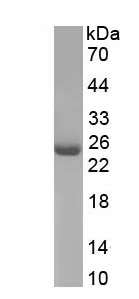 |
Greater than 90% as determined by reducing SDS-PAGE. |
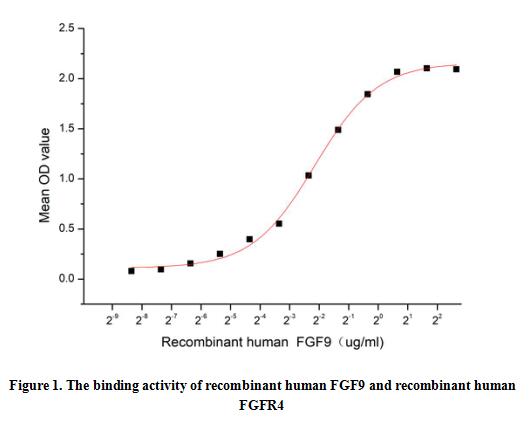 |
Fibroblast Growth Factor 9 (FGF9) is a member of the fibroblast growth factor (FGF) family. FGF family members possess broad mitogenic and cell survival activities and are involved in a variety of biological processes, including embryonic development, cell growth, morphogenesis, tissue repair, tumor growth and invasion. FGF9 was isolated as a secreted factor that exhibits a growth-stimulating effect on cultured glial cells. In nervous system, this protein is produced mainly by neurons and may be important for glial cell development. FGF9 secreted by HSC is a candidate activating ligand for hepatocyte FGFR4 functions, thus a functional binding ELISA assay was conducted to detect the interaction of recombinant human FGF9 and recombinant human FGFR4. Briefly, biotin-linked FGF9 were diluted serially in PBS, with 0.01% BSA (pH 7.4). Duplicate samples of 100 ul were then transferred to FGFR4-coated microtiter wells and incubated for 1h at 37℃. Wells were washed with PBST 3 times and incubation with Streptavidin-HRP for 30 min, then wells were aspirated and washed 5 times. With the addition of substrate solution, wells were incubated 15-25 minutes at 37℃. Finally, add 50 µl stop solution to the wells and read at 450 nm immediately. The binding activity of FGF9 and FGFR4 was shown in Figure 1, the EC50 for this effect is 0.23 ug/mL. |
| 分子别名Alternative Names | GAFHBFG9Glia-Activating FactorHeparin-Binding Growth Factor 9 |
|---|---|
| 背景介绍Background | Plays an important role in the regulation of embryonic development, cell proliferation, cell differentiation and cell migration. May have a role in glial cell growth and differentiation during development, gliosis during repair and regeneration of brain tissue after damage, differentiation and survival of neuronal cells, and growth stimulation of glial tumors. |
| 功能Function | Plays an important role in the regulation of embryonic development, cell proliferation, cell differentiation and cell migration. May have a role in glial cell growth and differentiation during development, gliosis during repair and regeneration of brain tissue after damage, differentiation and survival of neuronal cells, and growth stimulation of glial tumors. |
| 亚细胞定位Subcellular Location | Secreted. |
| 数据库链接Databases |
基因功能参考文献42 条
- Our results indicate that miR-4317 can reduce Non-small cell lung cancer (NSCLC) cell growth and metastasis by targeting FGF9 and CCND2. These findings provide new evidence of miR-4317 as a potential non-invasive biomarker and therapeutic target for NSCLC. PMID: 30227870 : 30227870
- We have demonstrated for the first time that mutations in FGF9 cause craniosynostosis in humans and confirm that FGF9 mutations cause multiple synostoses. PMID: 28730625 : 28730625
- Forced expression of miR-187 inhibited the subcutaneous growth of cervical cancer cells in nude mice. Furthermore, FGF9 was found to be the downstream target of miR-187 in cervical cancer cells. PMID: 28849071 : 28849071
- Results show compelling data that homodimerization controls receptor binding specificity of FGF9 by keeping the concentration of active FGF9 monomers at a level, which is sufficient for a normal FGFR "c" isoform binding/signaling, but is insufficient for an illegitimate FGFR "b" isoform. Mutation in FGF9 N or C-terminus skews the ligand equilibrium toward active monomers causing off-target binding and activation of FGFb. PMID: 28757146 : 28757146
- The upregulation of FGF9 or the downregulation of miR-372-3p substantially retarded lung squamous cell carcinoma (LSCC) cell growth, mitosis, and invasion. MiR-372-3p enhanced LSCC cell proliferation and invasion through inhibiting FGF9. PMID: 28440022 : 28440022
- Data suggest that fibroblast growth factor 9 (FGF9) may provide the anti-apoptotic function and be useful as a novel independent marker for evaluating gastric cancer (GC) prognosis. PMID: 27166269 : 27166269
- CCND1 mRNA expression is increased by FGF9 in bovine theca cells and granulosa cells. PMID: 27816766 : 27816766
- The present data indicate that non-natural FGFR2 ligands, such as FGF10 and FGF19, are important factors in the pathophysiology of Aspert syndrome. PMID: 27339175 : 27339175
- In FGF9-overexpressing colorectal cancer cell lines, FGF9 overexpression induced strong resistance to anti-EGFR therapies via the enforced FGFR signal, and this resistance was cancelled by the application of an FGFR inhibitor. PMID: 26916220 : 26916220
- FGF9 and FGF18 increased the migratory capacities of human lung fibroblasts, and FGF9 actively modulated matrix metalloproteinase activity in idiopathic pulmonary fibrosis. PMID: 26773067 : 26773067
- we conclude that the S99N mutation in Fgf9 causes multiple synostoses syndrome (SYNS) via the disturbance of joint interzone formation. These results further implicate the crucial role of Fgf9 during embryonic joint development PMID: 28169396 : 28169396
- These studies identify FGF9 as a target of DICER1 in lung epithelium that functions as an initiating factor for pleuropulmonary blastoma. PMID: 25978641 : 25978641
- Data indicate that expressing either human FGF9 in the kidney subcapsular space of female BALB/c mice yielded rapidly expanding local tumors. PMID: 26183774 : 26183774
- FGF9 was strongly expressed in CAFs in comparison with NGFs, being compatible with microarray data indicating that FGF9 was a novel growth factor overexpressed in Cancer-associated fibroblasts PMID: 25925261 : 25925261
- the relative levels of FGF9 in relation to other members of the FGF family may prove key to understanding vulnerability or resilience in affective disorders. PMID: 26351673 : 26351673
- we found that Kl treatment impairs Nodal mRNA expression and Fgf9-mediated Nanos2 induction, reinforcing the antagonistic effect of these two growth factors on the meiotic fate of male germ cells PMID: 25766327 : 25766327
- our data demonstrate that FGF9 can initiate a complex astrocytic response predicted to compromise remyelination, while at the same time stimulating microglial/macrophage recruitment in multiple sclerosis lesions PMID: 25907862 : 25907862
- expression is associated with poor prognosis in lung cancer PMID: 24239165 : 24239165
- MAP3K1 mutations tilt the balance in the sex-determining pathways by downregulating SOX9 and FGF9. PMID: 24135036 : 24135036
- The data demonstrates that FGF9 IRES functions as a cellular switch to turn FGF9 protein synthesis 'on' during hypoxia, a likely mechanism underlying FGF9 overexpression in cancer cells. PMID: 24334956 : 24334956
- FGF9 was proved to be a direct target of miR-26a PMID: 24015269 : 24015269
- FGF9 can be associated with epithelial-to-mesenchymal transition and invasion by inducing VEGF-A expression in prostate cancer cells. PMID: 24511001 : 24511001
- In addition to the role of sex determination, FGF9 is expressed in postnatal Leydig cells and is involved in cell-to-cell interaction of testicular function. Aberrant expression of testicular FGF9 is associated with SCOS. PMID: 24011613 : 24011613
- The results demonstrate that FGF9 protein increased in regions of active cellular hyperplasia, metaplasia, and fibrotic expansion of idiopathic pulmonary fibrosis lungs. PMID: 23797050 : 23797050
- The importance of Fgf9 in hair follicle regeneration suggests that it could be used therapeutically in humans. PMID: 23727932 : 23727932
- neither DMRT1 nor FGF9 abnormalities are frequently involved in dysgenetic male gonad development in patients with non-syndromic 46,XY disorder of sex development. PMID: 22939835 : 22939835
- the FGF9(S99N) monomer is preferred to bind with the FGFR3c receptor to form an inactive complex, leading to impaired FGF signaling; the impaired FGF signaling is believed to be a potential cause of synostoses syndrome, implicating an important role for FGF9 in normal joint development PMID: 22920789 : 22920789
- These results indicate that FGF9 can stimulate proliferation and invasion in prostate cancer cells, thus FGF9 could be a candidate of a predictive factor for recurrence after radical prostatectomy. PMID: 22006051 : 22006051
- Fibroblast growth factor 9 was also overexpressed in all serous ovarian tumors with greater than 1000-fold increase in gene expression in 4 tumors. PMID: 21666490 : 21666490
- Microvessels formed in the presence of FGF9 had enhanced capacity to receive flow and were vasoreactive. PMID: 21499246 : 21499246
- FGF9 is an autocrine estromedin endometrial stromal growth factor that plays roles in cyclic proliferation of uterine endometrial stroma PMID: 12072406 : 12072406
- The capability of proliferation possessed by endometriotic stromal cell during menstruation when ovarian 17 beta-estradiol is in the nadir may be mediated, at least in part, by autocrined estrogen-stimulated expression of FGF-9 and its receptors. PMID: 14602803 : 14602803
- Recombinant human FGF-9 signaling enhances the intrinsic osteogenic potential by selectively expanding committed chick embryo osteogenic cell populations as well as inversely regulating bone morphogenetic protein 2 (BMP-2) and noggin gene expression. PMID: 15780951 : 15780951
- Mesothelial and epithelial transgenic FGF9 directs lung development by regulating mesenchymal growth, and the pattern and expression levels of mesenchymal growth factors that signal back to the epithelium. PMID: 16540513 : 16540513
- Our findings may also provide a molecular framework for considering roles for PGE2 in FGF-9-related embryonic development and/or human diseases. PMID: 16982695 : 16982695
- Polymorphic microsatellite in the 3'-UTR of FGF9 in patients with Gonadal dysgenesis. PMID: 17154280 : 17154280
- FGF9 mutant tumors showed normal membranous beta-catenin expression and the absence of mutation in the beta-catenin gene PMID: 18165946 : 18165946
- Inhibition of fibroblast growth factor 19 reduces tumor growth by modulating beta-catenin signaling. PMID: 18593907 : 18593907
- Androgen receptor-negative human prostate cancer cells induce osteogenesis in mice through FGF9-mediated mechanisms. PMID: 18618013 : 18618013
- the study ruled out microdeletions on the critical region as a common cause of Moebius syndrome and excluded FGF9 gene PMID: 19460469 : 19460469
- Data demonstrate that homodimerization autoregulates FGF9 and FGF20's receptor binding and concentration gradients in the extracellular matrix. PMID: 19564416 : 19564416
- Data demonstrate a previously uncharacterized mutation in FGF9 as one of the causes of Multiple synostoses syndrome, implicating an important role of FGF9 in normal joint development. PMID: 19589401 : 19589401
蛋白复溶体积计算器缓冲液体积 = 蛋白质量 ÷ 蛋白浓度
输入任意两项,第三项自动计算 |
蛋白浓度稀释计算器初浓度 × 初体积 = 终浓度 × 终体积
输入任意三项,第四项自动计算 |



