


| 纯度Purity | Greater than 90% as determined by reducing SDS-PAGE. |
|---|---|
| 内毒素Endotoxin | Please contact with the lab for this information |
| 蛋白构建Protein Construction |
【Cys24-Leu181】序列区间
|
| Accession | P01562 |
| 表达宿主Expression Host | E.coli |
| 种属Species | Homo sapiens (Human) |
| 预测分子量Predicted MW | 48.2 kDa |
| 制剂Formulation | Lyophilized from a 0.2 μm filtered solution of PBS, pH7.4, containing 0.01% SKL, 1mM DTT, 5% Trehalose and Proclin300. |
| 运输方式Shipping | The product is shipped with ice bag. Upon receipt, store it immediately at the temperature listed below. |
| 稳定性&储存Stability & Storage | 12 months at -20°C to -80°C in lyophilized state.6 months at -20°C to -80°C under sterile conditions after reconstitution.7-10 days at 2°C to 8°C under sterile conditions after reconstitution.Please minimize freeze-thaw cycles. |
| 复溶Reconstitution | Reconstitute in ddH₂O to a concentration of 0.1-0.5 mg/mL. Do not vortex. |
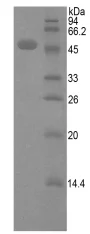 |
Greater than 90% as determined by reducing SDS-PAGE. |
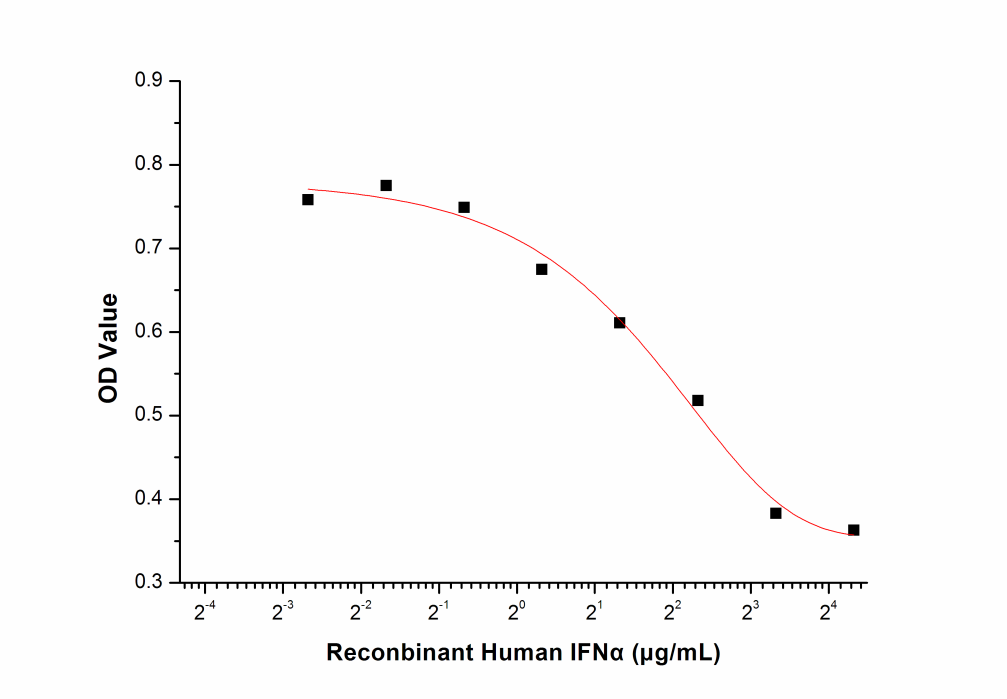 |
Interferon-alpha (IFN-α), also known as leukocyte interferon, represents a group of related but distinct proteins that share over 95% amino acid sequence homology. They are members of the type I interferon family which share a common cell surface receptor composed of two subunits. IFN-α has both anti-viral and immunomodulatory activities on target cells. To test the effect of IFN-α on cell apoptosis, A549 cells were seeded into 96-well plates at a density of 3,000 cells/well with 1% serum standard DMEM including various concentrations of recombinant human IFN-α. After incubated for 48h, cells were observed by inverted microscope and cell proliferation was measured by Cell Counting Kit-8 (CCK-8). Briefly, 10 µL of CCK-8 solution was added to each well of the plate, then the absorbance at 450 nm was measured using a microplate reader after incubating the plate for 2 hours at 37℃. Proliferation of A549 cells after incubation with IFN-α for 48h observed by inverted microscope was shown in Figure 1. Cell viability was assessed by CCK-8 (Cell Counting Kit-8 ) assay after incubation with recombinant human IFN-α for 48h. The result was shown in Figure 2. It was obvious that IFN-α significantly inhibit cell viability of A549 cells. The ED50 is 3.4 µg/mL. (A) A549 cells cultured in DMEM, stimulated with 10µg/mL IFN-α for 48h; (B) Unstimulated A549 cells cultured in DMEM for 48h. Figure 1. Inhibition of A549 cells proliferation after stimulated with IFN-α Figure 2. Inhibition of A549 cells proliferation after stimulated with IFN-α. |
| 分子别名Alternative Names | IFNA1IFLLeIF DIFNIFN-AlphaIFNA13IFN-AIFNAP22IFN-Alpha 1bInterferon Alpha 1bInterferon, LeukocyticIFN, LeukocyteInterferon alpha-D |
|---|---|
| 背景介绍Background | Produced by macrophages, IFN-alpha have antiviral activities. Interferon stimulates the production of two enzymes: a protein kinase and an oligoadenylate synthetase. |
| 功能Function | Produced by macrophages, IFN-alpha have antiviral activities. Interferon stimulates the production of two enzymes: a protein kinase and an oligoadenylate synthetase. |
| 亚细胞定位Subcellular Location | Secreted. |
| 数据库链接Databases |
基因功能参考文献50 条
- SOCS2 impairs IFN/JAK/STAT signaling through reducing the stability of tyrosine kinase 2 (TYK2), downregulating the expression of type I and III IFN receptors, attenuating the phosphorylation and nucleus translocation of STAT1. PMID: 28496097 : 28496097
- Significant associations were observed for 4 variants in IFNAR2, IFNLR1 with hepatitis B virus infection, and IFNLR1-rs4649203 was associated with hepatitis B recovery. Moreover, the authors demonstrated the clear relevance of 5 polymorphisms in IFNA1, IFNA2, IFNL4 with hepatocellular carcinoma. PMID: 29080269 : 29080269
- HIV-1 IIIB infection of myeloid ThP-1 cells also reduced the IFN-alpha-mediated induction of the anti-viral gene, ISG15, but not MxA, revealing a functional consequence of this HIV-1-mediated immune evasion strategy. PMID: 29580840 : 29580840
- Therefore, these results demonstrate the importance of MxB in alpha interferon-mediated inhibition of HIV-1 infection. PMID: 29925663 : 29925663
- Our results illustrate a novel regulatory role of TWEAK, in which its activity positively regulates type I IFN pathway in lupus nephritis (LN) based on preclinical models. Our findings suggest TWEAK could act as a critical target in preventing renal damage in patients with LN. PMID: 29333443 : 29333443
- Myeloid cells contribute more to the whole blood interferon signature in systemic lupus erythematosus than their lymphocytic counterpart. Very similar leukocyte subsets reveal distinctive IFN signatures. IFN alpha mixes up composition of blood and leads to a preferential neutropenia, yielding relative lymphocytosis. PMID: 28357476 : 28357476
- the polymorphic variant of IFNA1 (-2) gene is associated with chronic HBV infection PMID: 27101083 : 27101083
- Cerebrospinal fluid interferon alpha levels correlate with neurocognitive impairment in ambulatory HIV-Infected individuals. PMID: 27400930 : 27400930
- Data suggest a central role of XBP1 in TLR7-induced IFNalpha production and identify XBP1 as a potential novel therapeutic target in IFNalpha-driven autoimmune and inflammatory diseases. PMID: 28408069 : 28408069
- Study shows IFN-alpha rapidly induces a profound shift in whole brain network structure, impairing global functional connectivity and the efficiency of parallel information exchange. PMID: 26697999 : 26697999
- The review focuses on the value of the type I and III interferon subtypes (alphas, beta and lambdas) as therapeutics for prevention and treatment of viral infections (influenza, herpes, human immunodeficiency virus and hepatitis viruses). PMID: 27544015 : 27544015
- MiR-181a is an important mediator for interferons-induced SAMHD1 expression in astrocytes and microglia, but not for inhibition of HIV-1 infection induced by IFN-alpha. PMID: 27219130 : 27219130
- the expression of certain TAM components was reduced as a result of prolonged degradation of MYD88 by Porphyromonas gingivalis infection. PMID: 28076786 : 28076786
- Type I interferons (IFNs) signature is seen in a significant proportion of anti-nuclear antibody-positive (ANA(+) individuals and appears to be associated with ANA titre and type of autoantibodies, rather than with the presence or development of clinical systemic autoimmune rheumatic diseases (SARDs) symptoms. PMID: 28245862 : 28245862
- study found that endogenous IFNalpha autocrinally promotes the expression of Interferon-Stimulated Gene (ISG) mRNAs in IL-3-, but not in IFNlambda3 plus IL-3-, treated plasmacytoid dendritic cells (pDCs); production of IFNalpha by IFNlambda3 plus IL-3-treated pDCs is mostly dependent on endogenously produced TNFalpha PMID: 27513213 : 27513213
- results demonstrate that Sphingosine 1-phosphate lyase (SPL) is a host factor that augments type I IFN responses during influenza A virus infection; study delineates the relationship between IKKepsilon and SPL, which provides a mechanistic understanding of the pro-IFN activity of SPL PMID: 28600291 : 28600291
- These data suggest that plasmacytoid dendritic cells producing IFN-alpha and IL-33 play a pivotal role in the chronic fibro-inflammatory responses underlying murine autoimmune pancreatitis and human IgG4-related autoimmune pancreatitis. PMID: 28373582 : 28373582
- These findings also identify STAT3 as a therapeutic target against viral infection and highlight it as an essential pathway component for endogenous and therapeutic IFN-alpha responsiveness. PMID: 27988795 : 27988795
- Mothers of children affected by autoimmune congenital heart block had a significantly higher expression IFN-alpha. PMID: 28501799 : 28501799
- Suppression of the exogenous Type I IFN-induced Jak/STAT signaling by NSs might be one of the mechanisms of Severe fever with thrombocytopenia syndrome (SFTS) to evade host immune surveillance. PMID: 28234991 : 28234991
- the paper shows the data on the role of interferons -alpha and -beta in infections - not only commonly known viral infections, but also bacterial, fungal and parasitic. PMID: 28388697 : 28388697
- High Type I Interferon expression due to hypomethylation is associated with Systemic Lupus Erythematosus. PMID: 28085900 : 28085900
- these studies identify phosphorylation of S734-STAT2 as a new regulatory mechanism that negatively controls the type I IFN-antiviral response. PMID: 27802159 : 27802159
- The synthetic IFNP molecule exerted its antitumor activity by upregulating the downstream genes involved in the STAT1 pathway and in apoptosis. Using a cell receptor binding assay, we showed that this Jurkat-binding peptide facilitated the binding affinity of IFNalpha to the cell surface type I IFN receptor PMID: 28578326 : 28578326
- KSHV-encoded viral IRF4 interacts with the host IRF7 and inhibits interferon-alpha production. PMID: 28342865 : 28342865
- Data indicate ARID3a(+) B cells as a type of effector B cell, and link ARID3a expression in B lymphocytes to interferon alpha (IFNa)-associated inflammatory responses in systemic lupus erythematosus (SLE). PMID: 27522115 : 27522115
- On one hand, hepatitis B virus activates MMP-9 in infected patients and leukocytes. On the other hand, MMP-9 facilitates hepatitis B virus replication through repressing IFN/JAK/STAT signaling, IFNAR1 function, and IFN-alpha action. PMID: 28122987 : 28122987
- Interferon-alpha Induces the apoptosis of Hela cells by activating both the intrinsic mitochondrial pathway and endoplasmic reticulum stress-induced pathway. PMID: 27827850 : 27827850
- Decreased interferon alpha (IFN-alpha) secretion induced by Toll-like receptor 7 and Toll-like receptor 8 (TLR7/TLR8) activation was observed in common variable immunodeficiency (CVID), which was recovered with Toll-like receptor 9 (TLR9) signaling. PMID: 27392462 : 27392462
- Plasmacytoid dendritic cells (pDCs) and type 1 interferon (FNalpha/beta)frequently accompanied plasmablast/plasma cells (PB/PCs). PMID: 27102764 : 27102764
- These results establish that activation of STAT pathway is essential for anti-hepatitis c virus efficacy of IFN-alpha. PMID: 27855377 : 27855377
- IL-2 therapy should be used as a first- or second-line therapy following IFN-a therapy. IL-2 may have a lower response if it is used after molecular-targeted therapy or other treatments PMID: 27630356 : 27630356
- results show that IFNA1 rs1332190 and IFNA17 rs9298814 SNPs may play an important role in Crimean-Congo hemorrhagic fever susceptibility PMID: 26694082 : 26694082
- Interferon-alpha-induced TRIM22 interrupts hepatitis c virus replication by ubiquitinating NS5A. PMID: 25683609 : 25683609
- our data indicate that by targeting PTP1B, miR-744 plays a feed-forward role in regulating type I IFN signaling pathway. PMID: 26259828 : 26259828
- the findings demonstrate that treatment with anti-CD20-hIFNalpha reverses resistance of B-NHL PMID: 26398317 : 26398317
- NS of severe fever with thrombocytopenia syndrome virus inhibited the activity of IFN-alpha1, IFN-beta, IFN-lambda1 and IFN-lambda2 through inhibition of STAT1 phosphorylation. PMID: 26353965 : 26353965
- interferon (IFN)-alpha, weakens activation of the anti-bacterial interleukin (IL)-1/IL-22 axis in human peripheral blood mononuclear cells exposed to viable B. burgdorferi PMID: 26152778 : 26152778
- Shp-2 contributes to the control of respiratory syncytial virus replication and progeny production in pulmonary alveolar epithelial cells by interfering with IFN-alpha-induced Jak/Stat1 pathway activation PMID: 26119280 : 26119280
- Interferon alfa induces high response rates with low toxicity in patients with polycythemia vera. PMID: 26261238 : 26261238
- This study suggests that suppression of miR-122 induced by hepatitis B virus infection, leads to the inactivation of interferon expression, which in turn enhances hepatitis B virus replication. PMID: 25766860 : 25766860
- Data suggest that Viral microRNA hcmv-miR-UL112 subverts innate immunity by downregulating type I interferons IFN-alpha and IFN-beta signaling to inhibit natural killer (NK) cell cytotoxicity. PMID: 25530545 : 25530545
- Interferon-alpha and interferon-beta are at the crossroads of allergy and viral infections. (Review) PMID: 26026068 : 26026068
- The interaction between AIP and IRF7 is enhanced upon virus infection, and AIP potently inhibits IRF7-induced type I IFN (IFN-alpha/beta) production. PMID: 25911105 : 25911105
- Interferon-alpha inhibits CD4 T cell responses to interleukin-7 and interleukin-2 and selectively interferes with Akt signaling. PMID: 25784743 : 25784743
- Data show that chemokine CXCL13 production by monocytes required toll-like receptor 7 activation and secretion of interferon-alpha. PMID: 25667414 : 25667414
- Studies indicate that type I interfereon signaling cascade is initiated by the binding of the cytokines to the high-affinity interferon alpha receotor. PMID: 25747907 : 25747907
- Results show that histone-lysine N-methyltransferase Set7 facilitates hepatitis C virus (HCV) replication through the attenuation of interferon-alpha (IFN-alpha) signaling pathways and IFN-related effectors. PMID: 25681344 : 25681344
- Domain 2 of the hepatitis C virus core protein critically affected the magnitude of host IFN-alpha responses. PMID: 25552725 : 25552725
- Hepatitis C virus NS3-4A similarly diminished both human and mouse MAVS-dependent signaling in human and mouse cells and MAVS induces both type I and type III interferons, which together control the hepatitis C virus replication. PMID: 25609814 : 25609814
蛋白复溶体积计算器缓冲液体积 = 蛋白质量 ÷ 蛋白浓度
输入任意两项,第三项自动计算 |
蛋白浓度稀释计算器初浓度 × 初体积 = 终浓度 × 终体积
输入任意三项,第四项自动计算 |



