


| 纯度Purity | Greater than 80% as determined by reducing SDS-PAGE. |
|---|---|
| 内毒素Endotoxin | Please contact with the lab for this information |
| 蛋白构建Protein Construction |
【Gln103-Leu281】序列区间
|
| Accession | P48023 |
| 表达宿主Expression Host | E.coli |
| 种属Species | Homo sapiens (Human) |
| 预测分子量Predicted MW | 50.4 kDa |
| 制剂Formulation | Lyophilized from a 0.2 μm filtered solution of PBS, pH7.4, containing 0.01% SKL, 1mM DTT, 5% Trehalose and Proclin300. |
| 运输方式Shipping | The product is shipped with ice bag. Upon receipt, store it immediately at the temperature listed below. |
| 稳定性&储存Stability & Storage | 12 months at -20°C to -80°C in lyophilized state.6 months at -20°C to -80°C under sterile conditions after reconstitution.7-10 days at 2°C to 8°C under sterile conditions after reconstitution.Please minimize freeze-thaw cycles. |
| 复溶Reconstitution | Reconstitute in 10mM PBS (pH7.4) to a concentration of 0.1-1.0 mg/mL. Do not vortex. |
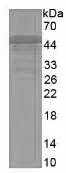 |
Greater than 80% as determined by reducing SDS-PAGE. |
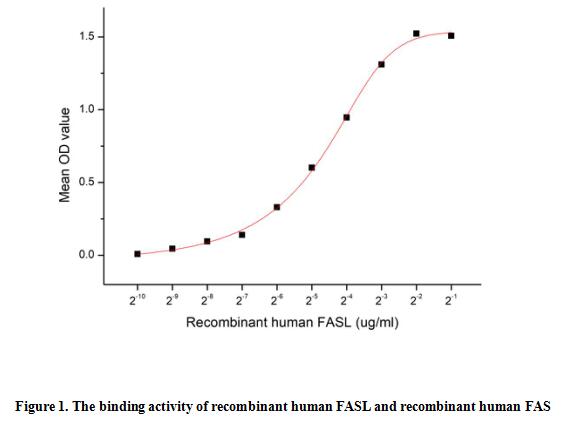 |
Fas ligand (FasL) is a 40 kDa type II membrane protein belonging to the TNF family. In the new TNF super family nomenclature, FasL is referred to as TNFSF6. The specific receptor for FasL is Fas (CD95, Apo-1), a 45 kDa type I transmembrane protein that is a member of the TNF receptor family. FasL is predominantly expressed on activated T cells and NK cells, while Fas is expressed on various types of cells. The Fas/FasL system plays a crucial role in modulating immune response by inducing cell apoptosis to maintain homeostasis, self-tolerance of lymphocytes, and immune privilege. FasL was reported to be a potent chemoattractant for neutrophils, suggesting a novel proinflammatory function of this molecule. A functional ELISA assay was conducted to detect the interaction of recombinant human FASL and recombinant human FAS. Briefly, FASL was diluted serially in PBS with 0.01% BSA (pH 7.4). Duplicate samples of 100 μl were then transferred to FAS-coated microtiter wells and incubated for 1h at 37℃. Wells were washed with PBST and incubated for 1h with anti-FASL pAb, then aspirated and washed 3 times. After incubation with HRP labelled secondary antibody for 1h at 37℃, wells were aspirated and washed 5 times. With the addition of substrate solution, wells were incubated 15-25 minutes at 37℃. Finally, add 50 µL stop solution to the wells and read at 450/630nm immediately. The binding activity of recombinant human FASL and recombinant human FAS was shown in Figure 1, the EC50 for this effect is 0.044 ug/mL. |
| 分子别名Alternative Names | CD178CD95LCD95-LFASLGFASLGAPT1LG1APT1-LG1TNFSF6Fas Antigen LigandTNF Superfamily Member 6Tumor Necrosis Factor(ligand)Superfamily,Member 6 |
|---|---|
| 背景介绍Background | Cytokine that binds to TNFRSF6/FAS, a receptor that transduces the apoptotic signal into cells. Involved in cytotoxic T-cell-mediated apoptosis, natural killer cell-mediated apoptosis and in T-cell development. Initiates fratricidal/suicidal activation-induced cell death (AICD) in antigen-activated T-cells contributing to the termination of immune responses. TNFRSF6/FAS-mediated apoptosis has also a role in the induction of peripheral tolerance. Binds to TNFRSF6B/DcR3, a decoy receptor that blocks apoptosis.; Induces FAS-mediated activation of NF-kappa-B, initiating non-apoptotic signaling pathways. Can induce apoptosis but does not appear to be essential for this process.; Cytoplasmic form induces gene transcription inhibition. |
| 功能Function | Cytokine that binds to TNFRSF6/FAS, a receptor that transduces the apoptotic signal into cells. Involved in cytotoxic T-cell-mediated apoptosis, natural killer cell-mediated apoptosis and in T-cell development. Initiates fratricidal/suicidal activation-induced cell death (AICD) in antigen-activated T-cells contributing to the termination of immune responses. TNFRSF6/FAS-mediated apoptosis has also a role in the induction of peripheral tolerance. Binds to TNFRSF6B/DcR3, a decoy receptor that blocks apoptosis.; Induces FAS-mediated activation of NF-kappa-B, initiating non-apoptotic signaling pathways. Can induce apoptosis but does not appear to be essential for this process.; Cytoplasmic form induces gene transcription inhibition. |
| 亚细胞定位Subcellular Location | Cell membrane; Single-pass type II membrane protein. Cytoplasmic vesicle lumen. Lysosome lumen.; [Tumor necrosis factor ligand superfamily member 6, soluble form]: Secreted.; [FasL intracellular domain]: Nucleus. |
| 数据库链接Databases |
基因功能参考文献50 条
- FASLG single-nucleotide polymorphisms rs763110 and rs5030772 are involved in the pathogenesis of Idiopathic Aplastic Anemia PMID: 29611722 : 29611722
- Evaluation of FAS/FASL polymorphisms can predict lack of response to BCG immunotherapy and prevent the loss of valuable time before such alternative treatments as early cystectomy are initiated. PMID: 29453645 : 29453645
- results suggest that miR-21 regulates the apoptosis of keloid fibroblasts via targeting FasL, and caspase-8 and the mitochondria-mediated apoptotic signaling pathway is involved in this process. PMID: 29527928 : 29527928
- the detailed mechanisms of FasL-Fas necroptosis can help in understanding the processes of elimination of tumor cells that have blocked apoptosis signal transduction PMID: 30103900 : 30103900
- Increased FASL expression is associated with dermatofibrosarcoma protuberans. PMID: 29509956 : 29509956
- data demonstrated that FASL-844C/T SNP was substantially associated with idiopathic azoospermia, indicating that it might be a genetic predisposing factor of idiopathic azoospermia in the Western of Iran. PMID: 28942044 : 28942044
- platelet-derived FasL has a role in apoptosis in stroke PMID: 27608763 : 27608763
- The Fas-ligand SNP and TNF gene -308 SNP are associated with anti-TNF treatment response in Crohn's disease and may help select patients likely to benefit from therapy. PMID: 28785150 : 28785150
- serum levels of soluble FAS ligand (sFASL) and interferon gamma (IFN-gamma) were analyzed and correlated with sFGL2 levels in Hepatitis C Virus-Infected Patients and Hepatocellular Carcinoma Patients. PMID: 28609212 : 28609212
- Study shows for the first time that CD95L activates NHE1, which thereby enhances cell migration. Using a combination of inhibitors and site-directed mutagenesis, results subsequently demonstrate that this mechanism occurs through a modification of NHE1 cooperative response to intracellular protons and that it involves both the Akt and RhoA-dependent pathways. PMID: 27302366 : 27302366
- These results suggest that the FasL -844T>C single nucleotide polymorphism is implicated in the susceptibility to hepatitis C virus in Egyptian patients and firstly report the involvement of TRAIL gene polymorphism in the risk of the disease. PMID: 28587866 : 28587866
- Increased activation of B-cells is present following successful Tuberculosis treatment, and the expression of FASLG and IL5RA could potentially be utilized as a signature to monitor treatment response. PMID: 27682872 : 27682872
- This study highlights a coordinated neurovascular development instructed by CNS macrophage-derived CD95L. PMID: 28514658 : 28514658
- FasL -844C>T polymorphism plays a protective role against Head and Neck Cancer development in Asian population. PMID: 29419701 : 29419701
- The Fas mRNA expression ratio was unchanged upon MTX treatment, but the FasL mRNA expression ratio was significantly higher in MTX-treated than nontreated polyps. In addition, the expression levels of the Fas and FasL proteins were significantly higher in polyps treated with both 10 and 100 muM MTX compared with nontreated polyps. PMID: 28468172 : 28468172
- Results show that the FasL:Fas complex shares structural features with the FasL:DcR3 assembly and the glycosylation contributes to the activity of soluble FasL PMID: 27806260 : 27806260
- FASLG c.-844TC genotype may be protective against familial mediterranean fever in the Turkish population. PMID: 28442396 : 28442396
- The rs763110 TT genotype significantly increased the risk of cervical cancer compared with the CC/CT genotype. Patients carrying this genotype presented a lower cancerous FASL expression than that of the CC/CT genotypes. OCT1 was recruited to the FASL promoter region and regulated the FASL gene transcription by interacting with C/EBPbeta. PMID: 27790710 : 27790710
- Inhibition of miR-149-5p can induce apoptosis in THP-1 cells. These inductive effects might be via targeting FASLG and activating FADD and caspases. PMID: 28013316 : 28013316
- FasL gene polymorphism is associated with Hashimoto's thyroiditis. PMID: 27572459 : 27572459
- There is a positive correlation of the serum level of sFasL ( Fas/FasL axis )with uptake index of parotid gland in our expectation. In addition, liver injury involvement in SS patients showed decreased level of sFasL. Furthermore, we here also observed that the protective cytokine IL-10 expression was positively correlated with sFasL expression PMID: 28326325 : 28326325
- The results of this study did show an initial decrease in sCD95L, but this was followed by a steady increase above initially measured concentrations. Furthermore, we found that patients with clinically documented neurological remission showed higher sCD95L serum concentrations than patients without remission. PMID: 27089864 : 27089864
- suppression of EP1 prevented RAMA-induced FasL suppression in CLT85 cells at both the mRNA and protein levels PMID: 26211005 : 26211005
- In sprint-trained male athletes, FasL, miR-21, and miR-146a were measured cross-sectionally (n = 67, 18-90 yrs) and serum FasL, miR-21, and miR-146a and their aging-related associations with physical performance were assessed over a 10-year follow-up (n = 49, 50-90 yrs). PMID: 28127562 : 28127562
- In women with endometriosis, immunostaining for Fas-Ligand in the eutopic endometrium was stronger in the epithelial cells of secretory phase, while the epithelial cells of endometriotic lesions showed a significantly stronger staining for Fas-Ligand independently from the menstrual phase PMID: 26156853 : 26156853
- The study identified Fas ligand (FASLG) as the target of let-7e-5p, and FASLG knockdown increased the migration and tube formation of endothelial progenitor cell. PMID: 26826505 : 26826505
- Case Reports: patients with autosomal recessive inheritance of ALPS-FASLG have a severe phenotype and a partial defect in activation-induced cell death in T- and B-cell lines. PMID: 26334989 : 26334989
- No mutation or variation could be found in FASL in patients or controls. PMID: 26690594 : 26690594
- FASL, granzyme B, and cytochrome c blood expression reflects breast cancer progression and response to therapy. (Review) PMID: 27117663 : 27117663
- No association has been found between FASL promoter polymorphisms and predisposition to HIV infection. PMID: 26429326 : 26429326
- FASL expression is an independent marker for earlier disease relapse and disease-specific death in oral squamous cell carcinoma. PMID: 26400345 : 26400345
- These data indicate that Epstein-Barr virus exosomes derived from EBV-infected cells are taken up by non-infected cells and induce apoptosis via the extrinsic pathway, and that exosomes trigger apoptosis through the FasL pathway. PMID: 26467838 : 26467838
- The expression of Ki67 and FasL is closely related to the occurrence and development of cervical carcinoma. PMID: 26345794 : 26345794
- Data suggest Faim2/LFG (lifeguard protein) protects against FasL-/Fas ligand-induced apoptosis by down-regulating calcium release from endoplasmic reticulum in cortical neurons. PMID: 26582200 : 26582200
- In patients with either Crohn's disease or ulcerative colitis, the extent of endothelial FasL expression was elevated in the submucosa and associated with an elevated number of lymphoid follicles. PMID: 26374830 : 26374830
- Th1 cells express high level of FAS-ligand (FASL), which interacts with FAS and leads to caspases' cleavage and ultimately to cell death. PMID: 25950471 : 25950471
- Fas Ligand Deficiency Impairs Tumor Immunity by Promoting an Accumulation of Monocytic Myeloid-Derived Suppressor Cells PMID: 26359460 : 26359460
- FASL -844 T > C promoter single nucleotide polymorphism is associated with oral cancers. PMID: 25944167 : 25944167
- Death induced by CD95R/L elimination (DICE) and CD95-mediated apoptosis have opposing roles in eliminating cancer stem cells (CSCs)and non-CSCs. PMID: 25366259 : 25366259
- Membrane-bound FasL mediates platelets-induced apoptosis, whereas Bax/Bak signaling is not required but reinforces platelets-induced apoptosis. PMID: 26232171 : 26232171
- DcR3 enhances ERK1/2 phosphorylation and opposes FasL signaling in pancreatic cancer cells PMID: 26102031 : 26102031
- MiR-21 up-regulation mediates glioblastoma cancer stem cells apoptosis and proliferation by targeting FASLG. PMID: 25394756 : 25394756
- FasL -844 CC combined with the Fas -1377 G allele is a protective factor against ESCC. PMID: 24473454 : 24473454
- High Fas expression promotes chemoresistance in gastrointestinal cancer by up-regulating P-glycoprotein. PMID: 25333257 : 25333257
- There was no correlation between TGF-beta1 levels and HBV load, but there is a positive correlation between sFas levels and HBV load. PMID: 25990938 : 25990938
- data strongly indicate that the inhibition of ceramide conversion to complex sphingolipids by D609 is accompanied by an enhancement of FasL-induced caspase-dependent and -independent cell death in T lymphocytes. PMID: 22942738 : 22942738
- during spontaneous miscarriages, the increased FasL-expressing population could be a part of an M1 phenotype participating in Fas/FasL-related apoptosis. PMID: 22942752 : 22942752
- these findings provide novel experimental evidences supporting that VC or/and VE could reduce p,p'-DDT-induced cytotoxicity of HL-7702 cells via the ROS-mediated mitochondrial pathway and NF-kappaB/FasL pathway. PMID: 25464339 : 25464339
- Fas ligand correlates with the documented degree of atrial apoptosis and atrial fibrosis in right atrial appendage tissue after cardiac surgery. PMID: 23790081 : 23790081
- The T/T genotype and the T allele of the c.-844T>C polymorphism were associated with increased occurrence of keratoconus, while the C allele was associated with decreased keratoconus occurrence. PMID: 25169582 : 25169582
蛋白复溶体积计算器缓冲液体积 = 蛋白质量 ÷ 蛋白浓度
输入任意两项,第三项自动计算 |
蛋白浓度稀释计算器初浓度 × 初体积 = 终浓度 × 终体积
输入任意三项,第四项自动计算 |



