


| 纯度Purity | Greater than 95% as determined by reducing SDS-PAGE. |
|---|---|
| 内毒素Endotoxin | Please contact with the lab for this information |
| 蛋白构建Protein Construction |
【Ser22-Arg408】序列区间
|
| Accession | P12644 |
| 表达宿主Expression Host | E.coli |
| 种属Species | Homo sapiens (Human) |
| 预测分子量Predicted MW | 48.0 kDa |
| 制剂Formulation | Lyophilized from a 0.2 μm filtered solution of 20mM Tris, 150mM NaCl, pH8.0, containing 1mM EDTA, 1mM DTT, 0.01% SKL, 5% Trehalose and Proclin300. |
| 运输方式Shipping | The product is shipped with ice bag. Upon receipt, store it immediately at the temperature listed below. |
| 稳定性&储存Stability & Storage | 12 months at -20°C to -80°C in lyophilized state.6 months at -20°C to -80°C under sterile conditions after reconstitution.7-10 days at 2°C to 8°C under sterile conditions after reconstitution.Please minimize freeze-thaw cycles. |
| 复溶Reconstitution | Reconstitute in 20mM Tris, 150mM NaCl (pH8.0) to a concentration of 0.1-1.0 mg/mL. Do not vortex. |
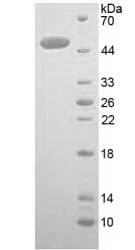 |
Greater than 95% as determined by reducing SDS-PAGE. |
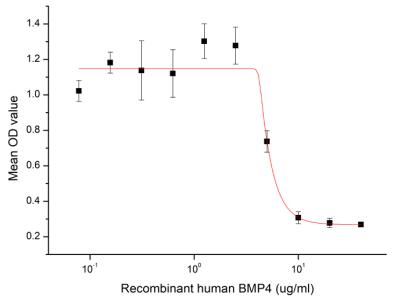 |
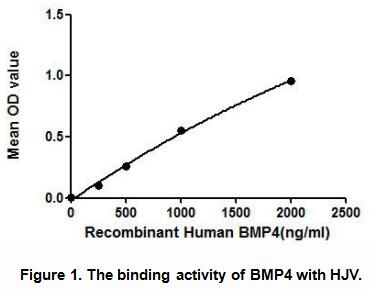
BMP4 (Bone morphogenetic protein 4) is a member of the bone morphogenetic protein family, which is involved in bone and cartilage development, specifically tooth and limb development and fracture repair. It has been proven that HJV (Hemojuvelin) acts as a coreceptor of BMPs, including BMP4; therefore, a binding ELISA assay was constructed to detect the association of recombinant human BMP4 with recombinant human HJV. Briefly, BMP4 were diluted serially in PBS, with 0.01%BSA (pH 7.4). Duplicate samples of 100uL were then transferred to HJV-coated microtiter wells and incubated for 2h at 37°C. Wells were washed with PBST and incubated for 1h with anti-BMP4 pAb, then aspirated and washed 3 times. After incubation with HRP labelled secondary antibody, wells were aspirated and washed 3 times. With the addition of substrate solution, wells were incubated 15-25 minutes at 37°C. Finally, add 50µL stop solution to the wells and read at 450nm immediately. The binding activity of BMP4 with HJV was shown in Figure 1 and this effect was in a dose dependent manner. To test the effect of BMP4 on cell apoptosis, HepG2 cells were seeded into triplicate wells of 96-well plates at a density of 4,000 cells/well and allowed to attach overnight, then the medium was replaced with various concentrations of recombinant human BMP4 diluted with 5% serum standard DMEM. After incubated for 72h, cells were observed by inverted microscope and cell proliferation was measured by Cell Counting Kit-8 (CCK-8). Briefly, 10 µl of CCK-8 solution was added to each well of the plate, then the absorbance at 450 nm was measured using a microplate reader after incubating the plate for 1-4 hours at 37 ℃. Apoptosis of HepG2 cells after incubation with BMP4 for 72h observed by inverted microscope was shown in Figure 1. Cell viability was assessed by CCK-8 (Cell Counting Kit-8 ) assay after incubation with recombinant human BMP4 for 72h. The result was shown in Figure 2. It was obvious that BMP4 significantly decreased cell viability of HepG2 cells. The ED50 of recombinant human BMP4 is 5.1 ug/ml. Figure 2. Inhibition of HepG2 cells proliferation after stimulated with recombinant human BMP4 |
 |
| 分子别名Alternative Names | BMP2BBMP2-BBMP2B1ZYMEDVR4Bone morphogenetic protein 2B |
|---|---|
| 背景介绍Background | Growth factor of the TGF-beta superfamily that plays essential roles in many developmental processes, including neurogenesis, vascular development, angiogenesis and osteogenesis. Acts in concert with PTHLH/PTHRP to stimulate ductal outgrowth during embryonic mammary development and to inhibit hair follicle induction. Initiates the canonical BMP signaling cascade by associating with type I receptor BMPR1A and type II receptor BMPR2. Once all three components are bound together in a complex at the cell surface, BMPR2 phosphorylates and activates BMPR1A. In turn, BMPR1A propagates signal by phosphorylating SMAD1/5/8 that travel to the nucleus and act as activators and repressors of transcription of target genes. Can also signal through non-canonical BMP pathways such as ERK/MAP kinase, PI3K/Akt, or SRC cascades. For example, induces SRC phosphorylation which, in turn, activates VEGFR2, leading to an angiogenic response. |
| 功能Function | Growth factor of the TGF-beta superfamily that plays essential roles in many developmental processes, including neurogenesis, vascular development, angiogenesis and osteogenesis. Acts in concert with PTHLH/PTHRP to stimulate ductal outgrowth during embryonic mammary development and to inhibit hair follicle induction. Initiates the canonical BMP signaling cascade by associating with type I receptor BMPR1A and type II receptor BMPR2. Once all three components are bound together in a complex at the cell surface, BMPR2 phosphorylates and activates BMPR1A. In turn, BMPR1A propagates signal by phosphorylating SMAD1/5/8 that travel to the nucleus and act as activators and repressors of transcription of target genes. Can also signal through non-canonical BMP pathways such as ERK/MAP kinase, PI3K/Akt, or SRC cascades. For example, induces SRC phosphorylation which, in turn, activates VEGFR2, leading to an angiogenic response. |
| 亚细胞定位Subcellular Location | Secreted, extracellular space, extracellular matrix. |
| 数据库链接Databases |
基因功能参考文献50 条
- The expression of BMP4 and FGF8 corelates well with the proliferative component of the pathologies, indicating a possible role in the pathogenesis and progression of Odontogenic Cyst and Tumors. PMID: 30079292 : 30079292
- We detected a haplotype-based interaction for BMP4 and IRF6 genes for expression of the orofacial cleft phenotype. Although the MDR methods indicate that the effect of interaction between these genes appears to be mild, the presence of specific haplotype combinations conferring a higher risk for NSCL/P reveals the possible combined role of these genes in the pathogenesis of this prevalent birth defect. PMID: 28133786 : 28133786
- Data show that bone morphogenetic protein 4 (BMP4) expression is associated and favored type II macrophage differentiation. PMID: 28928159 : 28928159
- MiR-876-5p suppresses epithelial-mesenchymal transition of lung cancer by directly down-regulating BMP-4. PMID: 29229885 : 29229885
- endothelial BMP4 controls leukocyte recruitment through a VE-cadherin-dependent mechanism and BMP4-induced inflammation might be involved in the pathogenesis of endothelial cell damage following successful resuscitation after cardiac arrest. PMID: 28755278 : 28755278
- Studied serum levels of bone morphogenic protein-4 (BMP-4) and matrix Gla protein (MGP) in patients who were admitted to emergency department with the diagnosis of acute coronary syndrome (ACS) and underwent primary percutaneous coronary intervention. MGP and BMP-4 levels were significantly elevated when compared to subjects with normal coronary arteries. PMID: 28605143 : 28605143
- BMP4 inhibits epithelial-mesenchymal transition of the retinal pigment epithelium. PMID: 27586653 : 27586653
- Potentially functional and tagging SNPs of BMP2 (rs170986, rs1979855, rs1980499, rs235768, rs3178250) and BMP4 (rs17563, rs4898820, rs762642) were genotyped in NSCLC. PMID: 28574846 : 28574846
- BMP4 polymorphic site rs4901474 (T>C) had an effect on hypertension; CC genotype carriers had a 1.48-fold risk for hypertension at the age of 50 years when compared with T-allele carriers PMID: 29390526 : 29390526
- High serum BMP4 levels are associated with postmenopausal osteoporosis. PMID: 28238166 : 28238166
- results indicate that the BMP4 rs17563 variant is likely to confer a protective effect against the occurrence of Non-Syndromic Cleft Lip with or without Cleft Palate in a sample of the southeast Iranian population. PMID: 29211286 : 29211286
- cardiomyocyte (CM) conditioned medium can trigger the recruitment of pro-inflammatory (M1) macrophages, through a mechanism that involves, in part, CM-derived BMP4. PMID: 26103914 : 26103914
- BMP4 participates in the regulation of invasion and migration by EC109/Taxol cells PMID: 28315766 : 28315766
- Bone morphogenetic protein 4 regulates expression of microRNAs miR-494 and miR-126-5p to control endothelial cell function in angiogenesis. PMID: 28124060 : 28124060
- BMP4 expression was significantly increased in HCC tissue, and was correlated with tumor de-differentiation and unfavorable prognosis. BMP4 promoted HCC EMT and was correlated with OXA resistance. PMID: 28987388 : 28987388
- Gene expression profiling showed that MuSK was required for the BMP4-induced expression of a subset of genes in myoblasts, including regulator of G protein signaling 4 (Rgs4). PMID: 27601729 : 27601729
- BMP4 levels are increased dramatically in individuals with impaired glucose tolerance and type 2 diabetes. PMID: 27524617 : 27524617
- The results suggest that selective RNA decay via TGF-beta and BMP4 signaling is critical for specifying the developmental fate of specific human embryonic cell lineages. PMID: 27304915 : 27304915
- Expression of bone morphogenetic protein (BMP) 4, an upstream stimulator of SOX9, was upregulated by CG. PMID: 27931264 : 27931264
- Study shows that BMP4 is overexpressed in hepatocellular carcinoma (HCC) tissues and BMP4-induced ID2/CDKN1B signaling facilitates the proliferation of HCC. PMID: 28543546 : 28543546
- we demonstrate that expression of bone morphogenetic protein 4 (BMP-4) is universally upregulated in human colorectal cancer cells and tissues, resulting in activated BMP signaling PMID: 28611046 : 28611046
- RUNX1T1 serves as a common angiogenic driver for vaculogenesis and functionality of endothelial lineage cells PMID: 28640846 : 28640846
- Phosphorylated Smad1/5/8/9 specifically bound to the BREs of Smad8/9 gene. The present study reveals that Smad8/9 is a unique R-Smad regulated through the BMP pathway at the mRNA level. PMID: 26748560 : 26748560
- Meta-analysis to assess the effect of BMP4 rs17563 polymorphism on nonsyndromic cleft lip with or without cleft palate (NSCL/P) suggests that the C allele of BMP4 rs17563 may be a risk factor for NSCL/P among Asians and Caucasians, and may be a protective factor for NSCL/P in Brazilian population. PMID: 28767592 : 28767592
- this study identified BMP-4 as a potential molecular marker for predicting the invasion and progression of papillary thyroid carcinoma PMID: 28214211 : 28214211
- Bmp4 drives terminal differentiation into mature white rather than brown fat cells. Bmp4 seems to have a dual role in metabolism either promoting or repressing oxidative metabolism in a cell context dependent manner. PMID: 28425843 : 28425843
- Data suggest that serum BMP4 levels are associated with visceral adiposity and may play role in fat distribution; role of BMP4 in males and females may be different; visceral adiposity may predict serum BMP4 levels in females with obesity; serum BMP4 levels are decreased after GLP-1 receptor agonist (exenatide) treatment in obesity. This study was conducted in China. PMID: 28376799 : 28376799
- BMP4 is a potential cause of digital and eye abnormalities in familial dopa-responsive dystonia. PMID: 28558098 : 28558098
- BMP4 expression was significantly upregulated in esophageal adenocarcinoma and Barrett's esophagus. BMP4 incubation inhibited cell viability,induced cell migration adnd upregulated SNAIL2 expression. PMID: 27191723 : 27191723
- the data identify MxA as a novel stimulator of BMP4 and BMP9 transcriptional signaling, and suggest it to be a candidate IFN-alpha-inducible mechanism that might have a protective role against development of pulmonary arterial hypertension and other vascular diseases. PMID: 27875556 : 27875556
- The 6007C>T polymorphism of BMP-4, -66T>G polymorphism of OPN, and VDR-FokI polymorphism are the susceptible factors of spinal TB and indicators of the clinical severity. These three genes may collaborate in the development of spinal TB. PMID: 28376475 : 28376475
- The results suggest that Osterix plays an important role in increasing BMP- 4-induced Cx43 activity. PMID: 27498006 : 27498006
- inhibitory role on glucagon secretion, pancreatic alpha-cell growth, and expression of genes maintaining alpha-cell identity PMID: 27479530 : 27479530
- BMP4 promotes a phenotype change of an esophageal squamous epithelium via up-regulation of KLF4. PMID: 27693253 : 27693253
- Study demonstrated that Chrdl1 acts as an inhibitor of BMP4-induced migration and invasion which stimulated breast cancer cell invasion and matrix degradation, in part, through MMP2 and MMP9 activity that is antagonized by Chrdl1. PMID: 26976638 : 26976638
- BMP4 GAAA (p=0.05) and GGGA (p=0.02) haplotypes were associated with peri-implantitis (p=0.03). Therefore, it may be concluded that BMP4 and FGF10 haplotypes are associated with peri-implantitis PMID: 27652695 : 27652695
- BMP4 inhibited ERalpha signaling by increasing the degradation of ERalpha, and that the expression of BMP4 itself was suppressed by estrogens. PMID: 27522322 : 27522322
- study shows that patients with CRA had high expression of BMP6 and hepcidin and low expression of s-HJV. BMP6 was found to be negatively correlated with s-HJV; both regulate hepcidin expression and play important roles in the development of anemia. PMID: 27051019 : 27051019
- we have for the first time characterized the BMP4-induced miRNA expression profiles in breast cancer cell lines, showing that induced miRNAs contribute to the fine-tuning of proliferation and migration phenotypes. PMID: 26684238 : 26684238
- BMP4 caused a trend towards accelerated metastasis formation, especially in bone. More work is needed to uncover the long-term effects of BMP4 and the clinical relevance of these findings. PMID: 26970275 : 26970275
- BMP4 is a direct thyroid hormone target and is involved in a positive autoregulatory feedback loop that modulates thyroid hormone signaling PMID: 26676745 : 26676745
- An up-regulated expression of BMP-4 and BMPR-II was observed in the peripheral blood of breast cancer patients especially in the advanced-stage of the disease. Moreover, BMP-4 and BMPR-II expressions were found to be correlated PMID: 26406943 : 26406943
- PDGF-AA impairs endothelium-dependent vasodilation and PDGF-AA mediates BMP4-induced adverse effect on endothelial cell function through SMAD1/5- and SMAD4-dependent mechanisms. PMID: 26769046 : 26769046
- BMP4 gene is involved in the ATO regulation of adipogenic and osteogenic differentiation balance, which provides a new target for the treatment of AA PMID: 26215597 : 26215597
- Overexpression of the BMP4/SMAD4/SMAD5 signaling pathway could predict poor clinical outcome in skull base chordomas, suggesting activation of this pathway is involved in chordoma pathogenesis. PMID: 26339396 : 26339396
- HIF-1alpha knockdown attenuated hypoxia-induced BMP4 expression and knockdown of either HIF-1alpha or BMP4 abolished hypoxia-induced TRPC expression and basal [Ca(2+)]i. PMID: 25824146 : 25824146
- The effect of TGF-beta1 and BMP-4 on bone marrow-derived stem cell morphology on a novel bioabsorbable nanocomposite material. PMID: 24245787 : 24245787
- Suggest that hypermethylation of ACP1, BMP4, and TSPYL5 are common events in HCC and could be used as potentially detectable biomarkers in HCC tissues. PMID: 26386860 : 26386860
- Additive Effects of Retinoic Acid (RA) and Bone Morphogenetic Protein 4 (BMP-4) Apoptosis Signaling in Retinoblastoma Cell Lines PMID: 26173116 : 26173116
- findings support a role of the BMP4 gene in the aetiology of non-syndromic CL/CLP and CP in the Latvian and Lithuanian populations. PMID: 25471993 : 25471993
蛋白复溶体积计算器缓冲液体积 = 蛋白质量 ÷ 蛋白浓度
输入任意两项,第三项自动计算 |
蛋白浓度稀释计算器初浓度 × 初体积 = 终浓度 × 终体积
输入任意三项,第四项自动计算 |



