


| 纯度Purity | Greater than 97% as determined by reducing SDS-PAGE. |
|---|---|
| 内毒素Endotoxin | Please contact with the lab for this information |
| 蛋白构建Protein Construction |
【Met1-Ser94】序列区间
|
| Accession | P23297 |
| 表达宿主Expression Host | E.coli |
| 种属Species | Homo sapiens (Human) |
| 预测分子量Predicted MW | 11.4 kDa |
| 制剂Formulation | Lyophilized from a 0.2 μm filtered solution of PBS, pH7.4, containing 0.01% SKL, 1mM DTT, 5% Trehalose and Proclin300. |
| 运输方式Shipping | The product is shipped with ice bag. Upon receipt, store it immediately at the temperature listed below. |
| 稳定性&储存Stability & Storage | 12 months at -20°C to -80°C in lyophilized state.6 months at -20°C to -80°C under sterile conditions after reconstitution.7-10 days at 2°C to 8°C under sterile conditions after reconstitution.Please minimize freeze-thaw cycles. |
| 复溶Reconstitution | Reconstitute in 10mM PBS (pH7.4) to a concentration of 0.1-1.0 mg/mL. Do not vortex. |
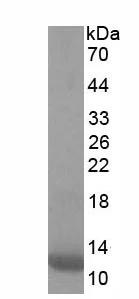 |
Greater than 97% as determined by reducing SDS-PAGE. |
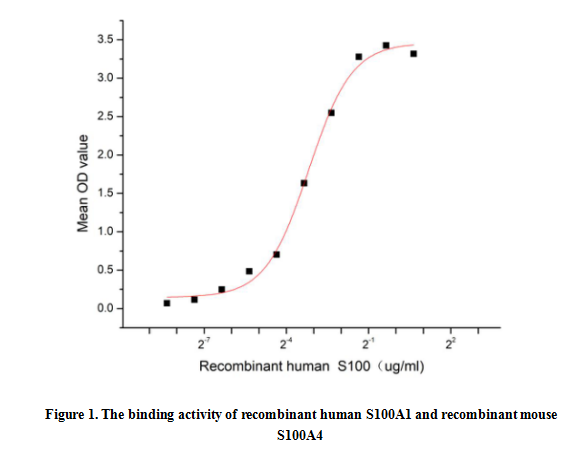 |
Small calcium binding protein that S100 Calcium Binding Protein (S100), also known as S100 Alpha (S100A1), is a member of the S100 family of calcium-binding proteins. As with most S100 proteins, S100A1 proteins are localized in the cytoplasm and/or nucleus of a wide range of cells, and it possess a variety of intracellular and extracellular functions. They interact with multiple receptors and signal transducers to regulate pathways that govern inflammation, cell differentiation, proliferation, energy metabolism, apoptosis, calcium homeostasis, cell cytoskeleton and microbial resistance. S100 Calcium Binding Protein A4 (S100A4) is one of targets of S100A1. Thus a functional binding ELISA assay was conducted to detect the interaction of recombinant human S100A1 and recombinant mouse S100A4. Briefly, S100A1 was diluted serially in PBS with 0.01% BSA (pH 7.4). Duplicate samples of 100 μl were then transferred to S100A4-coated microtiter wells and incubated for 1h at 37℃. Wells were washed with PBST and incubated for 1h with anti-S100A1 pAb, then aspirated and washed 3 times. After incubation with HRP labelled secondary antibody for 1h at 37℃, wells were aspirated and washed 5 times. With the addition of substrate solution, wells were incubated 15-25 minutes at 37℃. Finally, add 50 µL stop solution to the wells and read at 450/630 nm immediately. The binding activity of recombinant human S100A1 and recombinant mouse S100A4 was shown in Figure 1, the EC50 for this effect is 0.11 ug/mL. |
| 分子别名Alternative Names | S100-A1S100A1S100-AlphaS-100 ProteinS-100 protein subunit alphaS-100 protein alpha chain |
|---|---|
| 背景介绍Background | Small calcium binding protein that plays important roles in several biological processes such as Ca(2+) homeostasis, chondrocyte biology and cardiomyocyte regulation. In response to an increase in intracellular Ca(2+) levels, binds calcium which triggers conformational changes. These changes allow interactions with specific target proteins and modulate their activity. Regulates a network in cardiomyocytes controlling sarcoplasmic reticulum Ca(2+) cycling and mitochondrial function through interaction with the ryanodine receptors RYR1 and RYR2, sarcoplasmic reticulum Ca(2+)-ATPase/ATP2A2 and mitochondrial F1-ATPase. Facilitates diastolic Ca(2+) dissociation and myofilament mechanics in order to improve relaxation during diastole. |
| 功能Function | Small calcium binding protein that plays important roles in several biological processes such as Ca(2+) homeostasis, chondrocyte biology and cardiomyocyte regulation. In response to an increase in intracellular Ca(2+) levels, binds calcium which triggers conformational changes. These changes allow interactions with specific target proteins and modulate their activity. Regulates a network in cardiomyocytes controlling sarcoplasmic reticulum Ca(2+) cycling and mitochondrial function through interaction with the ryanodine receptors RYR1 and RYR2, sarcoplasmic reticulum Ca(2+)-ATPase/ATP2A2 and mitochondrial F1-ATPase. Facilitates diastolic Ca(2+) dissociation and myofilament mechanics in order to improve relaxation during diastole. |
| 亚细胞定位Subcellular Location | Cytoplasm. Sarcoplasmic reticulum. Mitochondrion. |
| 数据库链接Databases |
基因功能参考文献50 条
- Data suggest that TRPM4 exhibits binding sites for calmodulin (CaM) and S100 calcium-binding protein A1 (S100A1) located in very distal part of TRPM4 N-terminus. (TRPM4 = transient receptor potential cation channel subfamily M member 4) PMID: 29240297 : 29240297
- Data found that S100A1 was upregulated in hepatocellular carcinoma (HCC) tissues, and its upregulation was associated with large tumor size, low differentiation, and shorter survival rates. Further results supports the hypothesis that S100A1 functions as an oncogene and may be a biomarker for the prognosis of patients with HCC. S100A1 exerted its oncogenic function by interacting with LATS1 and activating Hippo pathway. PMID: 29901195 : 29901195
- The results indicate that changes in the circulating level of S100A1 protein occur in metabolic syndrome patients. The strong correlation between serum zinc-alpha2-glycoprotein and S100A1 might suggest that production or release of these two proteins could be related mechanistically. PMID: 28825380 : 28825380
- The results indicated that S100A1 enhanced the ovarian cancer cell proliferation and migration. PMID: 28595036 : 28595036
- found that S100B plays a crucial role in blocking the interaction site between RAGE V domain and S100A1. A cell proliferation assay WST-1 also supported our results. This report could potentially be useful for new protein development for cancer treatment PMID: 29444082 : 29444082
- Study provides evidence that mir-363 and its target S100A1 are under the regulatory function of FOXD2-AS1 aggravating nasopharyngeal carcinoma carcinogenesis. PMID: 29248577 : 29248577
- X-ray crystal structure of human calcium-bound S100A1 has been reported. PMID: 28368280 : 28368280
- a molecular mechanism for the potential regulation of TRPM1 by S100A1 PMID: 27435061 : 27435061
- Data suggest that calcium signaling plays important role in prevention of protein misfolding; complexes of S100A1 and STIP1 are key players in this pathway; the stoichiometry of S100A1/STIP1 interaction appears to be three S100A1 dimers plus one STIP1 monomer; each S100A1-STIP1-binding interaction is entropically driven. (S100A1 = S100 calcium binding protein A1; STIP1 = stress-induced-phosphoprotein 1) [REVIEW] PMID: 28819010 : 28819010
- Data suggest that three dimers of S100A1 (S100 calcium binding protein A1) associate with one molecule of STIP1 (stress-inducible phosphoprotein 1) in a calcium-dependent manner; individual STIP1 TPR (tetratricopeptide repeat) domains, TPR1, TPR2A and TPR2B, bind a single S100A1 dimer with significantly different affinities; TPR2B domain possesses highest affinity for S100A1. PMID: 28408431 : 28408431
- Results identified amino acids motif in S100A1 for protein binding to 2-oxohistidine which appears to be an evolutionarily conserved capacity from bacteria to human. PMID: 27644758 : 27644758
- a correlation between S100B + A1-positive Human Articular Chondrocytes in monolayer culture and their neochondrogenesis capacity in pellet culture, is reported. PMID: 27861869 : 27861869
- In line with these observations, rhesus monkey rhadinovirus infection resulted in rapid degradation of SP100, followed by degradation of PML and the loss of ND10 structures, whereas the protein levels of ATRX and DAXX remained constant. PMID: 27356898 : 27356898
- High Serum protein S100 levels are associated with postoperative delirium after off-pump coronary artery bypass surgery. PMID: 26943607 : 26943607
- molecular dynamics simulations of S100A1 in the apo/holo (Ca(2+)-free/bound) states, is reported. PMID: 26958883 : 26958883
- The relationship between the degree of infiltration by S100-positive (S100+) dendritic cells and prognostic factors, including histological subtype, histological grade, peritumor inflammatory infiltration, and stromal desmoplasia, were examined. PMID: 25611268 : 25611268
- In this review, we aim to describe the molecular basis and regulatory function of S100A1--{REVIEW} PMID: 25157660 : 25157660
- Patients with acute myocardial infarction (MI) showed significantly increased S100A1 serum levels. S100A1 signaling in cardiac fibroblasts occurs through endosomal TLR4/MyD88. PMID: 24833748 : 24833748
- hypoxia-induced MiR-138 is an essential mediator of EC dysfunction via its ability to target the 3'UTR of S100A1. PMID: 24244340 : 24244340
- It was suggested that S100A1 and S100B be used as markers to develop potency assays for cartilage regeneration cell therapies, and as a redifferentiation readout in monolayer cultures aiming to investigate stimuli for chondrogenic induction. PMID: 24402969 : 24402969
- Twenty-seven out of thirty-two (84.38%) cases of serous ovarian carcinoma were found to express S100A1. S100A1 expression was observed in one out of the two mucinous and three out of the six endometroid ovarian carcinomas. PMID: 24501865 : 24501865
- The triple mutation Arg852/Lys859/Arg860 exhibited significant disruption of the binding of S100A1 to TRPC6 implicating their involvement in the binding site. PMID: 23671622 : 23671622
- For autopsy material, all human cases of definite myocardial infarction and suspected early infarction showed well-defined areas without S100A1 staining. PMID: 23683996 : 23683996
- This study showed that overexpression of S100A10, may play a role in irritable bowel syndrome, and that the IL10-819 CC is a candidate genotype for irritable bowel syndrome and ulcerative colitis. PMID: 23595519 : 23595519
- In this review we will focus on the roles of S100A proteins in intracellular and extracellular calcium signalling and homeostasis. PMID: 23662436 : 23662436
- the increased calcium binding affinity of S100A1 upon thionylation arises, most probably, from rearrangement of the hydrophobic core in its apo form PMID: 23351007 : 23351007
- Report downregulation of S100A1 expression in critical limb ischemia impairs postischemic angiogenesis via compromised proangiogenic endothelial cell function and nitric oxide synthase regulation. PMID: 23048072 : 23048072
- S-Nitrosylation of S100A1 increases Ca(2+) binding and tunes the overall protein conformation. PMID: 22989881 : 22989881
- Uremia clearance using NHD is accompanied by improvement in LV strain, rotation, reduction in mass and volume index. Dialysis downregulates genes for cardiomyocyte apoptosis and fibrosis and upregulates S100A1, which may improve LV contractility. PMID: 22647434 : 22647434
- Calmodulin and S100A1 protein interact with N terminus of TRPM3 channel. PMID: 22451665 : 22451665
- The three-dimensional structure of human apo(calcium free)S100A1 protein was determined by NMR spectroscopy PMID: 21296671 : 21296671
- Thermodynamics of zinc binding to human S100A2 PMID: 21090249 : 21090249
- S100A1, S100A2, S100A4, S100A6 and S100B interacted with MDM2 (2-125). PMID: 20591429 : 20591429
- A single phenyl-Sepharose column was sufficient for the purification of human S100A11 whereas HiTrap Q anion exchange followed by phenyl-Sepharose columns were required for the purification of S100A1. PMID: 20347987 : 20347987
- The expression of S100A1 was low in benign melanocytic tumours and increased in malignant melanomas PMID: 20042890 : 20042890
- S100A1B and S100BB are increased in urine collected from asphyxiated newborns who will develop hypoxic-ischemic encephalopathy (HIE) since first urination, and their measurement may be useful to early predict HIE. PMID: 19482672 : 19482672
- S100A1 is a specific and sensitive immunohistochemical marker to differentiate nephrogenic adenoma from prostatic adenocarcinoma PMID: 19384190 : 19384190
- The presence of the S100A1 in myocardial sarcoplasmic reticulum and myofibrils may be related to the known target proteins for S100A1 at these sites. PMID: 11829317 : 11829317
- Impaired cardiac contractility response to hemodynamic stress in S100A1-deficient mice. PMID: 11909974 : 11909974
- identification of the S100A1 C terminus (amino acids 75-94) and hinge region (amino acids 42-54) to differentially enhance sarcoplasmic reticulum Ca2+ release with a nearly 3-fold higher activity of the C terminus PMID: 12721284 : 12721284
- S100A1 has a reglatory role in the contraction-relaxation cycle in the human heart PMID: 12804600 : 12804600
- S100A1 protein serves as a cardioprotective factor in vitro PMID: 12960148 : 12960148
- identified S100A1, but not calmodulin or other S100 proteins, as a potent molecular chaperone and a new member of the Hsp70/Hsp90 multichaperone complex PMID: 14638689 : 14638689
- Synapsins and S100A1 interact in nerve terminals where coexpresssed; S100A1 cannot bind SV-associated synapsin I and may function as a cytoplasmic store of monomeric synapsin I; synapsin dimerization and interaction with S100A1 are mutually exclusive PMID: 15147519 : 15147519
- Results demonstrate that restoration of S100A1 protein levels in failing myocardium by gene transfer may be a novel therapeutic strategy for the treatment of heart failure. PMID: 15578088 : 15578088
- This study provides the first evidence that intracellular S100A1, depending on its subcellular location, modulates cardiac Ca2+-turnover via different Ca2+-regulatory proteins. PMID: 15654019 : 15654019
- S100A1 was expressed in 2/15 clear cell RCCs, 11/15 papillary RCCs, 7/8 oncocytomas and in 0/7 chromophobe RCCs. PMID: 15780567 : 15780567
- the three-dimensional structure of calcium-bound S100A1 was determined by multidimensional NMR spectroscopy and compared to the previously determined structure of apo-S100A1 PMID: 16169012 : 16169012
- S-100 protein expression in tumour cells was associated with significantly decreased survival PMID: 16760135 : 16760135
- analysis of the different reactivity pattern of S100A1 in the external auditory canal cholesteatoma PMID: 16969478 : 16969478
蛋白复溶体积计算器缓冲液体积 = 蛋白质量 ÷ 蛋白浓度
输入任意两项,第三项自动计算 |
蛋白浓度稀释计算器初浓度 × 初体积 = 终浓度 × 终体积
输入任意三项,第四项自动计算 |



