Recombinant Human HDGF (C-6His)
Alternative NamesHepatoma-Derived Growth Factor; HDGF; High Mobility Group Protein 1-Kike 2; HMG-1L2; HDGF; HMG1L2
规格参数 Specifications
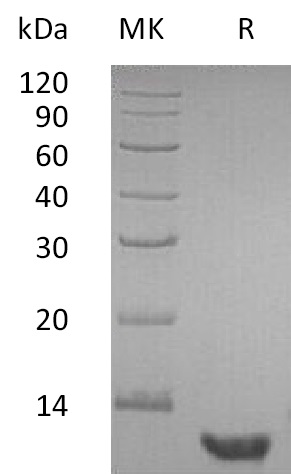
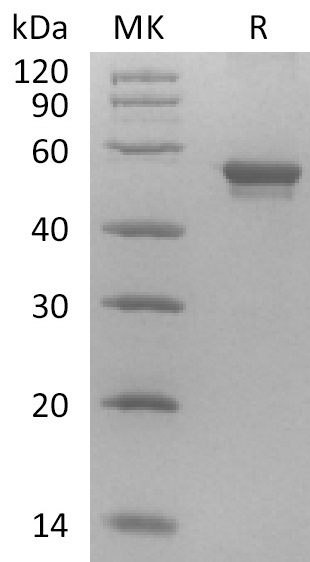
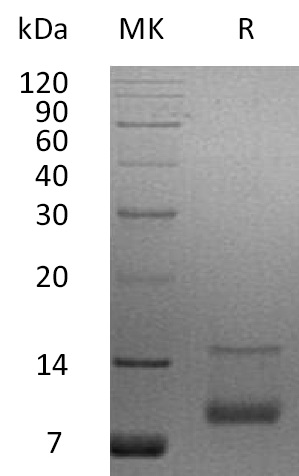
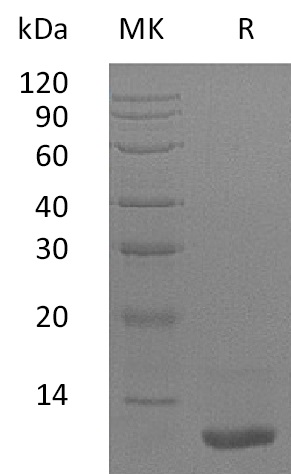
| 纯度Purity | Greater than 95% as determined by reducing SDS-PAGE |
|---|---|
| 内毒素Endotoxin | <1 EU/µg as determined by LAL test. |
| 蛋白构建Protein Construction |
【Met1-Tyr100】序列区间-6HisC 端标签
|
| Accession | P51858 |
| 表达宿主Expression Host | E. coli |
| 种属Species | Human |
| 预测分子量Predicted MW | 12.6 kDa |
| 制剂Formulation | Lyophilized from a 0.2 μm filtered solution of 20mM Tris-HCl, 1mM DTT, 1mM EDTA, pH 7.5. |
| 运输方式Shipping | The product is shipped with ice bag. Upon receipt, store it immediately at the temperature listed below. |
| 稳定性&储存Stability & Storage | 12 months at -20°C to -80°C in lyophilized state.6 months at -20°C to -80°C under sterile conditions after reconstitution.7-10 days at 2°C to 8°C under sterile conditions after reconstitution.Please minimize freeze-thaw cycles. |
| 复溶Reconstitution | Always centrifuge tubes before opening. Do not mix by vortex or pipetting. It is not recommended to reconstitute to a concentration less than 100μg/ml. Dissolve the lyophilized protein in distilled water. Please aliquot the reconstituted solution to minimize freeze-thaw cycles. |
!
本司产品仅用于科研,不用于临床诊断和治疗。
产品图片 Product Images点击图片可查看原图
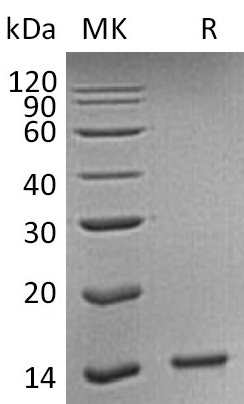 |
Greater than 95% as determined by reducing SDS-PAGE. |
靶点信息 Target Information
| 分子别名Alternative Names | Hepatoma-Derived Growth FactorHDGFHigh Mobility Group Protein 1-Kike 2HMG-1L2HDGFHMG1L2 |
|---|---|
| 功能Function | Acts as a transcriptional repressor. Has mitogenic activity for fibroblasts. Heparin-binding protein.; Does not have mitogenic activity for fibroblasts. Does not bind heparin.; Has mitogenic activity for fibroblasts. Heparin-binding protein. |
| 亚细胞定位Subcellular Location | [Isoform 1]: Nucleus. Cytoplasm. Secreted, extracellular exosome.; [Isoform 2]: Nucleus. Cytoplasm. Secreted, extracellular exosome.; [Isoform 3]: Nucleus. Cytoplasm. Secreted, extracellular exosome. |
| 数据库链接Databases |
基因功能参考文献50 条
- miR139 was downregulated in epithelial ovarian cancer, and acted as a tumor suppressor by directly targeting HDGF. PMID: 28713954 : 28713954
- high serum levels of HDGF were significantly correlated to bone metastasis and poorer prognosis of non-small cell lung cancer. PMID: 28592712 : 28592712
- Data suggested that HDGF knockdown inhibits cellular migration and invasion in vitro of prostate cancer via modulating epithelial-mesenchymal transition signaling pathway, as well as MMP2 and MMP9 signaling pathway. These results supported that HDGF is a relevant protein in the progression of prostate cancer and may serve as a potentially therapeutic target for prostate cancer as well as its downstream targets. PMID: 29300772 : 29300772
- HDGF is overexpressed in both androgen-sensitive and androgen-insensitive cell lines. Forced overexpression enhanced cell viability but knockdown reduced proliferation of benign prostate cells.Ectopic HDGF overexpression of HDGF in up-regulated cyclin E and BCL-2, but down-regulated BAX. Treatment with a HDGF monoclonal antibody and vitamin K2 reduced proliferation and inhibited NF-kB expression in a tumor cell line. PMID: 27692835 : 27692835
- functional diversity of HDGF isoforms PMID: 27926477 : 27926477
- our findings first indicate that the interaction of HDGF and beta-catenin may play a crucial role in tumorigenesis of synovial sarcoma. PMID: 26842923 : 26842923
- HDGF was overexpressed in hepatocellular carcinoma patients and cells. PMID: 27273265 : 27273265
- miRNA497 directly targets hepatomaderived growth factor (HDGF) in prostate cancer cells. PMID: 26780929 : 26780929
- describe two previously unknown HDGF isoforms, HDGF-B and HDGF-C, generated via alternative splicing with structurally unrelated N-terminal regions of their hath region PMID: 26845719 : 26845719
- study uncovers a novel function of HDGF as a messenger of cellular condition (alarmin) which in-turn modulates cellular function-aspects that could be used as a biomarker for ovarian cancer. PMID: 26612514 : 26612514
- HDGF and beta-catenin interact as a positive feedback loop, which plays an important role in carcinogenesis and progression of colorectal carcinoma. PMID: 26296979 : 26296979
- HDGF is important in promoting malignant biological behaviors, including proliferation, migration and invasion of hilar cholangiocarcinoma cells. PMID: 26081074 : 26081074
- Hepatoma-derived growth factor overexpression is involved in liver carcinogenesis. PMID: 25938538 : 25938538
- Meta-analysis results provide evidence that HDGF may be a new indicator of poor cancer prognosis. PMID: 25773828 : 25773828
- HDGF contains conserved N-terminal HATH domains with a characteristic structural motif, namely the PWWP motif. This study defines the role of the first residue of the PWWP motif in modulating HATH domain stability and oligomer formation in binding. PMID: 26067205 : 26067205
- HDGF overexpression is common in early-stage cervical adenocarcinoma. PMID: 25421244 : 25421244
- The expression level of hepatoma-derived growth factor (HDGF) significantly decreased in response to the virus-associated RNAs under replication-deficient condition. PMID: 25275311 : 25275311
- HDGF can promote IHCC cells progression, including proliferation, invasion, and angiogenesis PMID: 25262276 : 25262276
- Results suggest that HDGF downregulation significantly suppresses glioma cell proliferation, migration, invasion in vitro and tumorigenesis in vivo is probably involved in the activation of both the PI3K/Akt and the TGF-beta signaling pathways PMID: 24986090 : 24986090
- These data suggested that irradiated fibroblasts promoted invasion, growth, EMT and HDGF expression of ESCC. PMID: 25677618 : 25677618
- The expression of nuclear HDGF might be closely related to the carcinogenesis, clinical biological behaviors, and prognosis of gallbladder adenocarcinoma. PMID: 25071353 : 25071353
- HDGF is a potential unfavorable factor for the progression and prognosis of endometrial carcinoma. PMID: 24692842 : 24692842
- Data indicate that hepatoma-derived growth factor (HDGF) was a target of miR-195 in non-small cell lung cancer (NSCLC) cells. PMID: 24891187 : 24891187
- expression of HDGF was negatively correlated with miR-141 in gastric cancer tissues: the suppressive effects of miR-141 on GC cell proliferation, colony formation, in vitro migration, and invasion were partially mediated by suppressing HDGF expression. PMID: 24276755 : 24276755
- ADAM9 high expression is correlated positively and significantly with HDGF high expression in non-small cell lung cancer. PMID: 24770635 : 24770635
- Patients with higher HDGF and CD31 expression level had poorer overall survival rates. PMID: 23771798 : 23771798
- Positive expression of HDGF was detected in 46.2 % of patients with extrahepatic cholangiocarcinoma and correlated with poor tumor differentiation. The HDGF expression group had lower survival than the negative HDGF expression group. PMID: 23793608 : 23793608
- Combining p53 expression and HDGF expression significantly improved prognostic stratification for patients with Ewing family tumor. PMID: 24072730 : 24072730
- Together, these results indicate that HDGF downregulation participates in POMC-induced suppression of metastasis and EMT in melanoma. PMID: 23468531 : 23468531
- Suggest that HDGF exhibits oncogenic properties and may be a novel prognostic factor in Ewing's sarcoma. PMID: 23878072 : 23878072
- Up-regulation of hepatoma-derived growth factor facilities tumor progression in malignant melanoma. PMID: 23536873 : 23536873
- The suppressive effect of miR-16 on cell proliferation, colony formation, migration, and invasion is partially mediated by inhibiting HDGF expression. PMID: 23954293 : 23954293
- Studied HDGF in gallbladder cancer (GBC).Patients with nuclear HDGF-pos tumors had worse survival than patients with HDGF-negative tumors. Treatment of GBC-SD and SGC-996 lines with HDGF-siRNA significantly reduced the proliferation of GBC cell lines. PMID: 23609195 : 23609195
- Tumor samples from non-small cell lung cancers show an inverse relationship between microRNA-497 and HDGF levels, and ectopic expression of miR-497 significantly inhibited tumor growth and angiogenesis in a xenograft model PMID: 23673296 : 23673296
- Expression of a cytosolic variant of hepatoma-derived growth factor causes a redistribution of nucleolin into the cytoplasm. PMID: 23305559 : 23305559
- Hepatoma-derived growth factor regulates breast cancer cell invasion by modulating epithelial--mesenchymal transition. PMID: 22247069 : 22247069
- Hepatoma-derived growth factor overexpression contributes to the oncogenic processes in oral cancer cells PMID: 22361040 : 22361040
- Differential proteomic analysis of human glioblastoma and neural stem cells reveals HDGF as a novel angiogenic secreted factor PMID: 22331796 : 22331796
- High hepatoma-derived growth factor is associated with gliomas. PMID: 22037800 : 22037800
- The interactome suggests that HDGF is a multifunctional protein and participates in many cellular events, including ribosome biogenesis, RNA processing, DNA damage repair and transcriptional regulation. PMID: 21907836 : 21907836
- found that HDGF was overexpressed also in primary gastric, breast, and lung cancer tissues harboring mutant p53 genes PMID: 22006999 : 22006999
- HDGF was highly expressed in 158 non-small cell lung cancer tissues compared with normal control. PMID: 21426662 : 21426662
- High HDGF is associated with hilar cholangiocarcinoma. PMID: 20848225 : 20848225
- Increased nuclear expression of HDGF is a potential unfavourable prognostic factor for patients with hepatoma-derived growth factor PMID: 21255068 : 21255068
- High HDGF expression is associated with poor overall survival in patients with hepatocellular carcinoma. Down-regulation of HDGF inhibits the growth, anchorage-independent growth, migration and invasion of HepG2 cells. PMID: 20846397 : 20846397
- High hepatoma-derived growth factor is associated with colorectal carcinoma. PMID: 19924574 : 19924574
- results suggest that HDGF is involved in cell growth, cell invasion, and apoptosis PMID: 21302807 : 21302807
- The present study is aimed at examining the role of HDGF in keloid pathogenesis. PMID: 19432814 : 19432814
- HDGF expression is upgraded in postoperative stage I non-small cell lung cancer patients, and is a significantly independent predictive factor. PMID: 18478933 : 18478933
- Hepatoma-derived growth factor stimulates cell growth after translocation to the nucleus PMID: 11751870 : 11751870
蛋白复溶体积计算器缓冲液体积 = 蛋白质量 ÷ 蛋白浓度
输入任意两项,第三项自动计算 |
蛋白浓度稀释计算器初浓度 × 初体积 = 终浓度 × 终体积
输入任意三项,第四项自动计算 |