Recombinant Human FGF-10/KGF2
Alternative NamesFibroblast growth factor 10;FGF-10;Keratinocyte growth factor 2;FGF10;KGF-2;KGF2
规格参数 Specifications
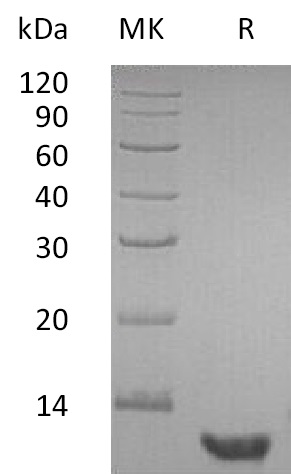
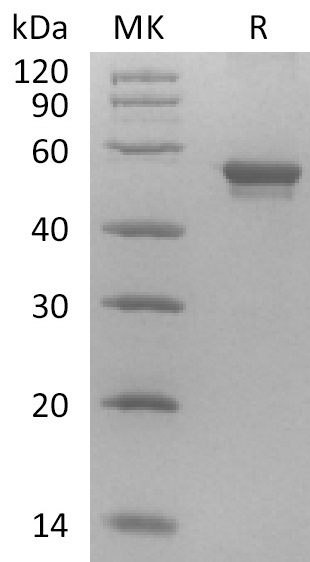
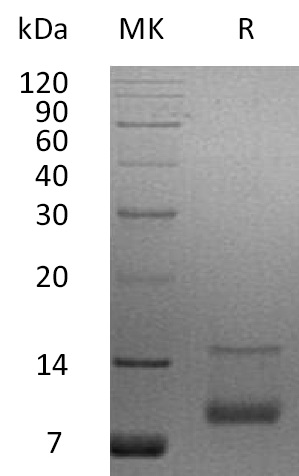
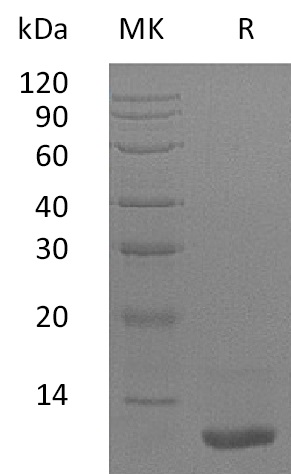
| 纯度Purity | Greater than 95% as determined by reducing SDS-PAGE |
|---|---|
| 内毒素Endotoxin | ≤10 EU/mg |
| 蛋白构建Protein Construction |
【Gln38-Ser208】序列区间
|
| Accession | O15520 |
| 表达宿主Expression Host | CHO |
| 种属Species | Human |
| 预测分子量Predicted MW | 19.3 kDa |
| 制剂Formulation | Lyophilized from a 0.2 μm filtered solution of PBS,5% mannitol and 0.01% Tween 80, pH7.4 |
| 运输方式Shipping | The product is shipped with ice bag. Upon receipt, store it immediately at the temperature listed below. |
| 稳定性&储存Stability & Storage | 12 months at -20°C to -80°C in lyophilized state.6 months at -20°C to -80°C under sterile conditions after reconstitution.7-10 days at 2°C to 8°C under sterile conditions after reconstitution.Please minimize freeze-thaw cycles. |
| 复溶Reconstitution | Always centrifuge tubes before opening. Do not mix by vortex or pipetting. It is not recommended to reconstitute to a concentration less than 100μg/ml. Dissolve the lyophilized protein in distilled water. Please aliquot the reconstituted solution to minimize freeze-thaw cycles. |
!
本司产品仅用于科研,不用于临床诊断和治疗。
产品图片 Product Images点击图片可查看原图
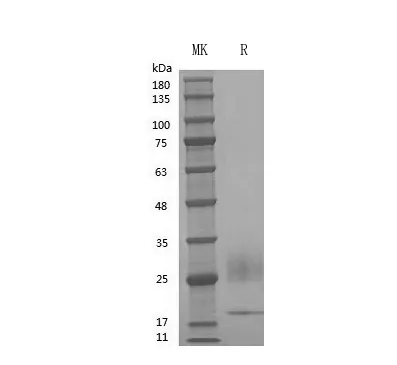 |
Greater than 95% as determined by reducing SDS-PAGE |
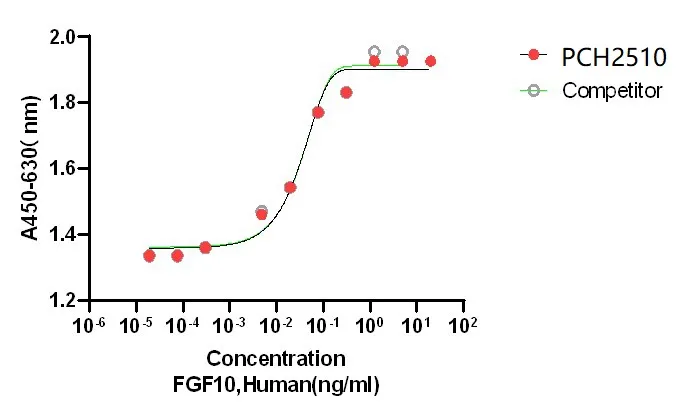 |
Measured by its ability to inducelL-11 secretion by Saos-2 human osteosarcoma cells. The ED50 for this effect is ≤2ug/mL. |
靶点信息 Target Information
| 分子别名Alternative Names | Fibroblast growth factor 10FGF-10Keratinocyte growth factor 2FGF10KGF-2KGF2 |
|---|---|
| 背景介绍Background | Fibroblast growth factor 10 (FGF-10, KGF-2), is a member of the fibroblast growth factor (FGF) family that includes FGF-3, -7, and -22. KGF-2 is secreted by mesenchymal cells and associates with extracellular FGF-BP. It preferentially binds and activates epithelial cell FGFR2 and interacts more weakly with FGFR1. It plays an important role in the regulation of embryonic development, cell proliferation and cell differentiation. It exhibits mitogenic activity for keratinizing epidermal cells, but essentially no activity for fibroblasts, which is similar to the biological activity of FGF7. FGF10 is required for normal branching morphogenesis. Defects in FGF10 are the cause of autosomal dominant aplasia of lacrimal and salivary glands (ALSG). ALSG has variable expressivity, and affected individuals may have aplasia or hypoplasia of the lacrimal, parotid, submandibular and sublingual glands and absence of the lacrimal puncta. The disorder is characterized by irritable eyes, recurrent eye infections, epiphora (constant tearing) and xerostomia (dryness of the mouth), which increases the risk of dental erosion, dental caries, periodontal disease and oral infections. |
| 功能Function | Plays an important role in the regulation of embryonic development, cell proliferation and cell differentiation. Required for normal branching morphogenesis. May play a role in wound healing. |
| 亚细胞定位Subcellular Location | Secreted. |
| 数据库链接Databases |
基因功能参考文献48 条
- We report the ophthalmological and genetic study of a 19-year-old woman and her relatives suffering from this syndrome. A new probably pathogenic variant is described in the FGF10 gene. PMID: 29053399 : 29053399
- We have revealed significant association of FGFR2 and MAP3K1 polymorphisms with breast cancer. PMID: 29372690 : 29372690
- data suggest that the strongest signal of association at 5p12 is mediated through coordinated activation of FGF10 and MRPS30, two candidate genes for breast cancer pathogenesis PMID: 27640304 : 27640304
- Fgf10 signaling has an essential role in the formation of lipofibroblasts during late lung development PMID: 26511927 : 26511927
- Expression of Fibroblast Growth Factor 10 is correlated with poor prognosis in gastric adenocarcinoma. PMID: 26268776 : 26268776
- FGF10 has a role in protecting neuron against oxygen-glucose deprivation injury through inducing heme oxygenase-1 PMID: 25446127 : 25446127
- Data identify autocrine activation of FGF signaling as an essential mechanism in promoting Pten-deficient skin tumors. PMID: 24582960 : 24582960
- The therapeutic potential of the FGF10 treatment. PMID: 24865969 : 24865969
- FGF10 plays an important role for tumor growth by both paracrine and autocrine manner. PMID: 24320134 : 24320134
- The findings show that immunohistochemistry with FGF10, FGFR2b, or SHH could be useful in differentiating CCAM from type I PPB, when a child presents with a focal cystic lung lesion. PMID: 24004862 : 24004862
- Paracrine FGF10 signaling stimulates the differentiation of human stem cell into urothelial cells. PMID: 23949743 : 23949743
- High FGF10 expression is associated with ameloblastoma. PMID: 24002438 : 24002438
- Three FGF10 single nucleotide polymorphisms in complete linkage disequilibrium--rs339501, rs12517396, and rs10462070--were associated with extreme myopia in the Japanese population. PMID: 24265547 : 24265547
- FGF-10 expression during the development of the human hindgut and anorectum suggests that it may play a role in hindgut and anorectal morphogenesis. PMID: 23774963 : 23774963
- The sclera of myopic eyes had higher FGF10 levels. The risk G allele of SNP rs339501 was associated with extreme myopia in human and caused a higher gene expression in the luciferase assay. PMID: 23599340 : 23599340
- the posttranslational and transcriptional mechanisms underlying stimulation of P-glycoprotein function and expression by keratinocyte growth factor-2 (KGF2) that may contribute to the beneficial effects of KGF2 in intestinal inflammatory disorders PMID: 23328208 : 23328208
- tooth agenesis had increased risk of a family history of cancer. tooth agenesis was associated with positive self-reported family history of cancer and variants in FGF10. PMID: 23169889 : 23169889
- Identification of FGF-10 at both protein and mRNA levels in ovaries from fetuses, girls, and women suggests that FGF-10 contributes to preantral follicle development; FGF-10 is expressed in both granulosa cells and oocytes. PMID: 22877940 : 22877940
- Our data suggest that common variants in FGF10 increase the risk for a wide range of non-syndromic limb deficiencies. PMID: 22965740 : 22965740
- [review] FGF10 mediates biological responses by activating FGF receptor 2b (FGFR2b) in a paracrine manner. PMID: 21696361 : 21696361
- The relationship between human ISL1 and FGF10 within the embryonic time window during which the linear heart tube remodels into four chambers, was examined. PMID: 22303449 : 22303449
- Investigation of the pulmonary functions of COPD patients heterozygous for loss of function mutations in the FGF10 gene was performed. The patients show a significant decrease in lung function parameters when compared to control values. PMID: 21742743 : 21742743
- Gremlin-mediated BMP inhibition results in activation of epithelial cells and transient fibrosis, but also induction of epithelium-protective FGF10 PMID: 20705941 : 20705941
- FGF2 and FGF10 regulate migratory activity of ovine trophoblast cells through MAPK-dependent pathways. PMID: 21310815 : 21310815
- FGF10 can promote the adipogenesis effect in situ. PMID: 19915940 : 19915940
- There was no association among gene FGFR1 rs13317, p. E467K, p. M369I, p. S393S and gene FGF10 rs1448037 and nonsyndromic cleft lip with or without palate in Chinese population. PMID: 19727229 : 19727229
- These results suggested that Thr-114 is a crucial functional residue for FGF10, and mutating Thr-114 to Ala or Arg would lead to great decrease in receptor-binding affinity and biological activity of FGF10. PMID: 20036575 : 20036575
- FGF10 upregulates Na(+)-K(+)-exchanging ATPase via the MAPK pathway. PMID: 12804770 : 12804770
- FGF-10 attenuates H2O2-induced alveolar epithelium DNA damage by mechanisms that involve activation of Grb2-SOS/Ras/RAF-1/ERK1/2 pathway and DNA repair. PMID: 14975937 : 14975937
- Fgf10 mRNA is overexpressed in a subset of human breast carcinomas. PMID: 15208658 : 15208658
- Data validate the symmetric two-end model of fibroblast growth factor (FGF) receptor (FGFR) dimerization and FGF binding and argue against the asymmetric model of FGFR dimerization. PMID: 15632068 : 15632068
- We suggest that haploinsufficiency for FGF10 during a crucial stage of development results in ALSG. PMID: 15654336 : 15654336
- Human embryonic pancreatic mesenchyme expresses FGF10, which might be used used to expand human embryonic pancreatic epithelial cells. PMID: 15690149 : 15690149
- Human recombinant FGF10 maintains murine Notch activation and induces the expansion of murine pancreatic precursors while blocking their differentiation. PMID: 16323074 : 16323074
- Localization of the FGF-10 receptor to the urothelial layer is clinically significant because intravesical administration of FGF-10 may provide a means to control the turnover of transitional epithelium in bladder disorders such as interstitial cystitis. PMID: 16597614 : 16597614
- Activation of Toll-like receptor 2 (TLR2) or Toll-like receptor 4 (TLR4) inhibited FGF-10 expression, leading to abnormal saccular airway morphogenesis. PMID: 17071719 : 17071719
- R80S and G138E mutations are associated with aplasia of the lacrimal and salivary glands. PMID: 17213838 : 17213838
- a nuclear localization signal-like motif of FGF-10 is a partial determinant of its intracellular distribution and is necessary for its mitogenic activity PMID: 17471512 : 17471512
- Trophoblast outgrowth and invasion (part of placental villi sprouting) at the fetal maternal interface is in part under delicate control of FGF 10 and Sprouty 2. PMID: 17496316 : 17496316
- Results suggest that Lacrimo-auriculo-dento-digital syndrome is caused by reduced activity of the fibroblast growth factor 10 (FGF10)-FGF receptor 2 signaling pathway. PMID: 17682060 : 17682060
- Expression in diverse niches of adult brain of Fgf10-lacZ reporter mice implicates Fgf10 in control of neurogenesis and/or conservation of neurogenic potential. PMID: 18329286 : 18329286
- It cannot be ruled out that other genes involved in the signalling pathway of FGF10 may contribute to the formation of these congenital malformations. PMID: 18587586 : 18587586
- Stromal FGF10 induces migration and invasion in pancreatic cancer cells through interaction with FGFR2, resulting in a poor prognosis. PMID: 18594526 : 18594526
- family-based approach revealed an intronic variation of the FGF10 gene causing aplasia of lacrimal and salivary glands-syndrome PMID: 19102732 : 19102732
- Disruption of localized pattern of mesenchymal fibroblast growth factor 10 expression results in impairment of lung branching morphogenesis, which progresses to emphysematous airspaces in adults. PMID: 19115389 : 19115389
- Fgf10 is a strong causative candidate for defects observed in Apert syndrome since its genetic knockdown in a mouse model of Apert syndrome results in the rescue of the skeletal and visceral defects associated with this congenital disease. PMID: 18773495 : 18773495
- An analysis of the distribution and fate of Fgf10-expressing cells in the adult mouse brain suggests that Fgf10 may have critical regulatory roles in stem cell function and generation of new neurons in diverse areas of the adult brain. PMID: 18773495 : 18773495
- TGFbeta1 caused a rapid and transient decrease in Fgf10 mRNA levels in primary prostatic cells. Deletion analysis of the Fgf10 promoter identified a region that mediated a proportion of promoter activity as well as promoter down-regulation by TGFbeta1. PMID: 14726452 : 14726452
蛋白复溶体积计算器缓冲液体积 = 蛋白质量 ÷ 蛋白浓度
输入任意两项,第三项自动计算 |
蛋白浓度稀释计算器初浓度 × 初体积 = 终浓度 × 终体积
输入任意三项,第四项自动计算 |