

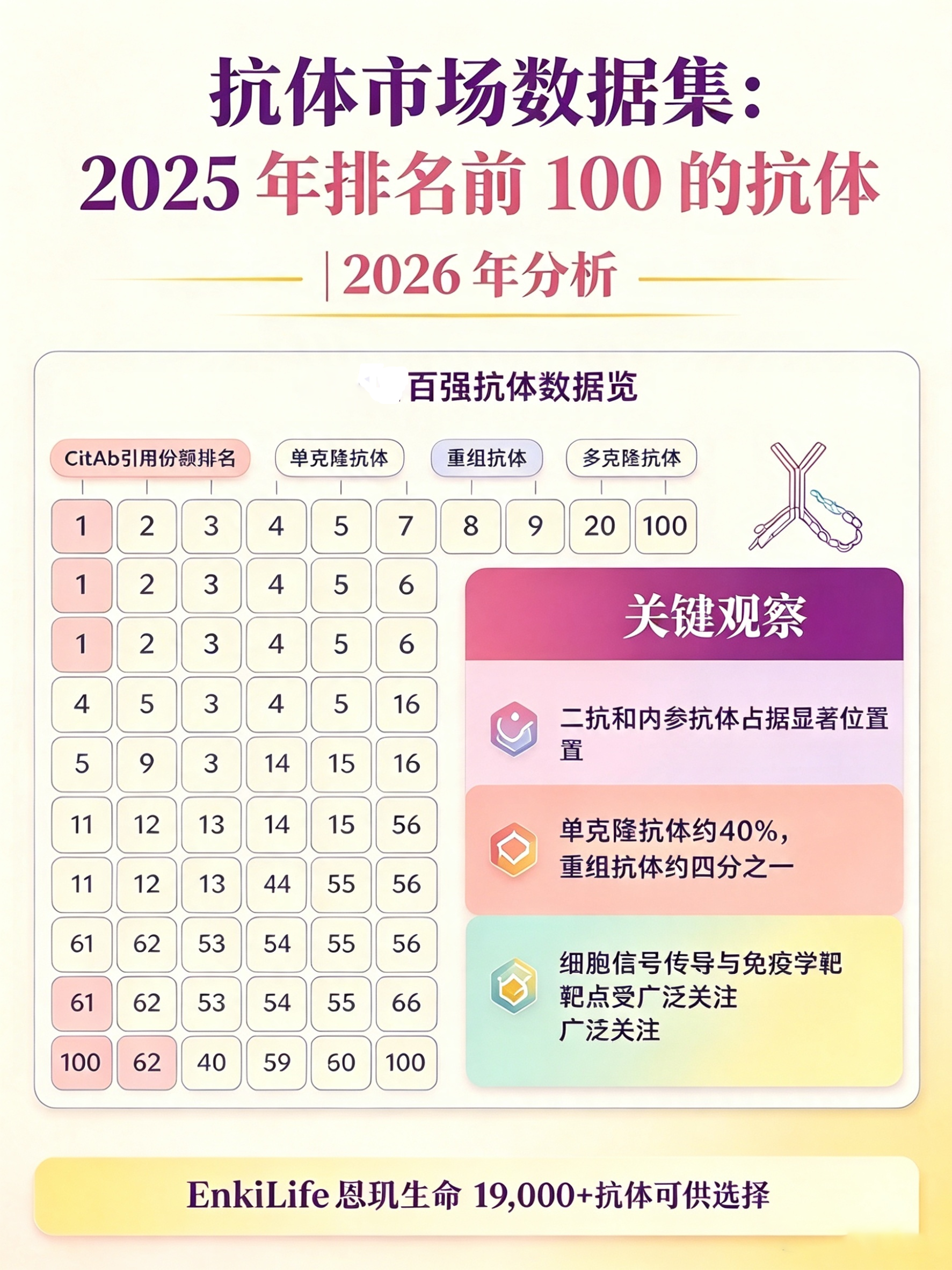
抗体市场数据集:2025年排名前100的抗体|2026年分析
CitAb根据2025年一年出版物中的引用份额对抗体试剂进行排名,从而编制最终名单——涵盖单克隆、多克隆和重组抗体。其特别关注引用次数:这是衡量产品在同行评审的已发表研究中出现频率的指标。
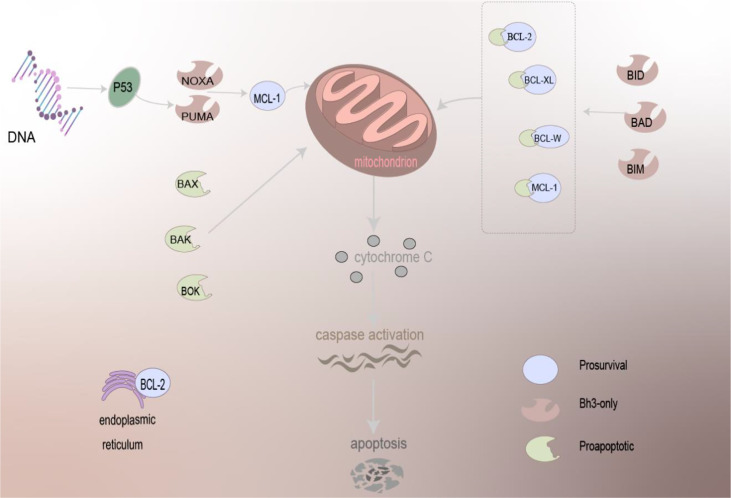
Bcl-2 家族由多个进化上保守的蛋白质组成,含有 Bcl-2 同源结构域(BH),通过调控线粒体膜通透性和细胞色素 c 的释放来调节细胞凋亡。目前已鉴定出四个 BH 结构域(BH1-4),介导蛋白质间的相互作用。根据功能和序列同源性,该家族可分为三组:促存活成员包括 Bcl-2、Bcl-xL、Mcl-1、A1 和 Bcl-w;促凋亡蛋白包括 Bax、Bak 和 Bok;"仅含 BH3"蛋白包括 Bad、Bik、Bid、Puma、Bim、Bmf、Noxa 和 Hrk。促凋亡和抗凋亡 Bcl-2 家族成员之间的相互作用引出了"变阻器模型",即促凋亡和抗凋亡蛋白的比例决定了细胞命运。因此,促存活成员通过结合并拮抗促凋亡成员来发挥其功能。一般来说,"仅含 BH3"成员能够结合并拮抗促存活蛋白,导致凋亡增加。虽然该系统可能存在一定的冗余性,但许多家族成员的组织特异性、转录水平和翻译后调控可以解释其不同的生理作用。

Apoptosis is a regulated physiological process leading to cell death. Caspases, a family of cysteine acid proteases, are central regulators of apoptosis. Initiator caspases (including 2, 8, 9, 10 and 12) are closely coupled to proapoptotic signals, which include the FasL, TNF-α, and DNA damage. Once activated, these caspases cleave and activate downstream effector caspases (including 3, 6 and 7), which in turn cleave cytoskeletal and nuclear proteins like PARP, α-fodrin, DFF and lamin A, and induce apoptosis.

Bcl-2 家族由多个进化上保守的蛋白质组成,含有 Bcl-2 同源结构域(BH),通过调控线粒体膜通透性和细胞色素 c 的释放来调节细胞凋亡。目前已鉴定出四个 BH 结构域(BH1-4),介导蛋白质间的相互作用。根据功能和序列同源性,该家族可分为三组:促存活成员包括 Bcl-2、Bcl-xL、Mcl-1、A1 和 Bcl-w;促凋亡蛋白包括 Bax、Bak 和 Bok;"仅含 BH3"蛋白包括 Bad、Bik、Bid、Puma、Bim、Bmf、Noxa 和 Hrk。促凋亡和抗凋亡 Bcl-2 家族成员之间的相互作用引出了"变阻器模型",即促凋亡和抗凋亡蛋白的比例决定了细胞命运 (4)。因此,促存活成员通过结合并拮抗促凋亡成员来发挥其功能。一般来说,"仅含 BH3"成员能够结合并拮抗促存活蛋白,导致凋亡增加。虽然该系统可能存在一定的冗余性,但许多家族成员的组织特异性、转录水平和翻译后调控可以解释其不同的生理作用。

The synapse is the unit of information transfer in the brain between neurons. Synaptic transfer is initiated by action potential-initiated synaptic vesicles fusion at the presynaptic terminal to release neurotransmitters. The basic molecular machinery that drives all membrane fusion events in all cells include N-ethylmaleimide-sensitive factor attachment protein receptor (SNARE) proteins that form a trans-ternary complex between to-be-fused membranes. The zippering up of SNARE proteins provides the energy required for membrane fusion. At the synapse, the SNARE proteins include 25 kDa synaptosome-associated protein (SNAP25), syntaxin 1A (STX1A), and vesicle-associated membrane protein 2 (VAMP2, also called synaptobrevin). Neurotransmitter release, however, is a highly regulated process that occurs in response to action potential-initiated Ca2+-influx. Regulation of synaptic vesicle fusion is mediated by SNARE-binding proteins like complexin and the Ca2+-associated vesicle protein, synaptotagmin-1, that cooperatively function to initiate Ca2+-induced synaptic vesicle fusion. The synaptic vesicle cycle represents a cycle of events that prime the synaptic vesicle before fusion and retrieve fused membrane after full fusion. Synaptic vesicle-associated proteins like synaptophysin and synapsin-1, as well as target membrane proteins like Munc18-1, play a complex role in priming synaptic vesicles to be fusion competent.
Phosphoinositide-specific phospholipase C (PLC) plays a significant role in transmembrane signaling. In response to extracellular stimuli, such as hormones, growth factors, and neurotransmitters, PLC hydrolyzes phosphatidylinositol 4,5-bisphosphate (PIP2) to generate two secondary messengers: inositol 1,4,5-triphosphate (IP3) and diacylglycerol (DAG). At least four families of PLCs have been identified: PLCβ, PLCγ, PLCδ, and PLCε. Phosphorylation is one of the key mechanisms that regulate the activity of PLC. PLCγ is activated by both receptor and non-receptor tyrosine kinases. PLCγ forms a complex with EGF and PDGF receptors, which leads to the phosphorylation of PLCγ at Tyr771, 783, and 1248. Phosphorylation by Syk at Tyr783 activates the enzymatic activity of PLCγ1. PLCγ2 is engaged in antigen-dependent signaling in B cells and collagen-dependent signaling in platelets. Phosphorylation by Btk or Lck at Tyr753, 759, 1197, and 1217 is correlated with PLCγ2 activity.
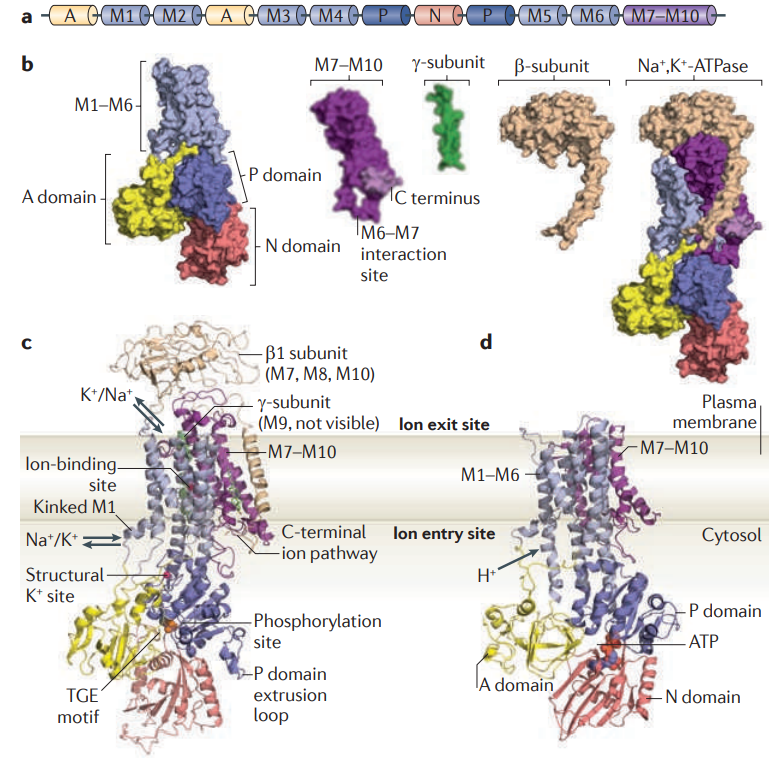
The Na,K-ATPase is an integral membrane heterodimer belonging to the P-type ATPase family. Phosphorylation of Na,K-ATPase at Tyr10 has been implicated in the regulation of enzyme activity in response to hormones and neurotransmitters. Cadherins are a superfamily of transmembrane glycoproteins that contain cadherin repeats of approximately 100 residues in their extracellular domain. Cadherins mediate calcium-dependent cell-cell adhesion and play critical roles in normal tissue development. The classic cadherin subfamily includes N-, P-, R-, B-, and E-cadherins, as well as about ten other members that are found in adherens junctions, a cellular structure near the apical surface of polarized epithelial cells. 4F2hc is a transmembrane protein that belongs to the solute carrier family. 4F2hc forms heterodimeric complexes with various amino acid transporters, such as LAT1 and LAT2, and regulates uptake of amino acids. The 21-24 kDa integral proteins, caveolins, are the principal structural components of the cholesterol/sphingolipid-enriched plasma membrane microdomain caveolae. Three members of the caveolin family (caveolin-1, -2, and -3) have been identified with different tissue distributions. Ectonucleotide pyrophosphatase-phosphodiesterase 1 (ENPP1) is a single-pass, type II transmembrane protein primarily involved in ATP hydrolysis at the plasma membrane. ENPP1 plays important roles in bone mineralization and soft tissue calcification.

The 90 kDa ribosomal S6 kinases (RSK1–4) are a widely expressed family of serine/threonine kinases, featuring two distinct functional kinase domains and a C-terminal docking site for extracellular signal-regulated kinases (ERKs). Key phosphorylation sites, including Ser380, Thr359, Ser363, and Thr573, are critical for RSK activation. RSK1–3 are activated by coordinated phosphorylation mediated by mitogen-activated protein kinases (MAPKs), autophosphorylation, and phosphoinositide-3-OH kinase (PI3K) in response to growth factors, polypeptide hormones, and neurotransmitters. This paper also lists relevant antibodies for RSK detection and provides related research references.

p70 S6 kinase is a mitogen‑activated Ser/Thr protein kinase essential for cell growth and G1 cell cycle progression. It phosphorylates the S6 protein of the 40S ribosomal subunit at key residues (Ser235, Ser236, Ser240, Ser244) and regulates translation of 5′ oligopyrimidine tract mRNAs. In vivo, it phosphorylates eIF4B at the rapamycin‑sensitive Ser422 site; the Ser422Ala mutant of eIF4B exhibits reduced activity in in vitro translation assays. Additionally, phosphorylation of eEF2K by p70 S6 kinase and p90RSK inactivates eEF2K, promoting eEF2 dephosphorylation and facilitating protein translation. This paper summarizes specific antibodies targeting key proteins in this pathway, providing experimental tools for related molecular mechanism studies.

The p53 tumor suppressor protein is critical for cellular responses to DNA damage, triggering cell cycle arrest, DNA repair, or apoptosis. Its activity is tightly regulated via post‑translational modifications, including phosphorylation (Ser6/9/15/20/33/392) and acetylation (Lys382), which disrupt MDM2‑mediated degradation. Key kinases (ATM/ATR/Chk1/Chk2) and acetyltransferases (p300/CBP) modulate p53 function, while SIRT1 mediates deacetylation. Specific antibodies targeting modified p53 enable detection in research applications.